Advertisement
Introduction
It is important to step back and take in the broader landscape from time to time in order to be able identify important changes that are occurring. I’ve asked a few experts to join me in sharing their thoughts on the changing landscape within the green roof and wall industry. The question I posed was, “In your opinion, what do you think are the top one or two innovations within the green roof and or wall industry over the past five years and why?” Here are our responses, starting with my own observation.

Steven W. Peck, GRP, GRIMP, Honorary ASLA, Founder and President, Green Roofs for Healthy Cities
“Within the broader green infrastructure realm, I believe that one of the big changes that we are still in the midst of is the movement towards using quantifiable performance data to better understand and sell the multiple benefits of green infrastructure. This is a major departure from aesthetic driven design and sales, because it now incorporates metrics like the resulting increase in property values, the carbon footprints of different design choices, the resulting air quality improvements, stormwater detention and retention capacity and more. Performance metrics for landscapes can be used to help us marshal billions in public and private resources needed to future proof our cities: protect what we have, regenerate what is degraded and expand green infrastructure. “
“A roof park is a great asset for its recreational value for the occupants of a building, but when it also saves energy, protects membranes from hail damage, helps generate renewable energy, cools the building, saves energy costs, increases property values and doubles the life of the membrane it becomes an investment that delivers a public and private return – not something just nice to have. If its cost vs something nice to have, then nice to have often gets value engineered out or removed at the outset. The monetization of benefits also helps to facility natural asset accounting, another important development that will change our industry over time.
Performance metrics are key to supporting the necessary shift in thinking about roofs and walls to critically important natural assets that protect our quality of life in the face of extreme weather, the biodiversity crisis and social equity challenges. Performance metrics are the way forward. Fortunately, more and more designers and policy makers are using performance-based metrics as tools to make a much stronger case for implementing their projects. “
Advertisement

Warren Gorowitz, CLIA, EMSL, Director, Sustainability and Social Impact, Hunter Industries
“Irrigation technology has evolved rapidly over the past five years, becoming both more advanced and more accessible. Onsite flow meters now offer wireless communication directly to the irrigation controller, and web-based smart controllers use sophisticated weather data to deliver precise, efficient schedules, all managed remotely from a smartphone. Innovations that were once limited to municipal-scale systems are now affordable and available to everyday users.”
“We’re also seeing major improvements in irrigation hardware. Newer overhead and subsurface options give green roof managers better tools to irrigate efficiently, even within the constraints of engineered shallow soil profiles. And with AI now entering the irrigation space, I’m excited to see how the next wave of innovation will help us conserve even more water while maintaining healthy landscapes.”

Chris Kann, Product Manager – Specialty Products and Sustainability, Carlisle Construction Materials, LLC
“Improvements to leak detection technology: We all know that verifying a roof membrane is leak-free before overburden placement is critical. In the past, verification was often limited to visual inspections, which provided little assurance of true waterproof integrity. The industry later shifted toward flood testing, a process that involves holding approximately 2" of potable water on the roof for 48 hours and then inspecting the underside of the deck for signs of leakage. This method is time-consuming, disruptive, and ineffective at accurately pinpointing breaches.”
“Advancements in electronic leak detection (ELD) have been a game changer, providing a far more reliable way to confirm membrane integrity prior to green roof installation. In addition, continuous monitoring systems can now track rising moisture levels within the roofing system—often detecting leaks early—so damage does not go unnoticed for years. Looking ahead, continued innovation in this space is expected to further improve accuracy while reducing costs, making leak detection even more accessible and effective.”

Bruce Dvorak, FASLA, PLA, Professor, Texas A&M University, GRHC Board Member
“Innovations in green roof substrates. For many decades, green roof designers and providers have developed critical innovations for substrates as a growing medium for green roof plants. Green roof substrates can be designed to immediately deliver more than seventeen (17) economic, social and environmental benefits for green roofs. The design, application and development of substrates have come from several areas of influence: guidelines for green roofs, industry innovations and research. Recent innovations include the development of lightweight and biologically active substrates, development of additives for substrates such as biochar, silicates, and hydrogels. Additionally, new research on the performance of green roof substrates demonstrates benefits and limits of growing plants on green roofs. Innovations in media composition include developing media blends for dry, mesic or wetland rooftop habitats, as well as innovations in new substrate blends to grow rooftop edibles, or development of blue-green roof combinations to maximize stormwater management. “
“Together, these assurances bring confidence to the green roof industry and developers that green roofs can bring long term benefits and are economically and environmentally smart investments municipalities can support. For these reasons, the US Federal Government established mandates that include green roofs for all federal buildings, with investment paybacks seen as soon as six years. My Plants Column in the Winter Issue of this Living Architecture Monitor explores these ideas in more detail.”
Advertisement

Kees Govers, Technical Sales Manager, LiveRoof Ontario Inc.
“It was 19 years ago when I became actively involved in the green (vegetated) roof industry. During that time, I have seen the industry go from nascent to maturity. One of the striking aspects of the industry has been the willingness to work together to help create codifiable test standards. Developing standards and getting them included in the building code is a long process. In 2025 we are celebrating the inclusion of the Vegetated Roof Wind Uplift Test Standard in the National Building Code of Canada (NBCC), 2025 edition. The process for the creation of CSA A123.24 Test Standard started in 2012 when the Canadian Roofing Contractors Association formed a consortium of companies and municipalities invested in vegetated roofing and engaged the National Research Council Construction Research Centre to define how to test a vegetated roof system for wind uplift resistance in a way that was codifiable. The first version of the resulting standard was released in 2016 for modular vegetated roof assemblies only. In 2021 an updated version was released that is designed to be applicable to all vegetated roof systems. That version of the test standard has now been adopted in the 2025 NBCC. All thanks to a collaboration agreement within the industry to advance knowledge. We have now made it possible for consultants to specify assemblies based on the wind uplift performance of the assembly as tested under one uniform standard.”
“The collaboration on the wind uplift performance test standard has led to further collaborations that are currently ongoing, such as a CSA “Vegetated Roof Construction Standard” led by the Canadian Standards Association (CSA) and a stormwater test standard for nature based solutions on commercial roofs undertaken with the NRCC Building Construction Research Centre. Companies within the vegetated roof industry have really stepped up to broaden the collective knowledge base on the performance of the products that our industry delivers.”

Lily Turner, WELL AP, Director of Green Walls, Urbanstrong, GRHC Board Member
“Green walls are rapidly evolving into fully integrated, tech-enabled ecosystems. Today’s systems increasingly incorporate IoT sensors that monitor moisture levels, temperature, nutrient availability, and overall plant health in real time. These systems can automatically adjust watering and care based on live data, significantly reducing water use, labor demands, and plant loss. The result is higher performance, fewer replacements, and green walls that are far more viable at a commercial scale.”
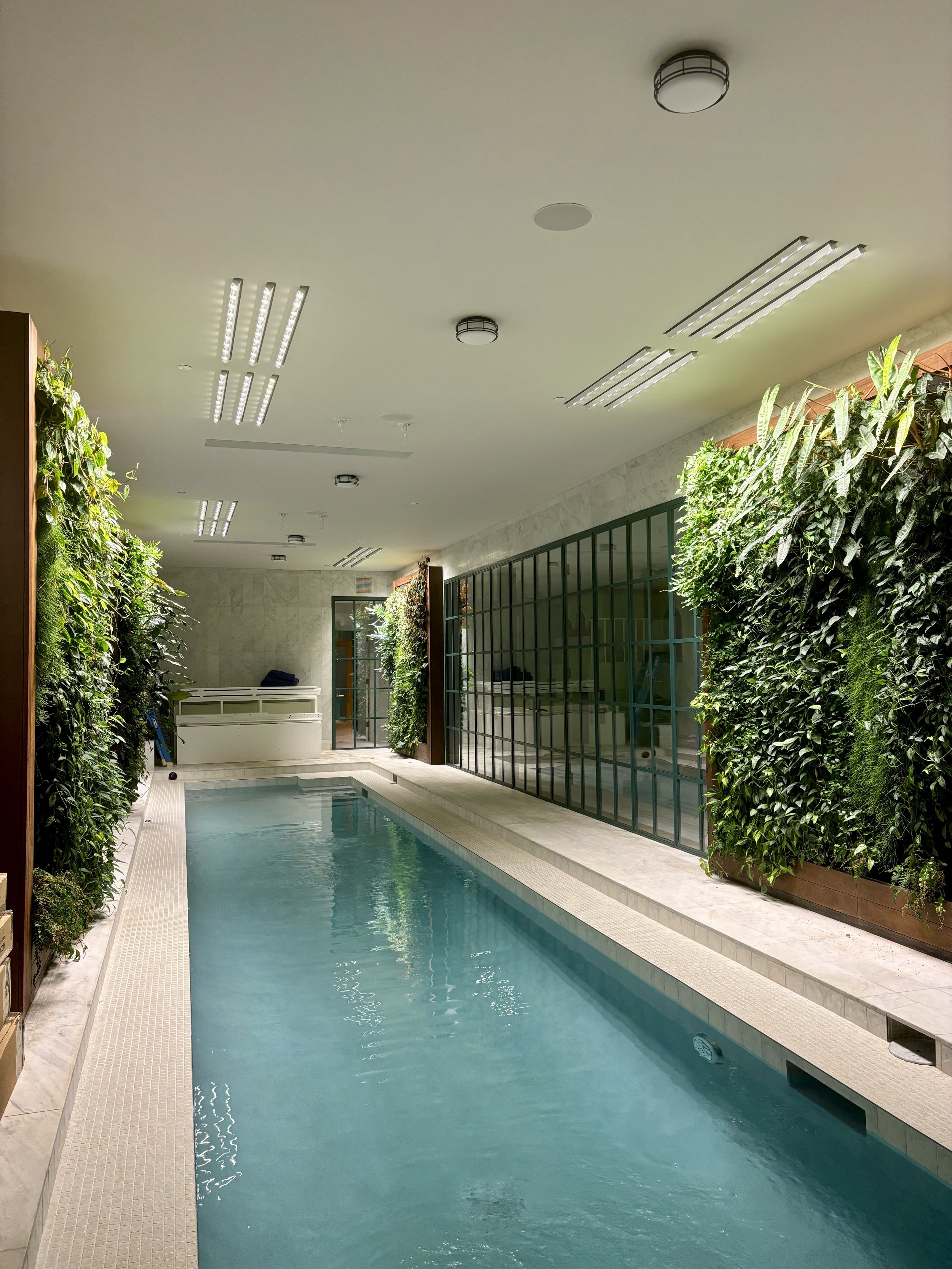
Batty pool room with a green wall. Photo: Lily Turner
“At the same time, the industry has seen a decisive shift toward modular and prefabricated green wall systems. Pre-planted panels with integrated irrigation and growing media streamline installation, reduce onsite labor, and allow plants to stabilize prior to installation. This lowers the risk of plant shock and early failure that can occur with onsite planting. This modular approach makes green wall design more accessible to architects and building owners alike, from small interior installations to large façades.”
“Ultimately, these innovations have driven healthy competition, pushing manufacturers to differentiate through lighter-weight systems, smarter prefabrication, and more thoughtful, eco-friendly material compositions.”
Advertisement