Advertisement
Introduction
It took ten years to pass the City of Toronto’s internationally award-winning Green Roof By-Law. Toronto was the first major North American city to require green roofs on new buildings, a testament to green roof industry perseverance, and political and bureaucratic leadership. During those early days of the North American green roof industry, Green Roofs for Healthy Cities members built a research and demonstration project on Toronto’s City Hall Roof, held technical workshops, organized two major conferences, developed the Green Roof Professional Accreditation program, participated in and promoted green roof benefits, research and analysis, lobbied council members, and were involved in numerous consultations with the city, the development industry and public stakeholders. The result: on May 29, 2009, 43 Toronto City Councilors from both the left and the right, all voted in support of Green Roof By-Law No. 583-2009.
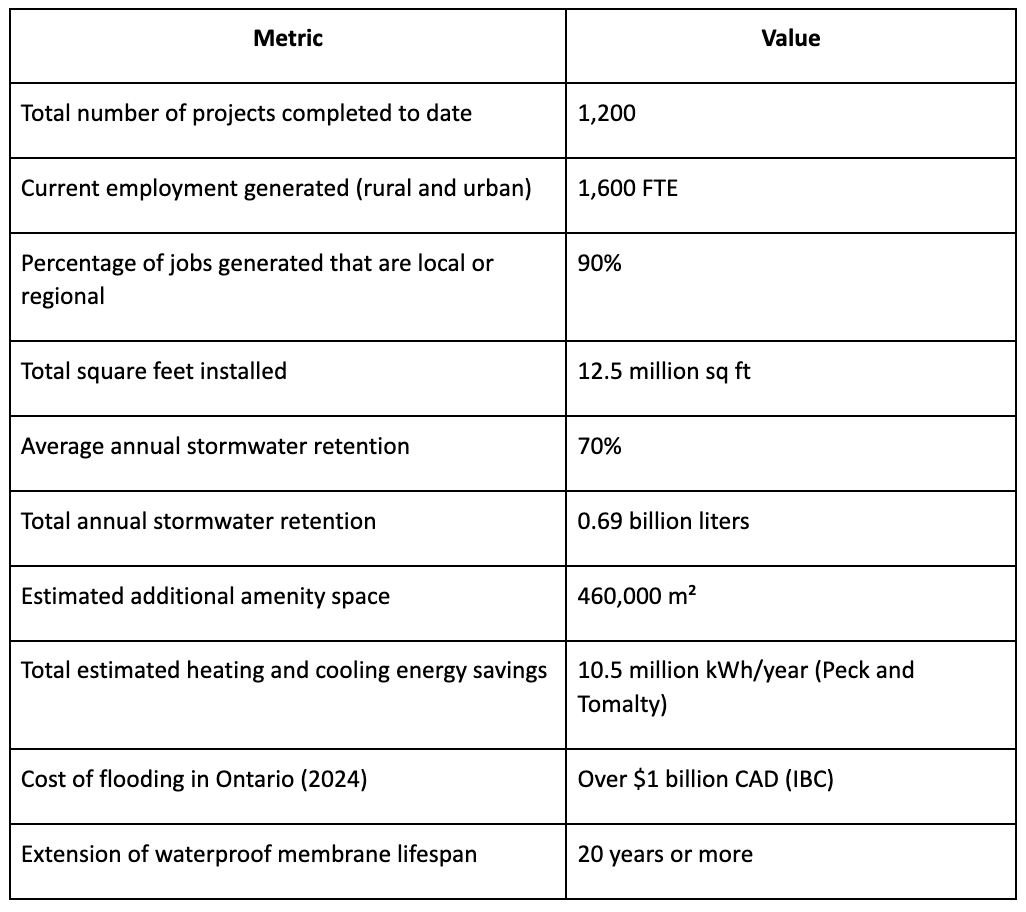
The positive impacts of the revoked Toronto Green Roof By-Law
The only hold-out was the late Rob Ford, soon to become the infamous crack-smoking Mayor of Toronto. He was also the brother of Doug Ford, the current Premier of the province of Ontario.
Then suddenly out of nowhere, upheaval! On November 3, 2025, with no consultation, no advance notice, no phase-out period and no compensation, the Ford government revoked the section of the City of Toronto Act which enabled it to enact the 15 year-old Toronto Green Roof Bylaw. This rash move has put 1,600 jobs in jeopardy, and decoupled the development process from the very urgent need to make the city more resilient and livable. In terms of jobs, a 2020 study conducted by the Delphi Group found that the Ontario green roof and wall industry had a gross output of more than $90 million and contributed more than $51 million to the GDP in 2018. (Delphi). The 1,200 green roof projects have resulted in more than 12.5 million square feet of green space which cleans the air, retains enormous amounts of stormwater, cools the city reducing the severity of heat stress, saves energy, supports pollinators and provides much needed amenity space. Several dozen projects have also been designed to grow food, recreationally and commercially, which improves food security.
Advertisement
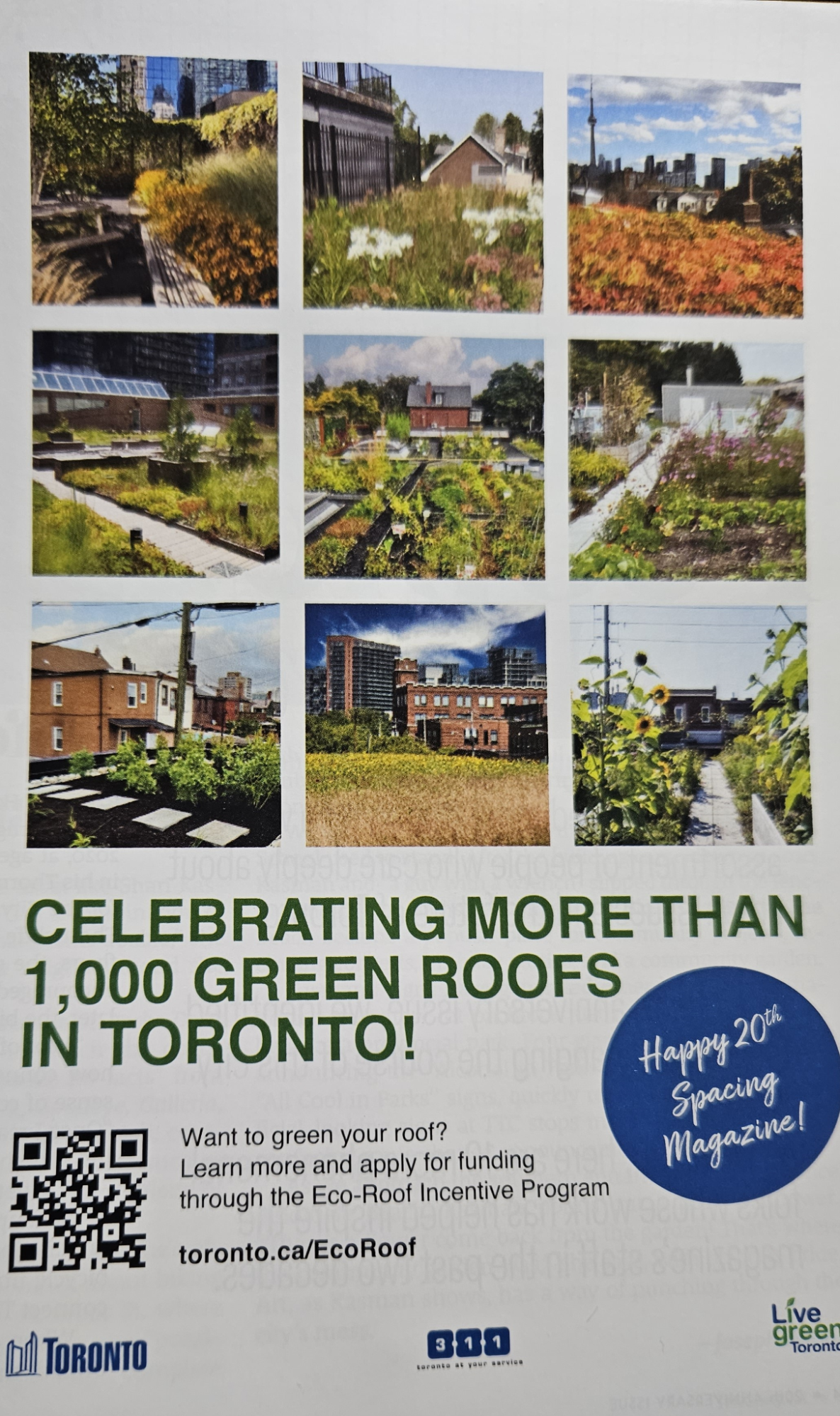
Advertising in Spacing Magazine in 2023 Celebrating the 1000 green roof project milestone. Photo: City of Toronto
A Legacy of Innovation
Unfortunately, this poorly considered decision strips Toronto, Canada’s largest city, of its authority to require green roofs on new development. Yet despite this setback, the Toronto Green Roof By-Law and its companion, the threatened Toronto Green Standard are both innovative policies. These initiatives may provide other jurisdictions with examples of proven approaches to future-proofing their communities. So here are some of the most innovative aspects of these policies and related programs.
It’s a legacy to be proud of.
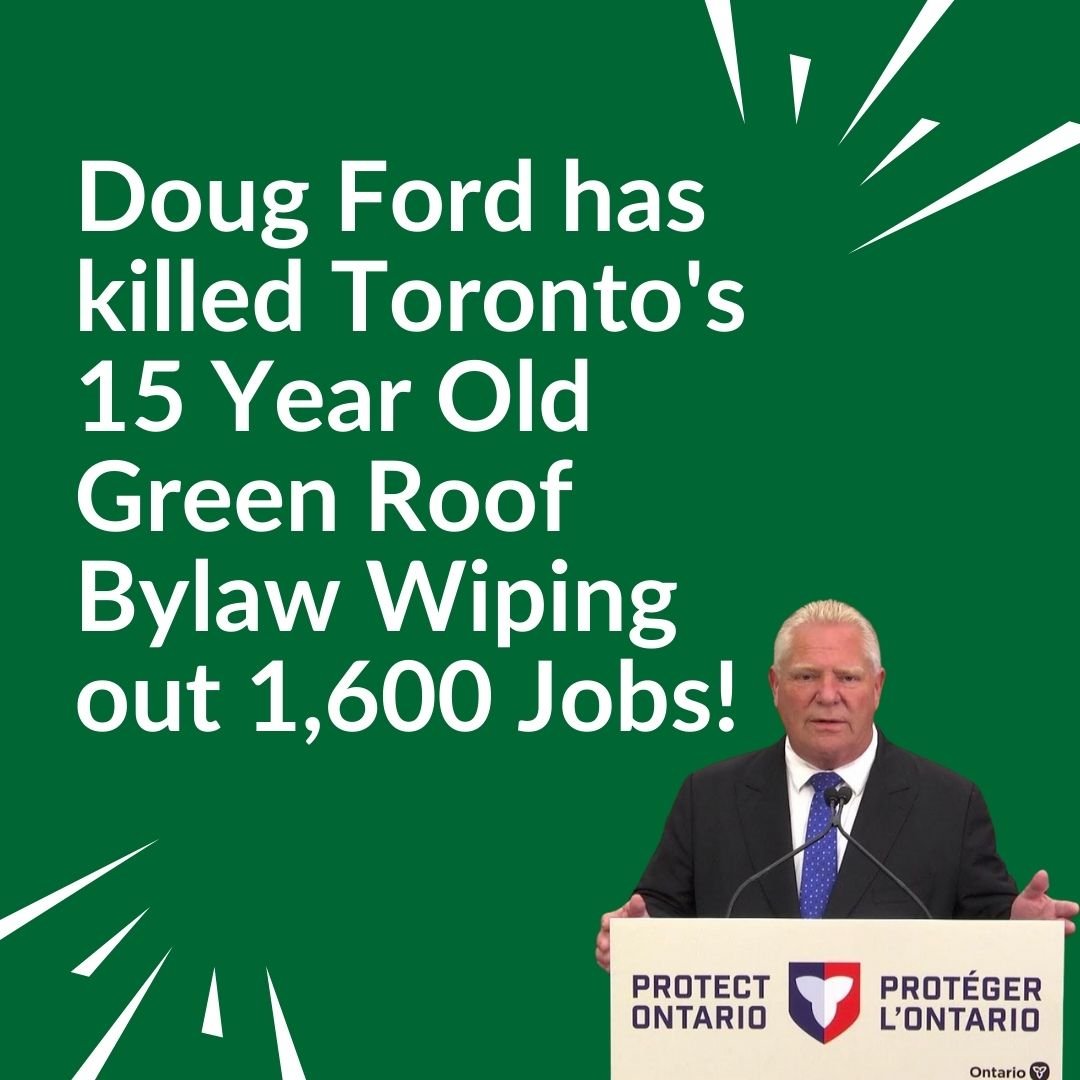
A graphic developed by GRHC to push back against the destruction of Toronto’s Green Roof Bylaw by the Premier of Ontario. Photo: GRHC
A Green Roof Construction Standard
The Green Roof By-law mandated green roofs on new buildings, but it also established a detailed construction standard which governed all green roofs built in Toronto. In 2009 when the By-Law was adopted, green roofs were not recognized in the Ontario Building Code. In response, the city established a committee of experts and developed a construction standard. Most public policies in place in North America do not incorporate a construction standard for green roofs which leaves room for design, installation and maintenance errors. The Toronto Green Roof Construction Standard in the by-law is a comprehensive template for building code standards. The Construction Standard contains detailed requirements in the following areas:
Green Roof Assemblies
Structural loading
Slope Stability
Parapet Height and/or Overflow Scuppers Locations
Wind Uplift
Fire Safety
Drainage
Water Retention
Irrigation
Plant Selection
Vegetation Performance
Occupant Safety
Maintenance Planning
The Construction Standard is too long to fully summarize here, but several innovative aspects are worth noting. First, one must submit a maintenance plan as part of the documentation required to obtain a permit for the building. Second, the standard requires a leak detection test of the waterproof membrane prior to the installation of the overburden. Thirdly, wind uplift engineering requirements have resulted in the industry pooling resources to support wind uplift testing of modular and loose laid green roof systems. The Canadian Standards Association CSA A123.24 was the result of a multi-year research program led by the National Research Council Canada (NRC), in collaboration with the members of the green roof industry, to study the wind performance of green roofs. (Wind) Each Vegetative Roofing Assembly (green roof) must undergo both wind uplift and wind flow testing to determine its wind resistance. CSA A123.24 has applicability well beyond Ontario. Ontario’s green roof industry has begun working to have the Green Roof Construction Standard implemented into the Ontario Building Code. A recent study of Toronto’s green roofs found that over 90 per cent are flourishing, the result of having a good construction standard and skilled design, contracting and maintenance professionals. (See Wenxi and Drake in this issue of the LAM).
Advertisement
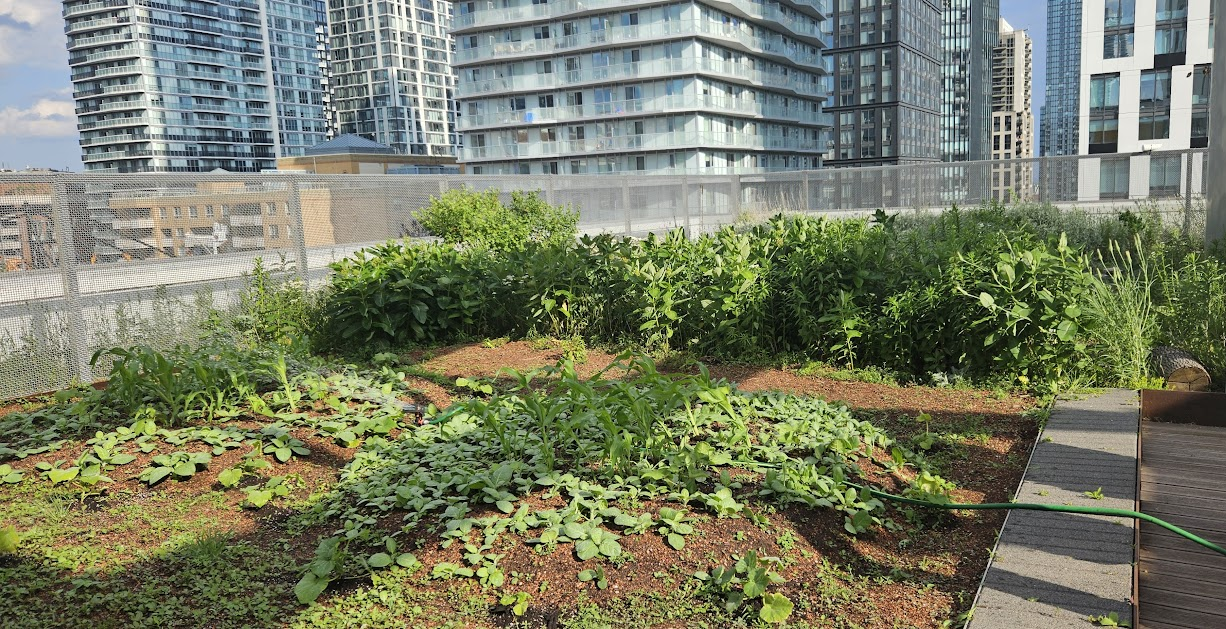
This roof top farm at Toronto Metropolitan University Daphne Coxwell Health Sciences Complex is the result of Toronto’s Green Roof Bylaw. Photo: Steven Peck
In addition to the Construction Standard, the city developed supplemental guidelines that support the establishment of green roofs designed to provide habitat for pollinators and provide incentives to encourage biodiverse green roofs, another innovative accomplishment. (Biodiversity Guidelines)
Tailoring Green Roof Requirements to Building Sizes
Another innovative policy in the Toronto Green Roof By-law is that the percentage of green roof area required is tied to the overall size (value) of the project, measured in gross floor area. Larger projects require more coverage than smaller projects. Single family residential homes are exempted as are buildings under six storeys. The coverage requirements and thresholds for commercial, industrial and residential buildings requiring green roofs are as follows:
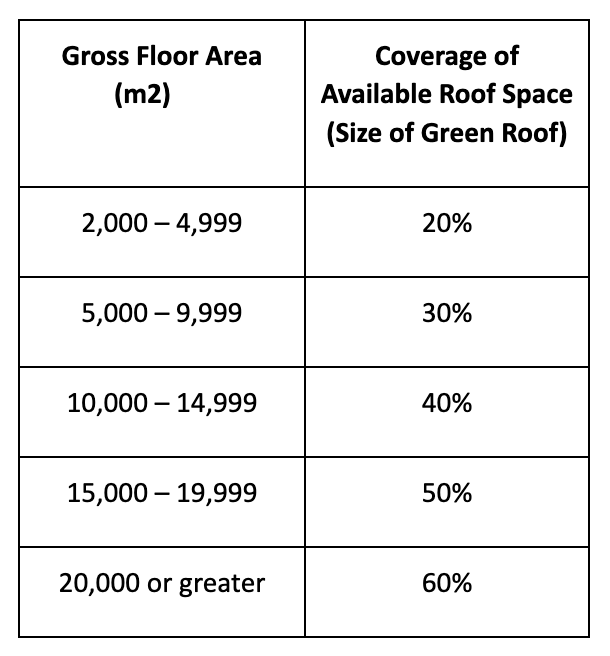
The “available roof space” equals the total roof area excluding areas designated for renewable energy, private terraces and required residential outdoor amenity space (to a maximum of 2m2 /unit). Tower roofs are exempted for buildings with a floor plate less than 750 m2. Smaller buildings essentially, are exempt from the mandate.
While this approach reduced the overall area of green roofing resulting from the by-law, it also ensured that the green roof component of the new construction remained a manageable upfront cost, relative to the overall project cost. This also helped to ensure alignment with municipal planning policies so that there was no conflict with the bylaw. A recent analysis of extensive green roofs conducted by Toronto green roof companies found that the addition of green roofs added less than a cup of coffee per square foot of living space, or between $1 to $2.5 CDN for condominium projects fetching between $800 to $1200 CDN per square foot in the market. The higher cost range for green roofs reflects enhanced stormwater management features. (GRB)
Advertisement
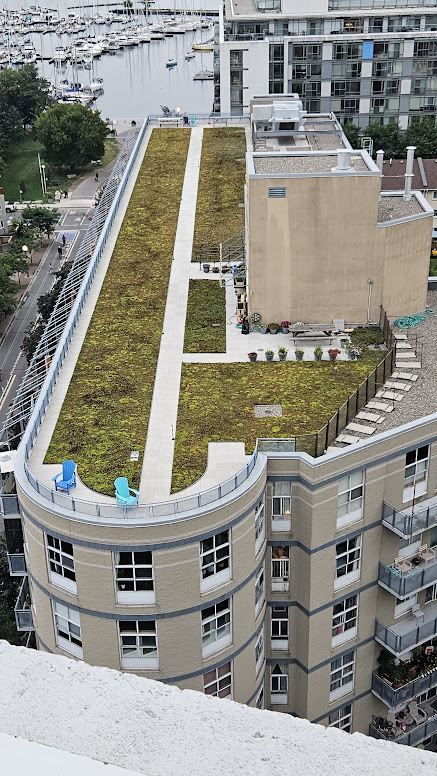
Accessible amenity space for condominium owners at this waterfront development. More than 400,000 square meters have resulted from the By-Law adding value to multi-residential buildings. Photo: Steven Peck
Design Flexibility – Opting Out Option
The Toronto Green Roof By-law allowed design flexibility. If the green roof could not be accommodated because of, for example, a steep roof design, developers could by-pass the requirement by contributing $200 CDN per square meter in lieu of installing the green roof areas required under the By-Law. Over 15 years, few companies have opted for this. These funds go into the Eco-Roof Incentive Program and are then used to provide grants of up to $100,000 CDN to existing building owners to implement green roofs. Of the 1,200 green roof projects implemented under the By-law in the past 15 years, approximately 100 of them were funded through the Eco-Roof Incentive Program.
Another innovation within the Eco-Roof Incentive Program is that it provides grants of up to $1,000 CDN to building owners to help offset the initial costs of hiring an engineer to conduct a structural assessment to determine if a green roof is even feasible. This helps eliminate an upfront financial barrier for some building owners.
The Toronto Green Standard
An important innovation that builds on the requirements of the Green Roof By-Law and adds more is the Toronto Green Standard. Under development since 2006 and now in its fourth iteration, the Toronto Green Standard describes Toronto’s sustainable design requirements for new private and city-owned developments, implemented through the municipal planning process. The Toronto Green Standard consists of tiers of performance measures with supporting guidelines that promote sustainable site and building design. Meeting Tier 1 of the Toronto Green Standard is required through the planning approval process, while Tiers 2 to 3 represent more robust performance levels. These Tiers are voluntary standards for private development, for which the City provides financial incentives. Higher Tiers are mandated for city owned developments, including affordable housing. The Green Standard addresses Toronto’s environmental and social priorities to:
Improve air quality and reduce the urban heat island effect
Reduce energy use and greenhouse gas emissions from new buildings while making buildings more resilient to power disruptions, and encourage the use of renewable and district energy
Reduce storm water runoff and potable water consumption while improving the quality of storm water draining to Lake Ontario
Protect and enhance ecological functions, integrate landscapes and habitats and decrease building-related bird collisions and mortalities
Divert household and construction waste from going to landfill sites.
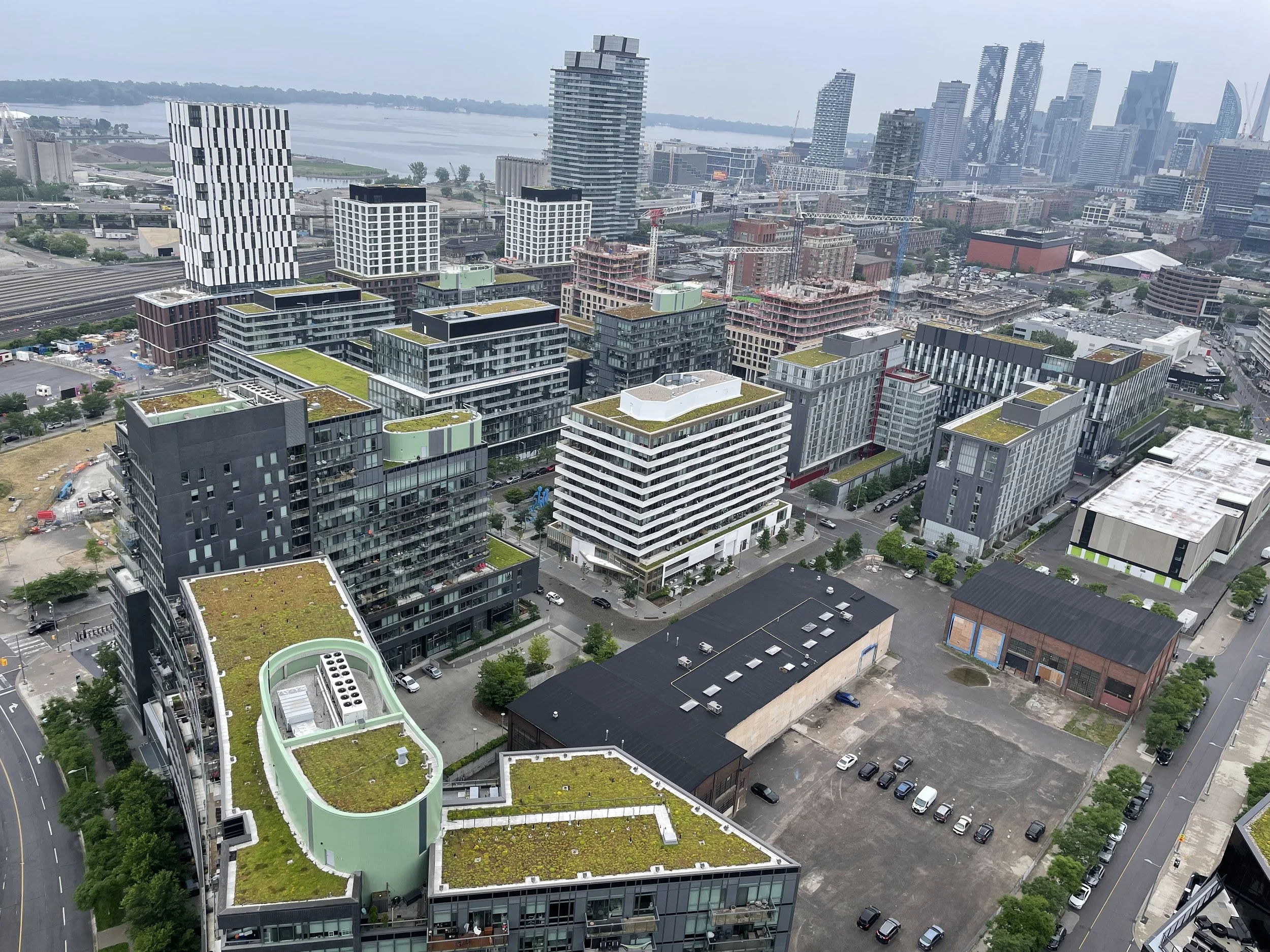
Multiple green roofs in Toronto. Photo: Eric Durnford
Climate change mitigation and adaptation measures are built into the Toronto Green Standard. Neither of these objectives are satisfied through the current Ontario Building Code, which hasn’t been updated since 2017. The Toronto Green Standard has provided stepped targets since 2018 that will result in greenhouse gas reductions of 30.6 megatonnes by 2050, contributing to Transform TO’s city-wide emissions reduction target of Net Zero by 2040. That is the equivalent to taking more than 250,000 cars off the road each year. Most of the Toronto Green Standard concerns site level requirements, such as the number of trees required, minimum soil volumes for street trees and native species planting.
The Green Standard also contains incentives for developers to go beyond the minimum requirements. For multi-unit residential buildings, development charge refund amounts depend on which tier is reached, and vary depending on the type of housing.
The Atmospheric Fund (TAF) is a city agency that finances and supports initiatives that reduce greenhouse gases and improve air quality in Toronto and the Greater Toronto Area. TAF recently stated that: “Green standards can have an incremental impact on upfront housing construction costs, although these impacts are dwarfed by other factors such as interest rates and inflation. Most studies have found that the construction of energy-efficient buildings cost two to four percent more than traditional methods, and those prices will continue to fall as more standards come into place.” (TAF)
Advertisement
The Rationale for Upheaval
The Ontario government, which has jurisdiction over all local and regional governments, is threatening to eliminate not only the Toronto Green Standard but other city’s green standards, and to restrict all cities across Ontario to only requiring health and safety measures in the Ontario Building Code. Ontario is desperately trying to reduce costs for developers, by creating a one size fits all regulatory regime across all Ontario, while transferring costs for things like managing lot level stormwater from builders to local governments and thus onto taxpayers.
After years of incredible growth and profitability, the Ontario building industry is facing difficult times, due to a number of factors including high demand due to increased immigration, higher construction costs, higher interest rates, and higher costs associated with taxes. All these factors impact affordability significantly. It’s clearly not the result of the marginal costs of adding green roofs to buildings or complying with green standards.
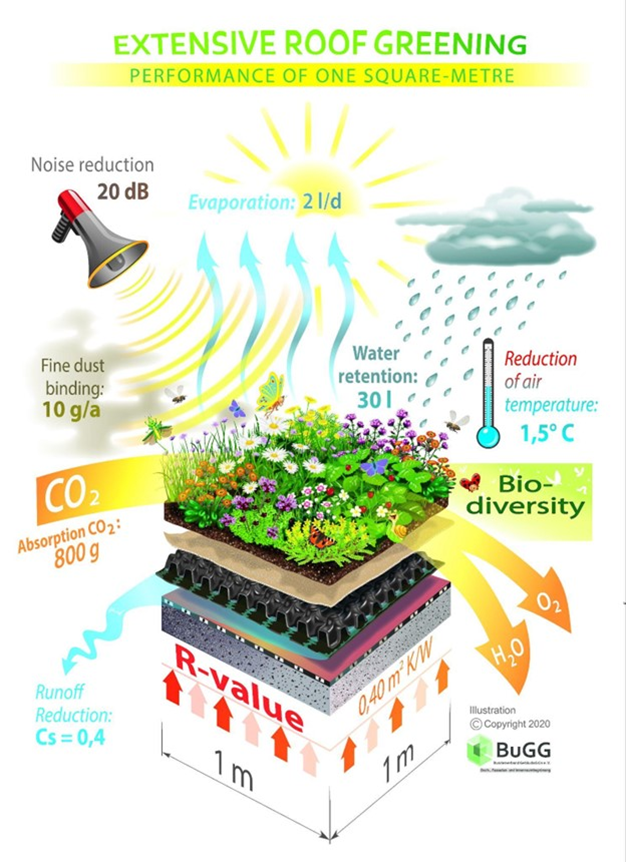
A diagram illustrating the multitude of benefits from one square meter of extensive green roof. Photo: BuGG.
According to TAF, “Green standards have been proven to increase the quality of buildings, create operational savings for residents and owners, reduce strain on the electricity grid, create local economic prosperity through skilled job creation, and reduce carbon emissions. Cities can and should be permitted to regulate such environmental health and safety under the Municipal Act.”
Conclusion
Eliminating local government sustainability policy measures in Ontario will not solve the challenges facing the building industry. Their issues are rooted in taxation rates, interest rates, construction costs and the forces of supply and demand, not whether or not a building has a green roof, more insulation, native trees or bird friendly glass. Destroying the Green Roof By-Law and threatening to eliminate the Green Standard is misguided and foolhardy. It shifts the health and financial burden of adapting to climate extremes to future generations. It is like revoking the requirement for seatbelts and airbags in new cars to sell more cars. You save a little on the cost of the car, but not enough to increase demand while putting drivers and passengers at a much greater risk.
Revoking the Green Roof By-Law and possibly the Green Standards will put the people of Ontario at greater financial, health and safety-related risk from extreme heat, more air pollution and worse flooding. It will also reduce the amount of accessible green space required to support people's mental health. These drastic initiatives will also strip building owners of money they would otherwise save from buildings with better energy performance and longer lasting waterproofing.
Until the political pendulum swings back in Ontario, which it inevitably will, the legacy of Toronto’s Green Roof By-Law provides a pathway for other forward-thinking jurisdictions to follow. Cities around the world have been inspired by Toronto’s early leadership and green roofs just make so much sense, that now more than 100 cities worldwide have adopted mandates and/or incentives to support them. One day soon, I believe all virtually new multi-story buildings will be required to implement green roofs. Innovative policies show the way and the need for livable cities will drive the change.
Advertisement
Steven W. Peck, GRP, GRIMP, Honorary ASLA is the founder of Green Roofs for Healthy Cities and the editor of The Living Architecture Monitor. He was intimately involved in the development of the Toronto Green Roof By-Law and participated in shaping the Toronto Green Standard.
Citations and More Information
Biodiversity Guidelines - https://www.toronto.ca/city-government/planning-development/official-plan-guidelines/green-roofs/biodiverse-green-roofs/. Email sustainablecity@toronto.ca to obtain a copy.
Delphi Group - Economic Impact Assessment of the Green Infrastructure Sector in Ontario (2020) https://greeninfrastructureontario.org/gio-and-partner-resources/
GBR – Toronto’s Green Roof By-Law. https://www.toronto.ca/city-government/planning-development/official-plan-guidelines/green-roofs/
TAF - https://taf.ca/getting-the-facts-straight-on-green-development-standards/
Toronto’s Eco-Roof Incentive Program- https://www.toronto.ca/services-payments/water-environment/environmental-grants-incentives/green-your-roof/
Wind - https://livingarchitecturemonitor.com/articles/wind-uplift-design-green-roofs-sp21
Peck, S and Tomalty, R. - Figures are based on data from the City of Toronto and benefit equations from Tomalty et al., “Methods for Calculating the Biophysical and Monetary Benefits of Green Roofs, Cool Roofs, and Pollinator Gardens for Application to City of Toronto Eco-Roof and PollinatorTO Programs” 2023. The volume of stormwater retained by green roofs is equivalent to the total volume of water processed by the Ashbridges Bay Treatment Plant in one day. Lot level stormwater retention frees up capacity in the sewer system to allow for additional development in the City of Toronto. Amenity green roof space supports greater human health and wellbeing but also provides an opportunity for developers to market themselves, selling and leasing their units faster and at a premium, thereby recovering their initial investment.
Video produced by the green roof industry in Ontario. https://mail.google.com/mail/u/0/#search/OIC+++joyce/FMfcgzQcqbdlwQwDnfRGfCzjpZSPPqKl?projector=1