Advertisement
Introduction
Water is an essential and dynamic element of ecosystem functions on the land and on green roofs. In nature, moisture levels vary greatly depending on slope, soil characteristics, and climate. Soils can be grouped into three general divisions: wet, mesic (moderate), and xeric (dry). Wet habitats are consistently moist or saturated throughout the year and can exhibit anaerobic conditions (lack of free oxygen). Mesic habitats have dynamic levels of soil moisture. Moisture levels can vary seasonally from wet to dry, but typically retain moderate levels of moisture. Xeric habitats include soils that are well-drained, exposed to ample sunlight, and have rapid drainage characteristics. Green roofs can be designed to mimic any or all these conditions, but successful projects require a good understanding of plant-water dynamics.
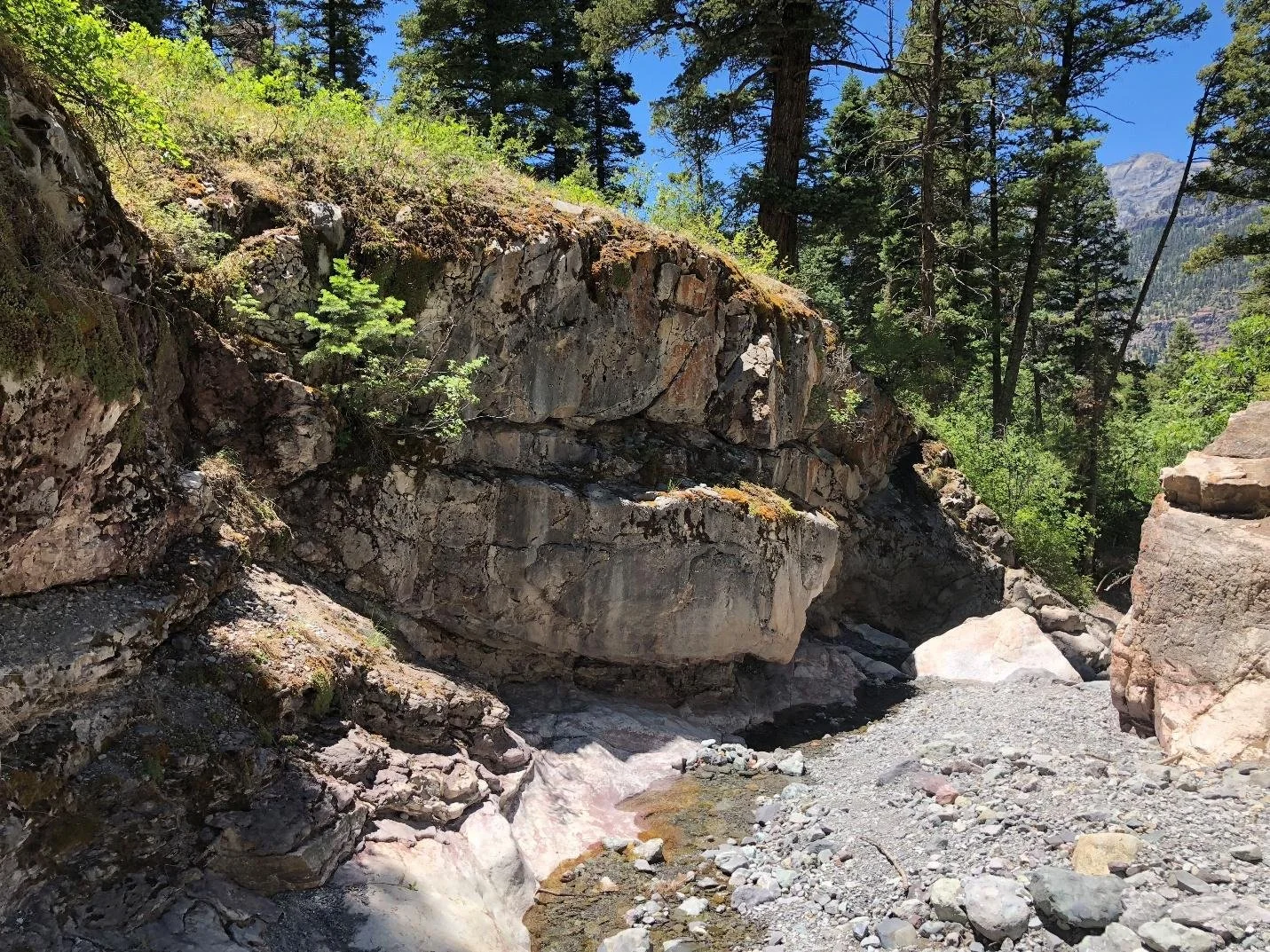
The same water that sustains and regenerates life carves its way through sedimentary rock along the Baby Bathtubs Trail in Ouray, Colorado. Plant distribution along the creek follows a moisture gradient: xeric species occupy shallow-soiled sunny ledges (shown here), "wet-footed" plants line the creek margins, and mesic species occupy spaces between. Photo: Bruce Dvorak 2018
Nature as Teacher
Identifying potential natural vegetation to use on green roofs requires creative exploration and observation. Green roof designers can visit natural environments and rooftops to learn and observe how vegetation adapts to soil-moisture dynamics in natural habitats and on rooftops (Lundholm 2006).
While North America boasts nearly 20,000 native plant taxa, only several hundred have been trialed for rooftop use (Dvorak and Volder 2010, Dvorak ed. 2021). By observing natural habitats—aided by tools like iNaturalist, Pl@ntNet, Flora Incognita, and PlantSnap —designers can learn to mimic "natural energy cycles" (Leopold 1966) on green roofs (Sutton 2015). Incorporating native plants into green infrastructure does more than replace lost habitat; it maximizes ecosystem services and improves building performance compared to conventional structures (Simmons, Gardiner et al. 2008). This article expands a 2022 LAM discussion of water for green roofs to include eastern North American climates, with nine taxa for wet habitats, thirteen for mesic habitats, and eight for xeric habitats.
Advertisement
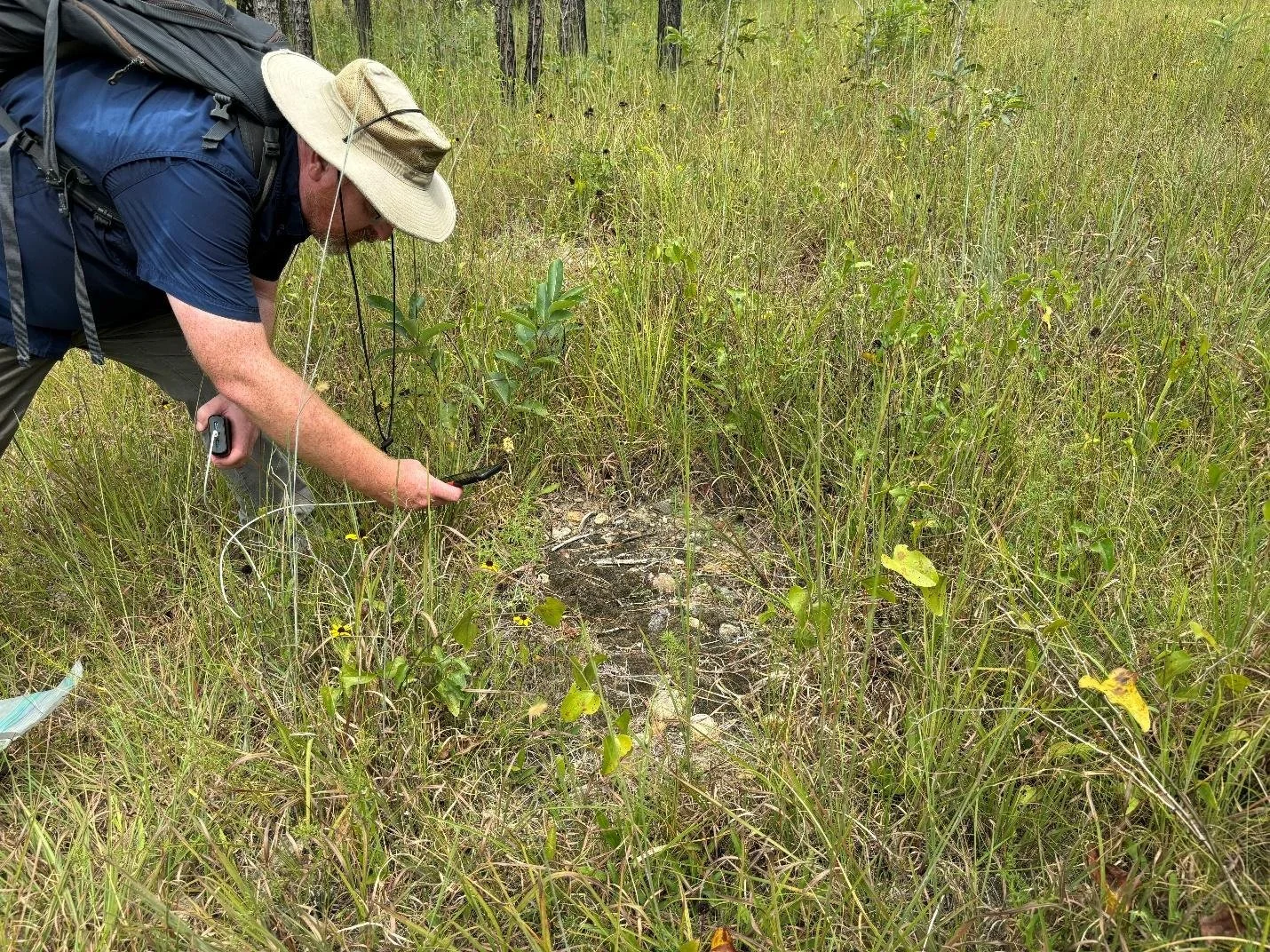
Theo Witsell, Co-founder and Chief Conservation Officer of the Southeastern Grasslands Institute, identifies native plants at the Stone Road Glade Natural Area in Arkansas. Shallow-soil systems like glades are a top-priority habitat for exploring potential plants for green roofs. Photo: Bruce Dvorak (with permission)
Wet Habitats
Wetlands are often misunderstood; they are primarily formed by subsurface baseflow rather than surface runoff. As rainwater soaks into porous uplands, it moves underground, where soil and roots provide natural detoxification (phytoremediation). In contrast, urban watersheds typically drain dirty stormwater directly into waterways and wetlands, which can degrade them and displace native plants and wildlife (Rooney et al. 2015). Green roofs and constructed wetlands can be used to protect wetlands and demonstrate how nature can be a source of inspiration and teacher.
Sites like the Seneca Meadows Wetland Preserve in central New York serve as a baseline for understanding how wetlands can be restored and serve as a model for “constructed" wetlands on the ground or on rooftops. At the preserve, 1,100 acres of croplands were restored to meadows, woodlands, and wetlands. The accessible preserve has 14 unique plant communities, including submerged and floating-leaf plant communities, wetlands, emergent wetlands, emergent prairies, and more. Some of the vegetation at the preserve that also performs well in constructed wastewater wetlands includes rushes, sedges, wildflowers, and grasses that thrive in consistently moist soils.
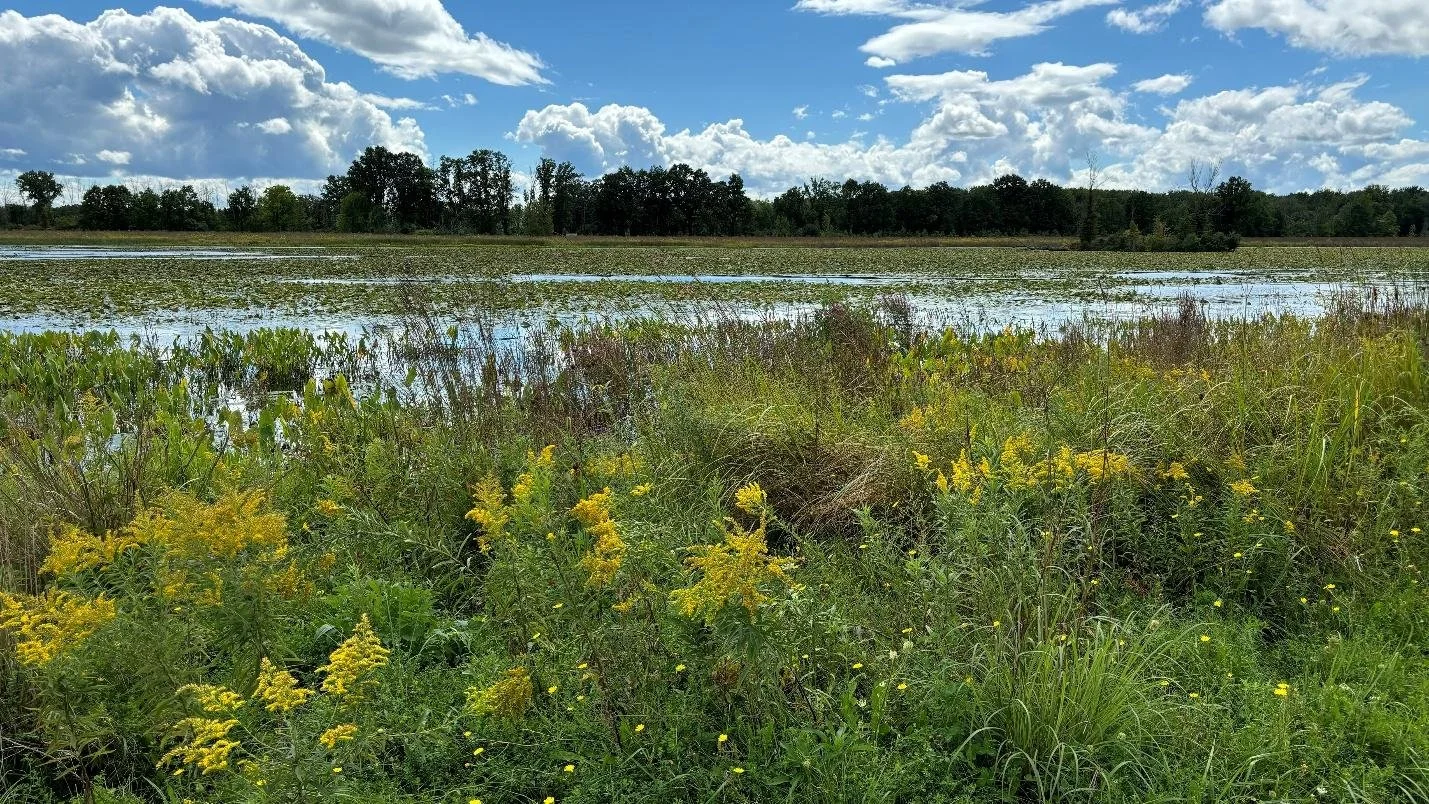
Seneca Meadows Wetland Preserve in New York re-establishes wetlands on a site that was drained and cleared for farming. Aquatic and emergent wetland vegetation thrives here in wet and mesic soils and serves as a model for understanding wetland values and functions. Photo: Bruce Dvorak 2024
Sidwell Friends Middle School
Constructed Wastewater Wetlands
When Sidwell Friends Middle School in Washington, D.C., decided to renovate, they didn't just want a "green" building—they wanted a closed-loop system. The LEED Platinum building integrates its plumbing and landscape to treat all sewer and stormwater on-site. The system treats its own wastewater from the building on-site using a one-acre constructed wetland (Ellis et al. 2012). While these constructed wetlands are not on a rooftop, they function like a contained system, looping water from rooftops to the wetland and back into the building for toilet flushing.
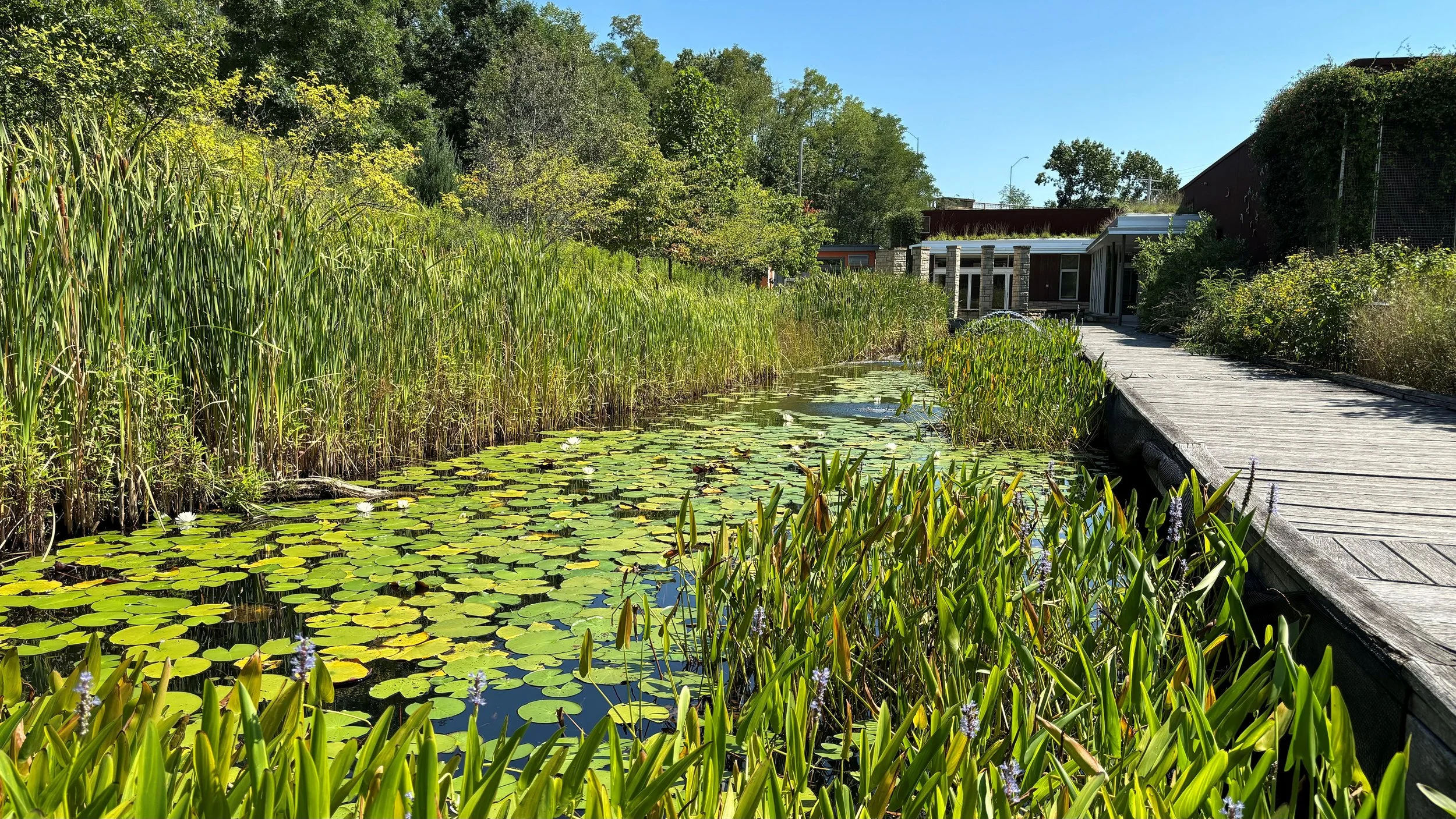
Over 80 taxa of emergent and aquatic wetland plants native to the Chesapeake Bay are used to soak up nutrients from the pre-treated water stored in cisterns in the basement. Some of the plant taxa include species of iris, bulrush (Scirpus spp.), cattail (e.g., Typha latifolia), horsetail (Equisetum spp.), soft rush (Juncus effusus), sensitive fern (Onoclea sensibilis), pickerel rush (Pontederia cordata), water lilies and water shields (Brasenia schreberi) (Ellis et al. 2012). Water leaving the constructed wetland is recycled back into the building to flush toilets. This odor-free system has reduced potable water use by 93 per cent since 2007.
Advertisement
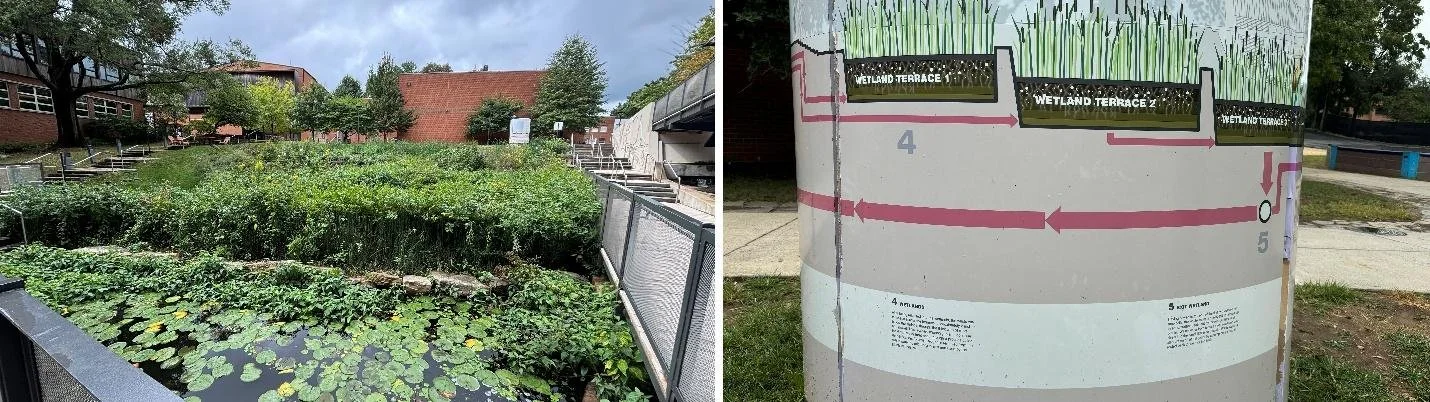
The constructed wetland and pond system at the Sidwell Friends School in Washington, D.C. (left). The holding tank at the top of the slope retains partially treated water before it enters the wetland terraces. The outside wall of the tank educates visitors about how the treatment process works (right). Photos Bruce Dvorak 2024
Green Roof
An extensive green roof was included in the renovation to conserve energy in the building, capture 100 percent of rooftop stormwater, and direct rooftop runoff into the constructed wetland system. Plants on the green roof include various species of xeric and mesic taxa, including species of Sedum, drought-hardy native perennial plants such as nodding onion (Allium cernuum), little bluestem (Schizachyrium scoparium), white wreath aster (Aster ericoides / Symphyotrichum ericoides), October skies aster (Aster oblongifolius / Symphyotrichum oblongifolium, 'October Skies'), blazing star (Liatris spicata), and purple coneflower (Echinacea purpurea). The green roof has protected the waterproofing system since 2007, which is almost 20 years without any major repairs.

The facility serves as a "living classroom." Eighth graders lead tours to explain the system’s components (left), and they also designed the educational signage as an art project. Student docents teach the ecological value of this project to the public (Elis et al. 2012). Photo Bruce Dvorak 2025
In addition to significantly reducing operating expenses, this project demonstrates how designs inspired by nature have served multiple and far-reaching purposes for decades, including teaching the next generation about integrated design. The constructed wetland serves as a demonstration site for students, teachers, and visitors.
Mesic Habitats
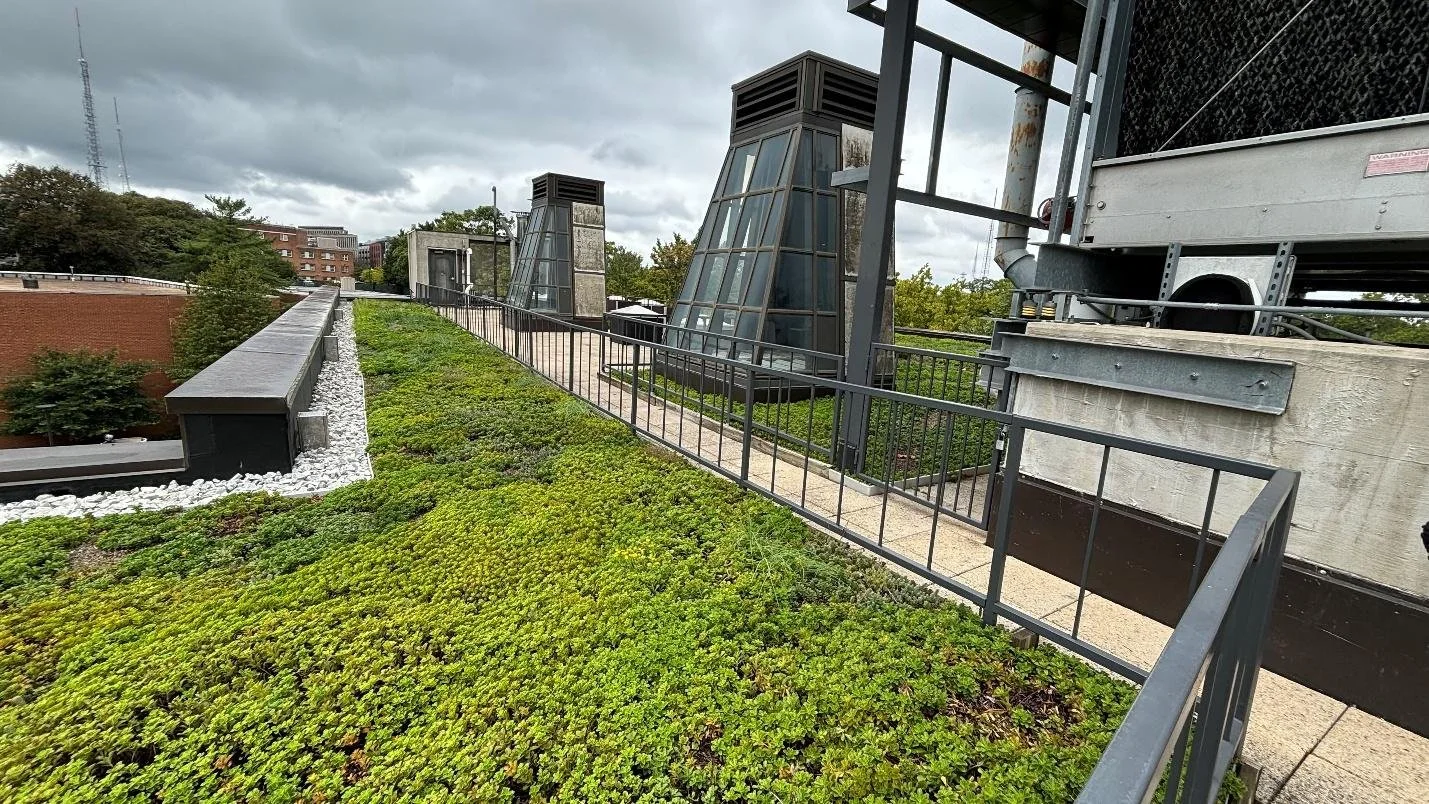
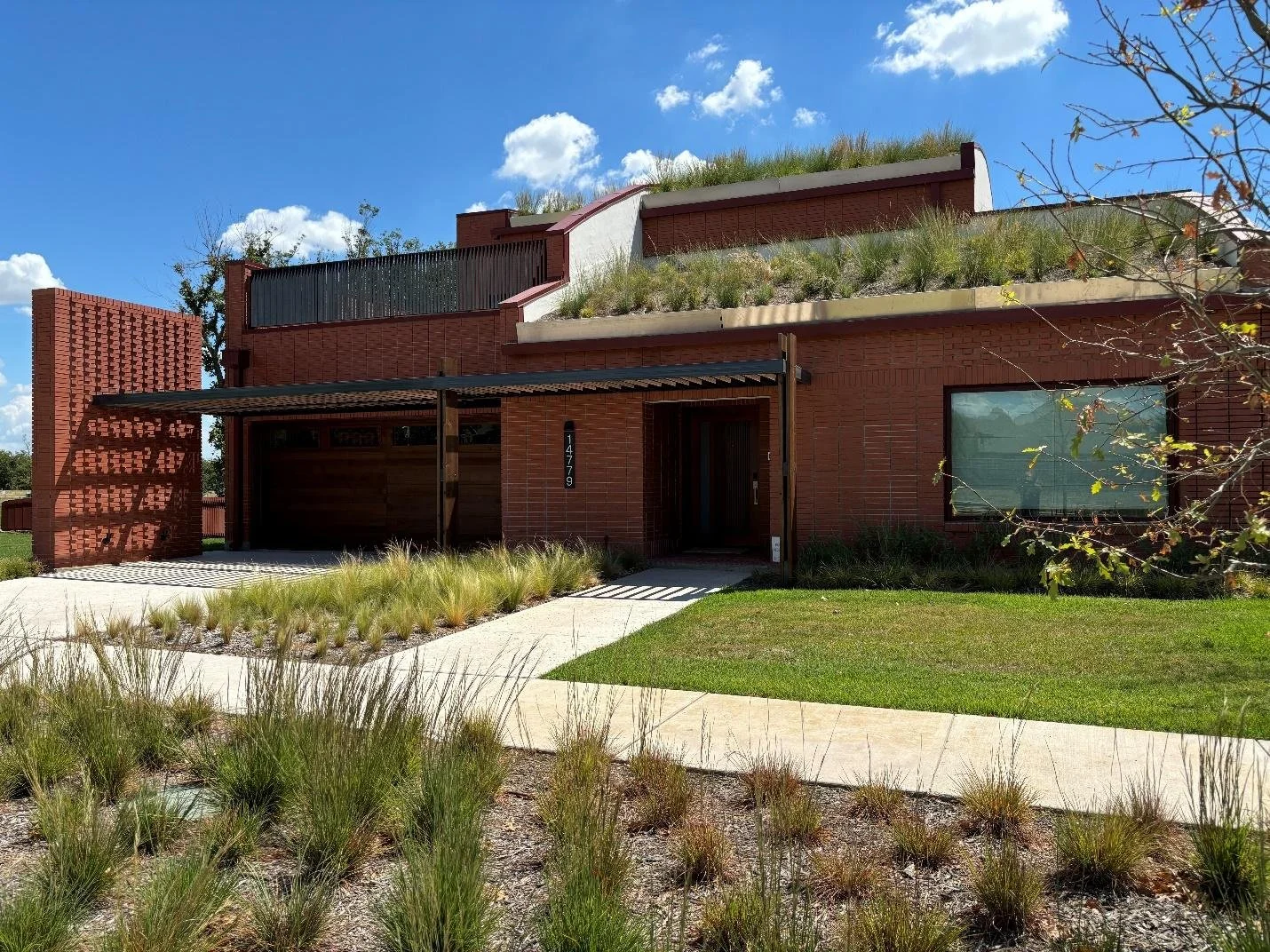
On the roof of the revamped building, an extensive green roof with 4 inches of substrate soaks up rooftop stormwater, conserves energy in the building, and supports wildlife habitat with the addition of some drought-adapted native plants (not visible here). The rooftop also has a small food crop area for students to experiment with and grow food. Photo Bruce Dvorak 2025
Mesic habitats are occupied by vegetation that is well-suited to environments that are neither consistently dry or wet for metabolic cycling (photosynthesis & nutrient cycling). The Jennings Environmental Education Center, in Western Pennsylvania, preserves an excellent example of an eastern prairie habitat that supports both wet and mesic prairie and woodland habitats. Throughout the East (and Midwest), Native Americans commonly engaged in cultural burning of the land to sustain fire-tolerant habitats for hunting and gathering. The Jennings Center is one of the last remnant fire-managed accessible prairie habitats in Western Pennsylvania and is an excellent location to discover mesic plants for green roofs.
Phipps Center for Sustainable Landscapes
Not far from the Jennings Environmental Education Center is a real-world application of native mesic prairie vegetation on a green roof in Pittsburgh, Pennsylvania. The Phipps Center for Sustainable Landscapes is one of the most sustainable buildings in North America, and it employs two green roofs. One is a sedum-based green roof, and the other employs native mesic prairie plants as its “habitat template.” The accessible flat roof deck drains to a cistern below, where all the water is captured for re-use inside the building.
Advertisement
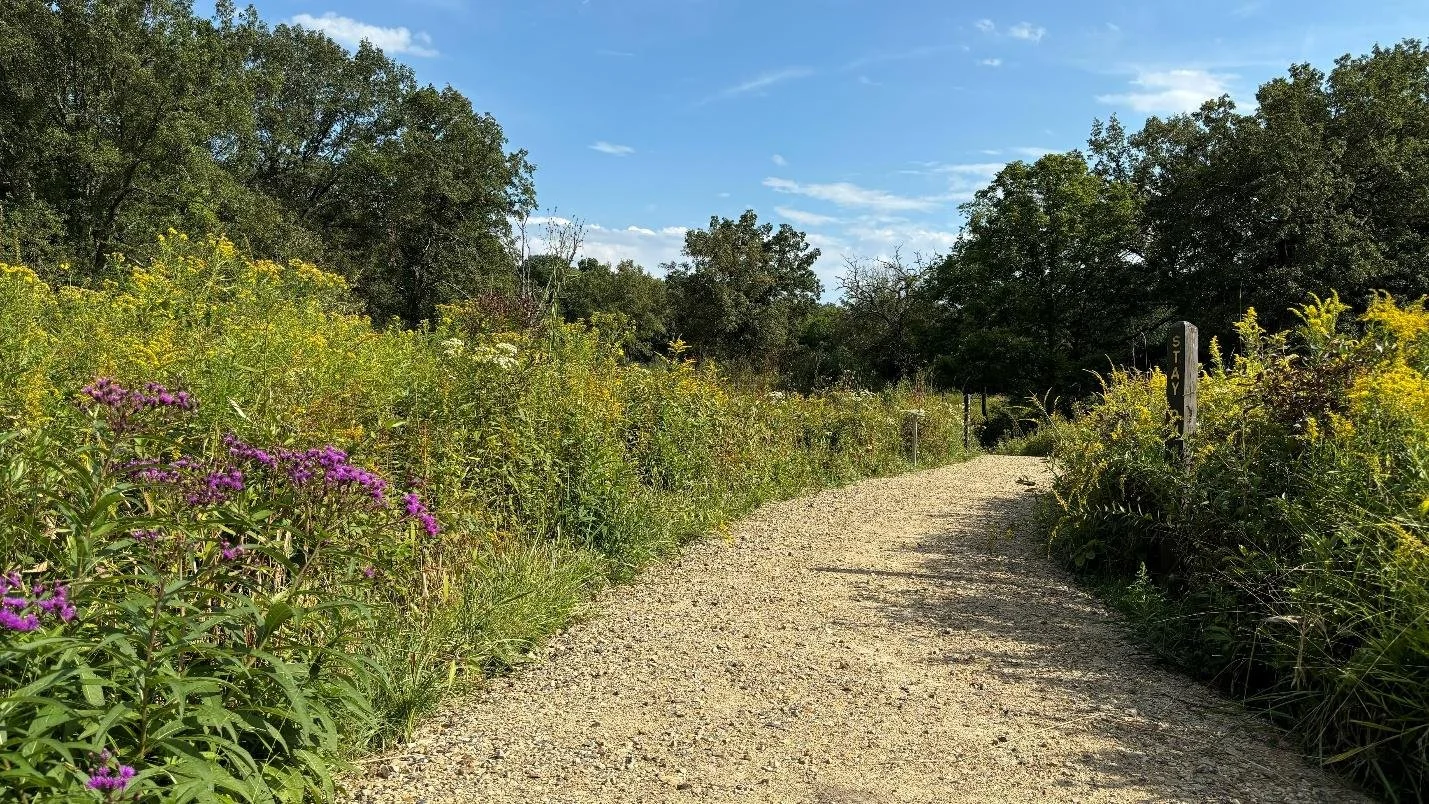
A trail at the Jennings Center cuts through the heart of a 20-acre remnant prairie. Over 225 native prairie taxa persist in wet and mesic habitats. Purple blooms of Joe-pye-weed, Eutrochium purpureum (left), contrast with yellow blooms of goldenrod, Solidago species (left and right). Photo Bruce Dvorak 2024.
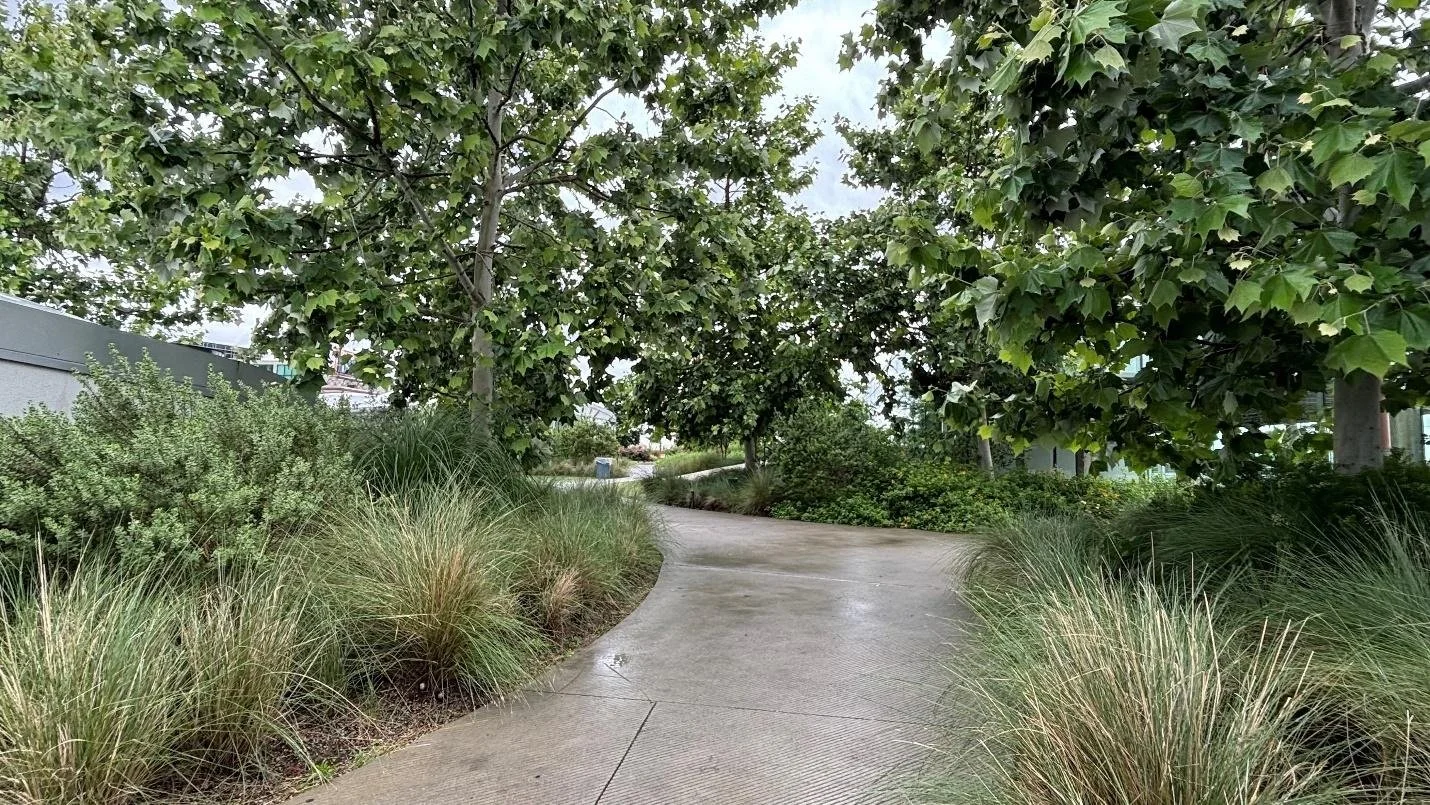
To support its prairie vegetation, the green roof utilizes 8 inches (20.32 cm) of substrate, capable of capturing up to 85% of annual rainfall. Some of the 36 taxa of mesic perennial vegetation include pollinators with species of Allium, Aster, Asclepias, Echinacea, and Monarda. Other plants that provide structural habitat support include species of Heuchera, Iris, Panicum, and Solidago. Some of these also adapt to drier habitats.
Prairies have nearly vanished from western Pennsylvania, but this biodiverse green roof brings back a rare habitat and demonstrates how well water-wise green roofs can work. Since 2012, this green roof has provided ecosystem services that help eliminate the building's monthly energy and wastewater expenses.
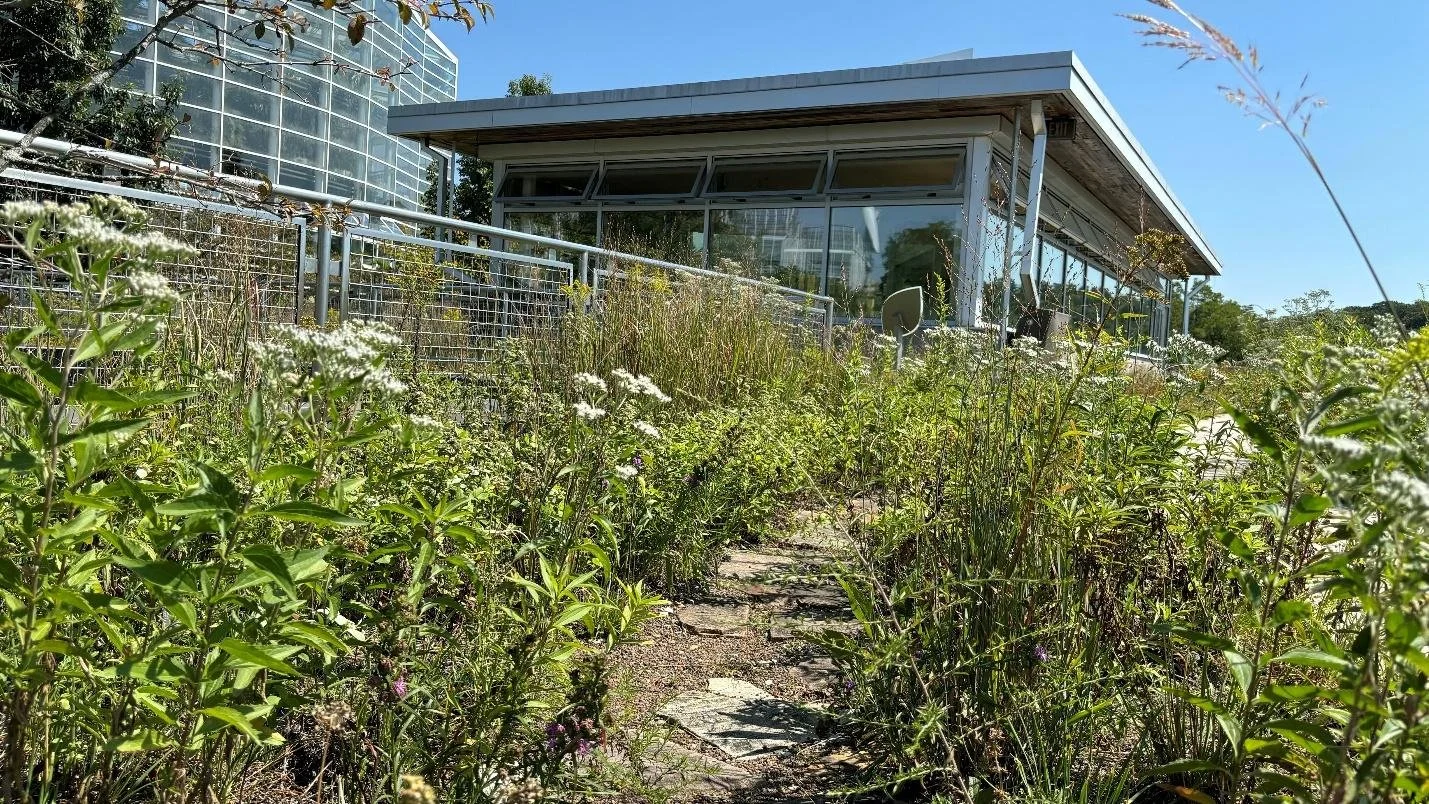
A semi-intensive green roof at the Phipps Center for Sustainable Landscapes includes a stone path that cuts through the heart of a mesic prairie habitat, which helps conserve energy and reduce monthly operating expenses. Photo Bruce Dvorak 2024.
Xeric Habitats
Although the North American East Coast generally has consistent rainfall throughout the year, it nonetheless supports xeric habitats. Peripheral habitats along the coastlines, west-facing slopes, barrens, glades, and rocky slopes exhibit xeric conditions. Prime examples of xeric habitats can be found on Long Island, New York, at Jones Beach State Park.
Plants native to xeric habitats at Jones Beach that could be considered for use on xeric green roofs include American beach grass (Ammophila breviligulata), little bluestem (Schizachyrium scoparium), switchgrass (Panicum virgatum in dry to mesic substrates), purple lovegrass (Eragrostis spectabilis), common hairgrass (Deschampsia flexuosa), and poverty grass (Danthonia spicata). These thrive in well-drained sandy or gravelly soils and some xeric to mesic habitats. Many of these plants are already used on green roofs in the region. In addition to grasses, there are many taxa of xeric herbs, groundcovers, shrubs, and trees native to xeric habitats that could be used on semi-intensive or intensive green roofs in the East.
Advertisement
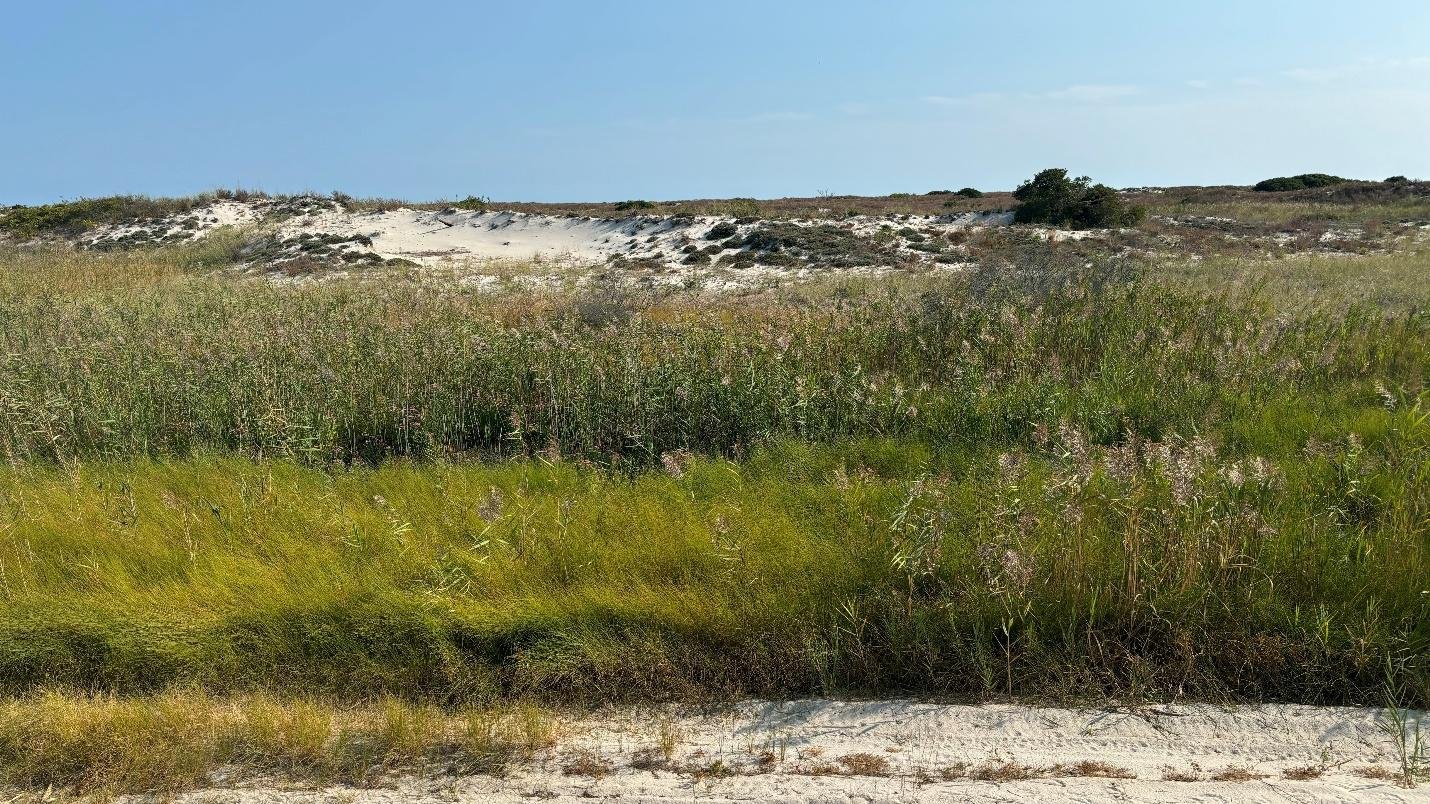
Xeric (background) and mesic (foreground) habitats at Jones Beach State Park (Long Island, New York). Sandy soils have sharp drainage characteristics. Native grasses and shrubs evolved to thrive here. Some plants native to these habitats perform well on green roofs, such as Dune Dwelling (a GRHC Award-winning project) and Little Island in New York City. Photo: Bruce Dvorak
Little Island, New York City
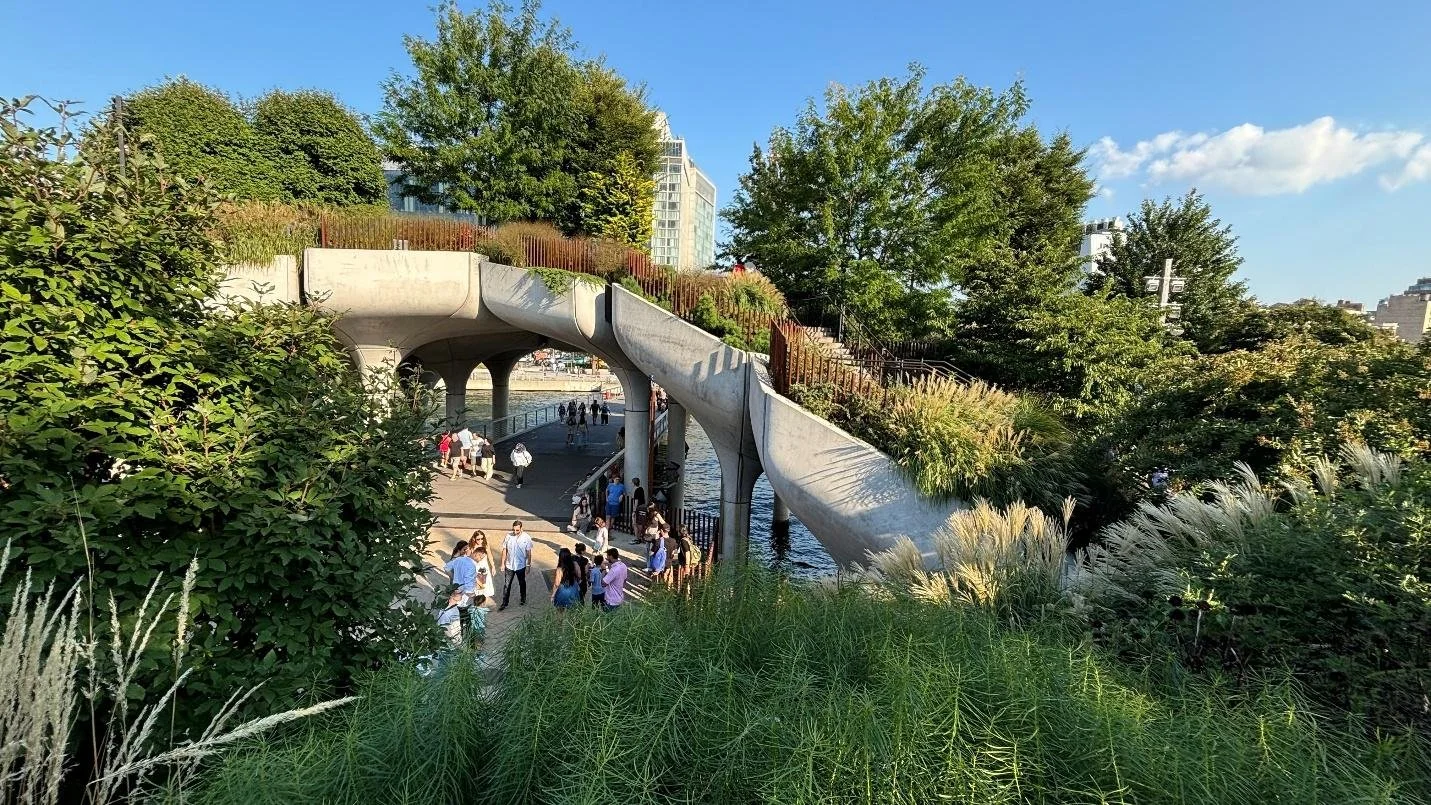
This formerly heavy industrial edge of the Hudson River was once labeled a “no-go” zone. Over the past decades, the once-neglected district has been transformed from grit to green. Contributing to this transformation was the development of an amazing miniature botanical park called “Little Island.” It was designed from 2012 to 2015 and constructed from 2018 to 2021 after Hurricane Sandy destroyed piers 54 and 55 (2012). Located in Hudson River Park, on the west end of Manhattan in New York City, Little Island is a plant lover’s paradise. It features hundreds of taxa native to xeric and mesic habitats, some native to Long Island and the eastern seaboard.
One hundred and thirty-two tulip-shaped piers, with cup-like tops, were custom-made to be clustered together and form the design of a lush park with varied-sized spaces. The compact botanical garden features over 400 plant taxa, including 270 grasses, vines, and perennials, with plants in bloom from early spring to late fall. Herbaceous vegetation grows in 14 to 24 inches (35-60 cm) of blended media, while trees and shrubs grow in four to six feet (1.2-1.8 m) of media. Excess water drains through the piers into a bioswale before it enters the Hudson River. Each pier contains its own drainage, irrigation, and substrate.
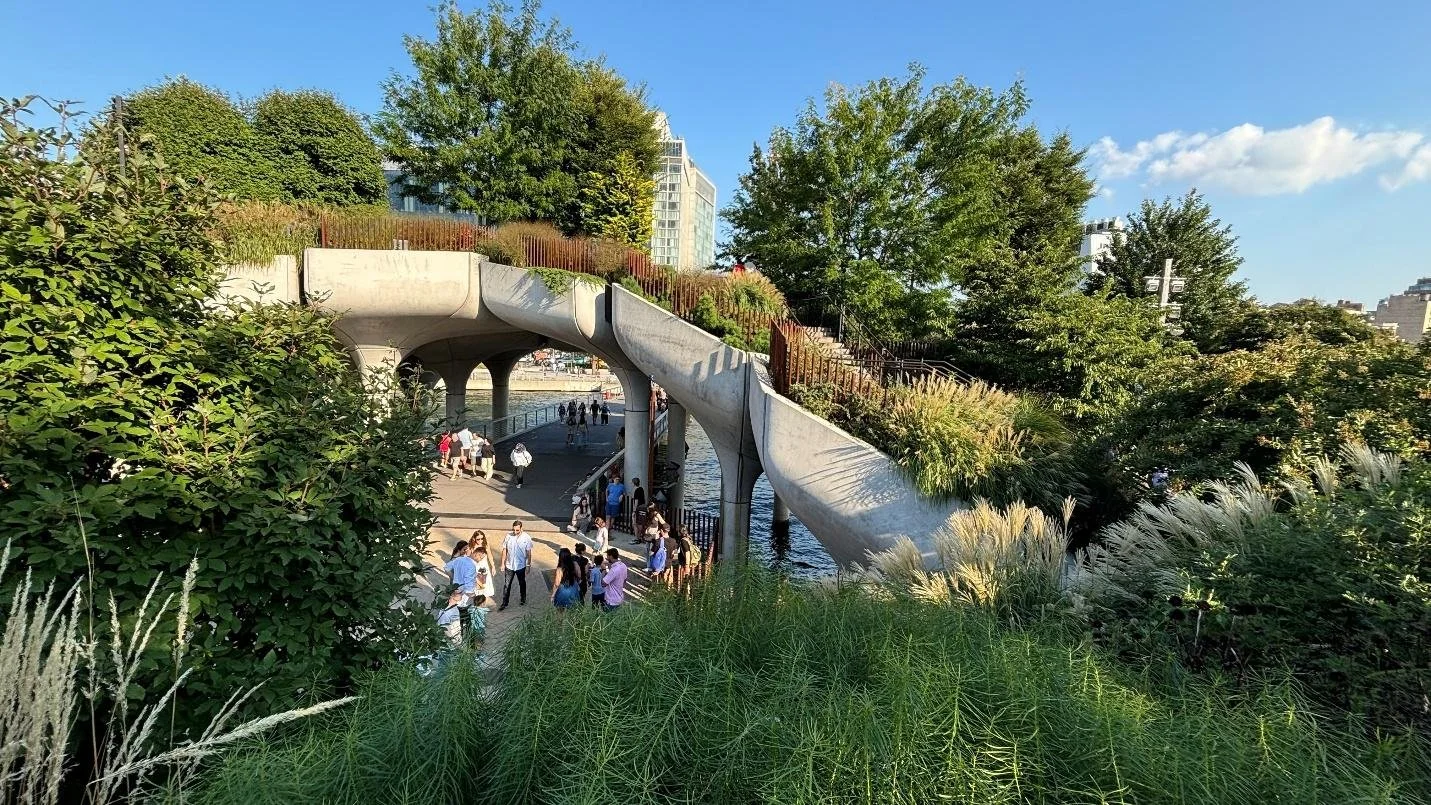
Hundreds of taxa of native xeric and mesic flora can be discovered at Little Island, New York. A collection of piers supports plants elevated high above the Hudson River. A maze of trails leads visitors through a 2.5-acre botanical garden with 70% taxa native to the region. Photo Bruce Dvorak 2024
Herbaceous vegetation includes an array of xeric and mesic plants, native to Long Island and elsewhere. Growing in the high and well-drained piers includes American marram grass (Calamagrostis breviligulata), purple coneflower (Echinacea purpurea for dry and mesic), little bluestem (xeric), seaside bluestem (Schizachyrium littorale), Aster, Solidago, Yucca, and many others. Some of the mesic plantings include species of Sporobolus, Asclepias, Monarda, and many more.
Conclusion
Summer is the perfect time to get outdoors, explore, and learn about how plants relate to water. Nature preserves abound with the potential to inform about plants for green infrastructure like green roofs, rain gardens, and living architecture. Green roofs can be designed for multiple purposes and functions, such as wastewater treatment, cooling, and soaking up rainwater. Wet, mesic, and xeric environments can and have been replicated on green roofs. Although much can be learned about plants growing in their natural environments, not all native plants adapt well to green roofs. Substrate depths, substrate moisture levels, maintenance, and seasonal monitoring are necessary. For those seeking to grow the green roof plant palette in their region, pilot studies may be necessary to learn which plants tolerate green roofs.
Advertisement
Bruce Dvorak, FASLA, PLA, is a Professor at Texas A&M University in the Department of Landscape Architecture and Urban Planning, where he has been conducting green roof and living wall research since 2009. Bruce is the chair of the GRHC Research Committee and founded a new Regional Academic Center of Excellence in 2022, the Southern Plains Living Architecture Center. Bruce received the GRHC Research Award of Excellence in 2017 and teaches green roofs and living walls in his courses in landscape architecture programs at Texas A&M University. Similar content can be found in Ecoregional Green Roofs: Theory and Application in the Western USA and Canada (Dvorak 2021).
Acknowledgements
I would like to extend my sincere thanks to Theo Witsell and Katie Morris for their invaluable insights into the plant and wildlife discoveries at Stone Road Glade Natural Area. Additionally, I am grateful to Lori Hardenbergh, Director of School Data, Analytics, and Research at the Sidwell Friends School, for providing a guided tour of the site's constructed wetlands and green roof systems.
Cities Alive 2026 Brooklyn, New York
The Cities Alive 2026 green roof and living architecture conference includes guided field visits to Little Island, NYC, and more. Visit the conference website to learn more about the speakers, tours, and to register.
References
Dvorak, Bruce, and Astrid Volder. "Green roof vegetation for North American ecoregions: a literature review." Landscape and urban planning 96.4 (2010): 197-213.
Dvorak, Bruce, ed. Ecoregional Green Roofs: Theory and Application in the Western USA and Canada. Springer Nature, 2021.
Ellis, Christopher D., Byoung-Suk Kweon, and Mark Storie. “Sidwell Friends Middle School.” Landscape Performance Series. Landscape Architecture Foundation, 2012. https://doi.org/10.31353/cs0320
Leopold, A. (1966). A Sand County Almanac: with Essays on Conservation from Round River. United States of America, Oxford University Press, Inc.
Lundholm, J. T. (2006). "Green roofs and facades: a habitat template approach." Urban Habitats 4(1): 87-101.
Rooney, R.C., Foote, L, Krogman, N., Pattison, J.K., Wilson, M.J, Bayley, S.E, "Replacing natural wetlands with stormwater management facilities: biophysical and perceived social values," Water Resources, 73 (2015), pp. 17-28.
Simmons, Mark T., et al. "Green roofs are not created equal: the hydrologic and thermal performance of six different extensive green roofs and reflective and non-reflective roofs in a sub-tropical climate." Urban Ecosystems 11.4 (2008): 339-348.
Sutton, Richard K. "Introduction to green roof ecosystems." Green roof ecosystems. Cham: Springer International Publishing, 2015. 1-25.