Utilizing Green Roofs to Achieve Municipal Stormwater Compliance
Advertisement
Introduction
Urbanization disrupts the natural hydrological cycle by replacing permeable natural landscape with impermeable surfaces such as rooftops, parking lots and roadways. This aggregates and accelerates surface runoff, which can cause erosion and undesirable geomorphic changes in the watercourse downstream. During heavy rainstorms, rapid runoff can lead to flash floods that threaten vital infrastructure, buildings and even lives. Furthermore, urban runoff carries significant pollutants into receiving water bodies, which can harm aquatic life and negatively affect human uses such as swimming and fishing.
Climate change has further exacerbated the intensity and frequency of extreme rainfall events around the world. Rising temperatures increase moisture in the air, leading to more intense downpours. The infamous “atmospheric river” weather system in British Columbia in 2021 caused widespread flooding in the province that swept away homes and farms, damaged roadways and bridges, cutting off the mainland from the interior. Insured losses totalled over $675 million, the costliest natural catastrophe in the province’s history at the time¹.
To combat the impacts of extreme rainfall events and flash flooding due to climate change and urban growth, municipalities are mandating stormwater management (SWM) plans as part of their site plan approval process for new developments. These plans use a customized “treatment train” approach involving grey and green infrastructure to control runoff at the lot level, maintain natural hydrology and protect water quality.
While specific requirements vary depending on municipal land use and environmental planning policies, SWM targets generally fall into three categories: water quality, water balance and quantity control. On densely built urban sites where space at grade is frequently limited, rooftops become the primary and often the only surfaces available to manage stormwater. Green roofs have proven to be highly effective low-impact development (LID) tools that assist engineers in meeting SWM targets.
Advertisement
Water Quality
Total Suspended Solids (TSS) is a critical water quality parameter that indicates pollution levels and water clarity. Elevated TSS level reduces light penetration and can physically harm aquatic life. High TSS level also clogs pipes, damages pumps and reduces the efficiency of water treatment facilities. Consequently, municipal site plan approval processes often require new developments to treat their runoff to reduce the TSS in order to protect local watersheds.
Many municipalities in Ontario have mandates to achieve specific levels of TSS removal as recommended by the Ministry of Environment, Conservation and Parks.² For example, the City of Toronto mandates 80 per cent TSS removal in the runoff from new developments. Rooftop runoff is generally considered to be clean and does not require treatment to meet the 80 per cent TSS removal requirement. Green roofs can further reduce pollutant loadings by absorbing and filtering other contaminants that result from wet and dry atmospheric deposition.
Water Balance
Water balance targets are established to retain and manage rainfall on a development site in a manner that closely replicates pre-development hydrologic conditions. This is achieved through a combination of infiltration, evapotranspiration, landscaping, rainwater harvesting and reuse, as well as other LID practices.
The objective of water balance targets is to balance runoff, infiltration and evapotranspiration to an acceptable level based on the local watershed’s needs. This involves capturing rainwater on site as much as possible, and any runoff is then infiltrated and/or evapotranspirated to minimize the volume going into the municipal storm sewers.
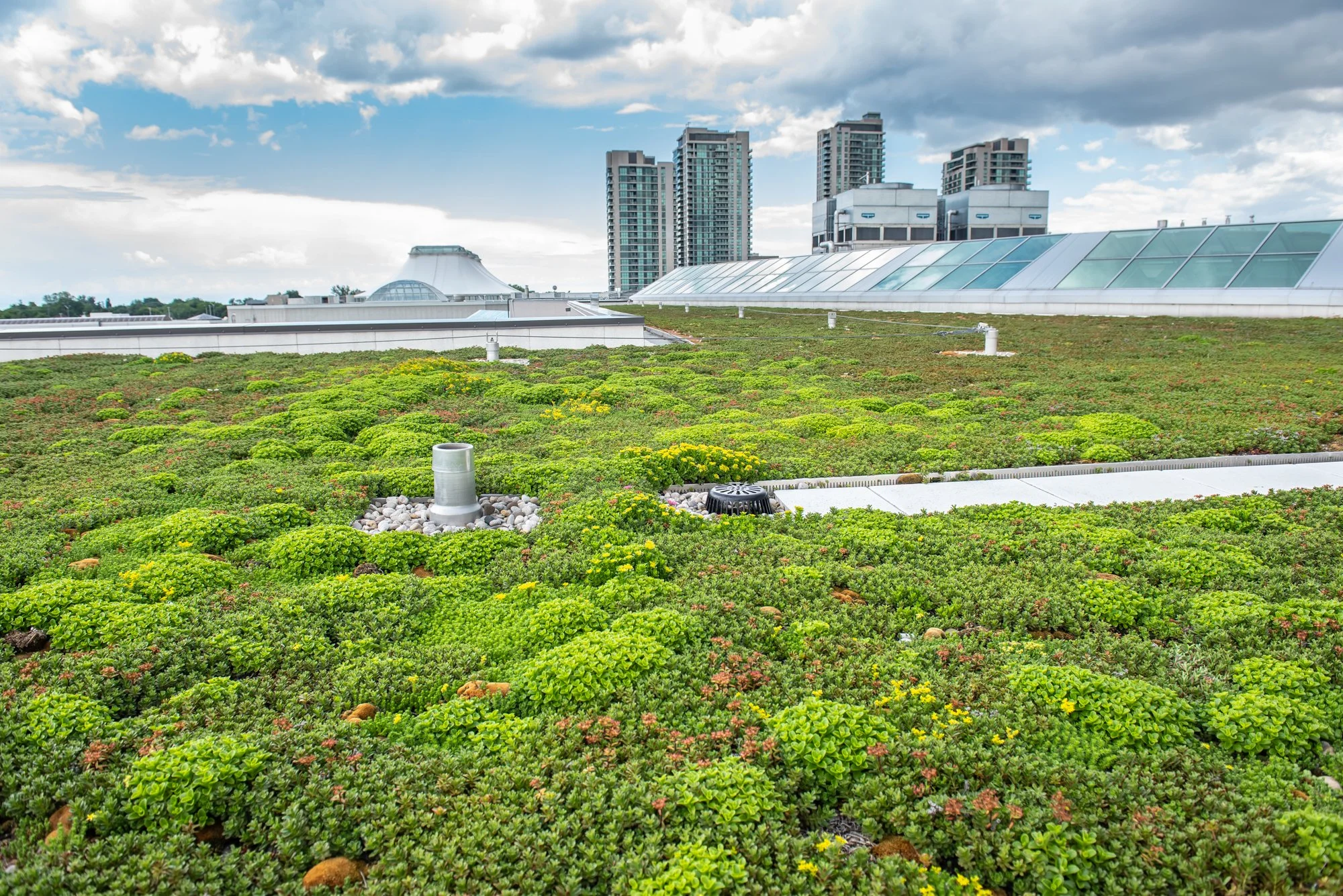
This 9,500 m² green roof on the Sherway Garden in Toronto can retain 340,000 liters of stormwater runoff.
Green roofs contribute to a site’s water balance in two ways. First, the plants and the growing media retain rainwater, reduce and slow runoff. Second, any site runoff can be collected in an underground retention tank and reused to irrigate the green roof (and ground level landscape) in a closed loop during dry periods. The retained water in the green roof assembly is either taken up by the plants or evapotranspirated to the atmosphere, without entering the municipal storm sewers.
Water Balance Example
The City of Toronto’s Wet Weather Flow Management Guidelines (WWFMG) require a development to retain water onsite, to the extent practical, to match pre-development runoff volumes.³ This is typically achieved by retaining the first 5 mm of every rainfall event, which is equivalent to 50 per cent of the total average annual rainfall.
Advertisement

Table 1: Initial abstraction values for different surface types.
Note: City of Toronto defines an intensive green roof as one with a growing medium depth equal to or greater than 150 mm while an extensive green roof contains less than 150 mm of growing medium.
Initial Abstraction (IA) is the depth of rainfall that must fall before surface runoff begins. Pervious surfaces have higher IA than impervious ones. Table 1 shows typical IA values for selected surfaces, set by Toronto Water, that are used in Water Balance calculations.
Let’s use a sample project to illustrate a typical water balance calculation. Table 2 shows the various surfaces, their IA and volume abstracted on a 600 m²-development in Toronto. The site is required to retain 3.0 m³ (5 mm over the 600 m²) by the WWFMG.
The volume abstracted by each surface is the product of the area and its associated IA. For example, the 200 m² of impervious roof has a volume abstracted of 0.2 m³ (200 m² X 1 mm) while the 100 m² of extensive green roof has a volume abstracted of 0.5 m³ (100 m² X 5 mm). The total volume abstracted by all surfaces is 1.6 m³.
The site’s IA can be calculated by dividing the total volume abstracted (1.6 m³) by the total contributing surface area (600 m²), which is 2.7 mm in our example.
Since the site is required to retain 3.0 m³ (the first 5mm of rainfall on the entire site), and the volume abstracted is 1.6 m³ by the various surfaces, therefore, the required storage volume for the site is 1.4 m³ (3.0 m³-1.6 m³), usually in an underground retention tank.
To meet the water balance target, the 1.4 m³ of stored water must be emptied within 72 hours through a combination of infiltration, irrigation and toilet flushing. Infiltration is rarely feasible on constrained urban sites in Toronto. Toilet flushing involves a separate set of pipes and plumbing network, which adds considerable costs.
Irrigation reuse, on the other hand, can kill two birds with one stone: using up the stored water to meet water balance target while conserving portable water for irrigating the green roofs and the landscape on site.
Advertisement
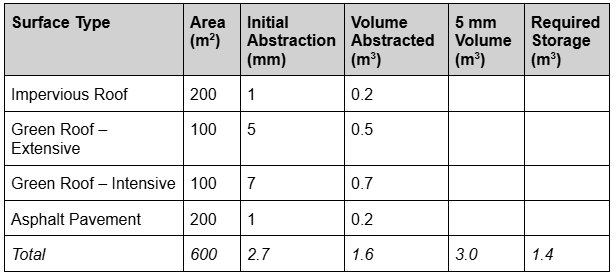
Table 2: Sample water balance calculation of a development in Toronto
The irrigation water demand of a green roof (or any landscape) depends on many factors such as the local evapotranspiration rate, its area and the irrigation efficiency, as well as the plant species, the planting density, and the microclimate according to Equation 14:
WR = (Eto*Kₛ*Kᴅ*Kₘ꜀-Re)*A/IE Equation 1⁴
Where
WR = Water requirement/demand (L/month)
ETₒ = Local reference evapotranspiration (mm/month)
Kₛ = Species factor (dimensionless)
Kᴅ = Density factor (dimensionless)
Kₘ꜀ = Microclimate factor (dimensionless)
Re = Effective rainfall (mm/month)
A = Area of the green roof (m²)
IE = Irrigation efficiency (dimensionless)
The reference evapotranspiration (ETo) is the amount of water lost to the atmosphere from a well-water lawn surface. It differs from one city to another, reflecting the local climate. The effective rainfall (Re) represents the portion of rainfall that infiltrates the growing medium and becomes available to support the vegetation. Naturally, the larger the green roof area (A), the higher volume of irrigation water will be required. The irrigation efficiency (IE) is the ratio of the water that reaches the plant-soil surface to the water delivered by the irrigation system. It reflects the water loss such as non-uniform water distribution.
The species factor (Kₛ) accounts for the difference in a species’ water needs, e.g. turfgrass has higher water needs and therefore a higher species factor than succulents. The density factor (Kᴅ) attributes the water needs of different amount of vegetation coverage, e.g. a pre-grown sedum mat has a higher density factor than sparsely planted plugs. The microclimate factor (Kₘ꜀) shows how the green roof location affects water needs, e.g. a green roof on top of a 30th floor condo will have a higher Kₘ꜀ than that on a 2nd floor podium roof.
Back to our example, let’s say the 72-hour irrigation demand are 7 mm and 9 mm for the extensive and intensive green roofs, respectively, as calculated and provided by the green roof supplier or the irrigation consultant. Therefore, the 72-hour average irrigation demand for the extensive and intensive green roofs are 0.7 m³ (100m² X 7 mm) and 0.9 m³ (100m² X 9 mm), respectively, for a total of 1.6 m³ for the site. Since the irrigation reuse volume (1.6 m³) is greater than or equal to the required storage (1.4 m³), water balance is met. Otherwise, the design team will adjust the various areas to meet the target.
Here are some strategies when using green roofs to meet water balance targets:
Maximize the green roof areas to retain more rainwater and reduce runoff.
Use an intensive system if structural loading permits to increase IA.
Add water retention layers and/or reservoirs to increase IA of the green roof.
To maximize the irrigation water reuse of the green roof for water balance:
Use pre-grown systems or dense plantings to increase the density factor (Kᴅ).
Select plants with high species factor (Ks) to use up the stored water quicker.
Advertisement
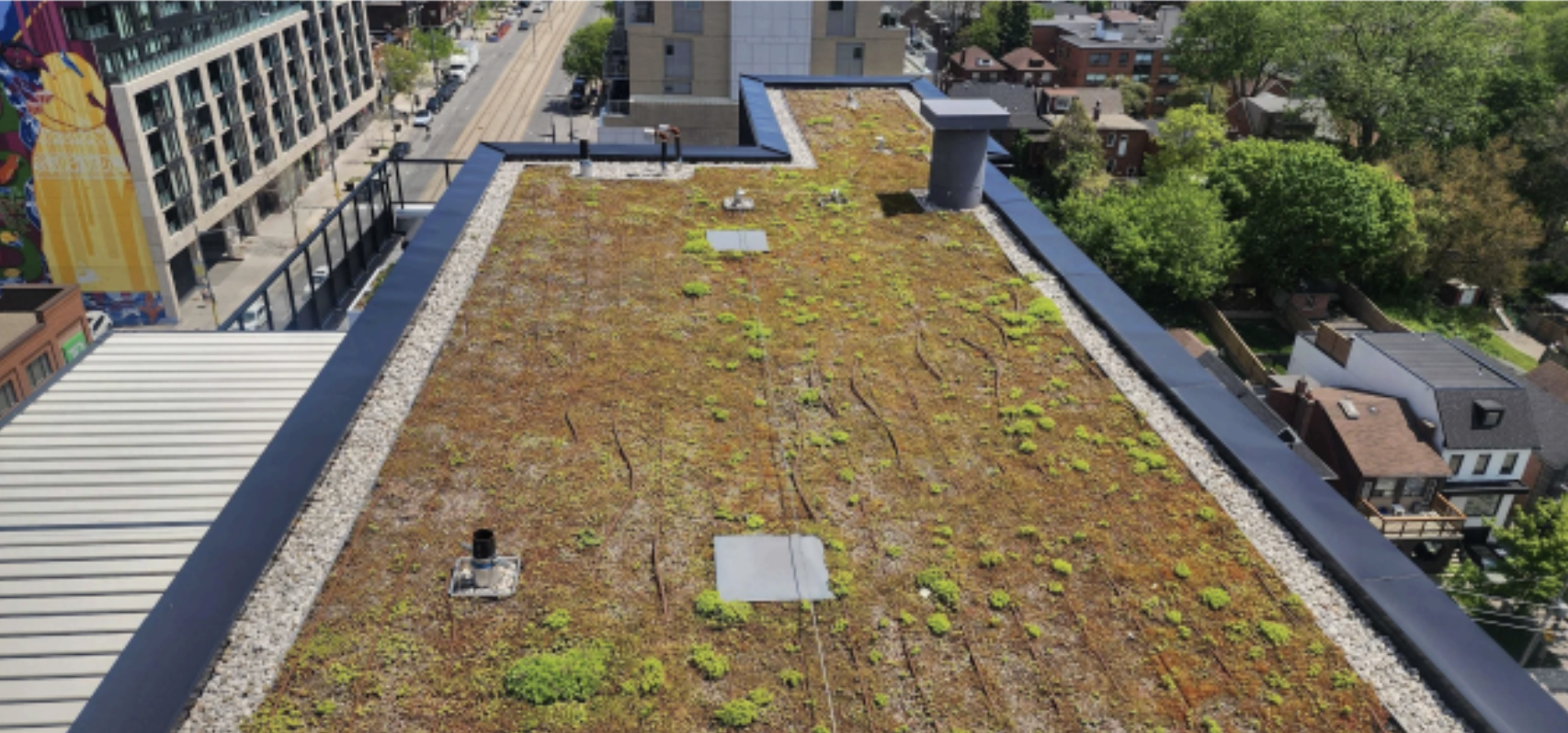
This friction based blue-green roof on Monza Condos in Toronto provides up to 5 m3 of detention storage on the rooftop while meeting the municipal release rate target.
Quantity Control
Imperviousness results in higher volumes and rates of stormwater runoff. When combined with rapid conveyance of runoff through the urban drainage system, stormwater can cause erosion downstream, degrade aquatic habitats and threaten life, property and infrastructure. Controlling post-development peak flow to either match or fall below pre-development conditions can mitigate these adverse effects.
For many constrained urban sites, runoff is temporarily stored in an underground detention tank and slowly released at a controlled rate to prevent overloading the city’s storm sewer infrastructure and reducing the need for costly upgrades. Peak flow control requirements are typically evaluated for ‘design storms’ with return periods ranging from 2 to 100 years.
Green roofs contribute to a site’s quantity control targets in two ways. First, they reduce imperviousness and thus the site’s Runoff Coefficient (C), which in turn lowers the post development peak flow rate and the detention storage volume required. Second, specialized blue-green roofs (i.e. green roofs with built-in detention basin and/or a friction based release rate control) can add more water storage on the rooftop to reduce or potentially eliminate the detention tank, thereby generating significant developer savings. Lot level stormwater management can also reduce the need for expensive sewer upgrades often required to facilitate new development projects that were formerly in low density areas.
Quantity Control Example – City of Vancouver
The City of Vancouver’s Rainwater Management Policy requires all new developments to manage rainwater on site. For sites >1000 m² and/or >1.0 Floor Space Ratio (FSR), they are required to release the detained water in 2 stages for CSO mitigation and peak flow control₅.
CSO Mitigation: The first 15 mm of rainfall that lands on the non-landscaped areas will be released at a rate of 5 L/s/hectare (site area).
Peak Flow Control: The 10-year 2100 release rate must be less than or equal to 25 L/s/hectare.

Table 3: Suggested runoff coefficients for selected surface types (excerpt from City of Vancouver’s Engineering Design Manual).⁶
Green roofs can help reduce the detention storage required for both stages by lowering the site’s imperviousness and the runoff coefficient as follows:
Since the first stage volume = 15mm X non-landscaped area, a green roof can reduce the non-landscape area and thus the first stage volume required.
Green roof reduces the site’s Runoff Coefficient (C) and thus the Post-Development Peak Flow (Qₚₒₛₜ), which in turn reduces the 10-year storage volume required.
Increasing the growing medium depth of the green roof reduces the Runoff Coefficient and therefore lowers the storage volume further (see Table 3).
For more details, sample calculations can be found in 2025 Vancouver Building By-law, Section A-2.4.2.5.⁵ Minimum Detention Volume Calculation.⁶ To learn more about how green roofs can help meet Vancouver’s Rainwater Management criteria, please check out this LAM article.⁷
Advertisement
Blue-Green Roofs
While green roofs are effective in retaining water, their retention capacity drops as they become saturated, such as during prolonged rainstorms or back-to-back rain events. Eventually, retention is no longer effective – rainwater percolates through the saturated growing substrate, goes down the roof and drains into the municipal sewage system. However, a specialized blue-green roof system can provide reliable quantity control on site.
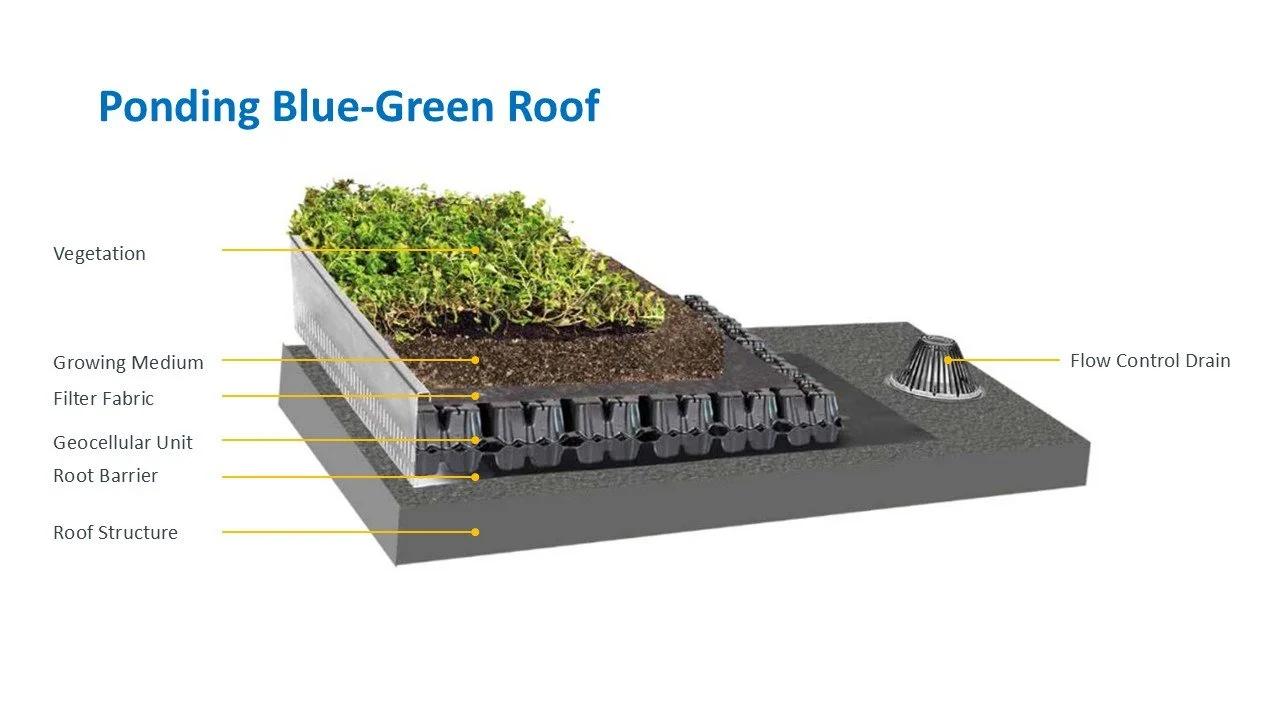
Ponding blue-green roofs are most effective on dead flat 0 per cent roof slope.
Blue-green roofs are specialized green roofs that incorporate built-in detention storage and a controlled release mechanism that releases the water over 24-48 hours depending on the local building codes. Some systems also allow stored water to be used by the plants through a wicking mechanism. By providing active storage on the rooftop, blue-green roofs can reduce or potentially eliminate the underground detention tank. This can free up valuable space for underground parking or other uses saving significant development costs. On sites where excavation is challenging or costly, or a lack of space for infiltration at grade, moving the detention storage to the rooftop makes considerable financial sense.
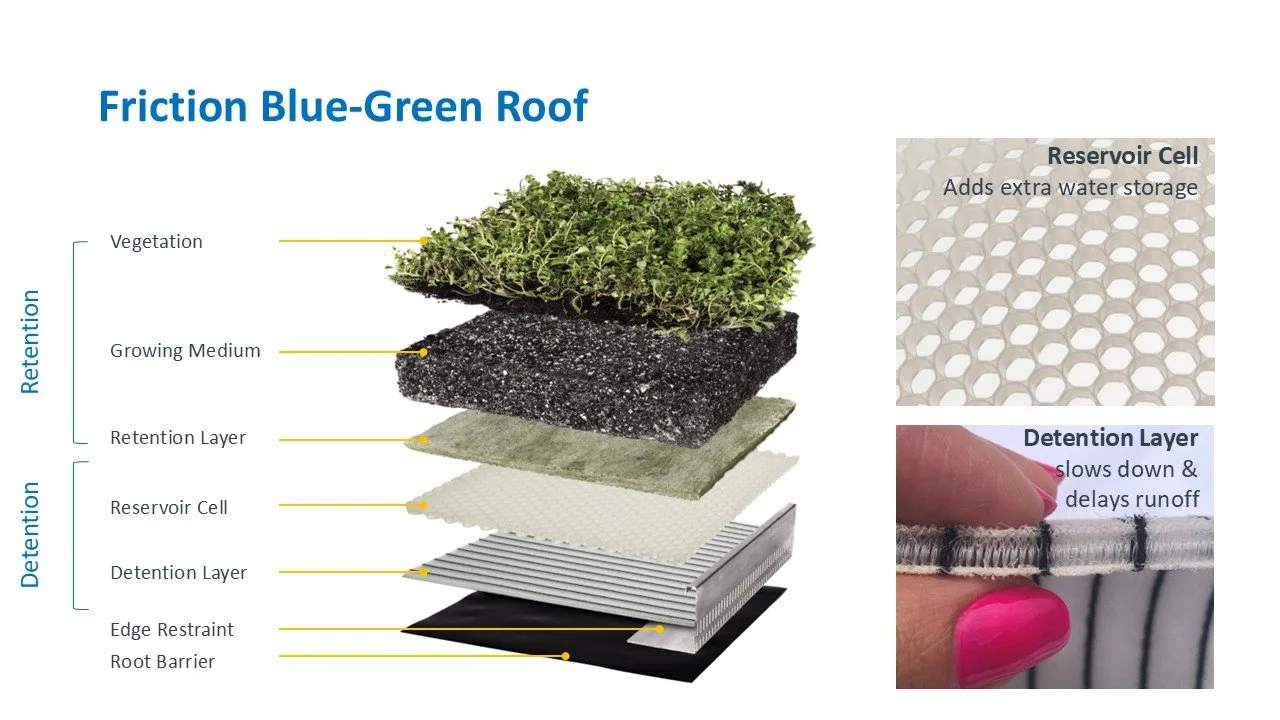
Friction blue-green roofs are best suited on low-slope roofs at 2-3 per cent.
There are two common blue-green roof technologies on the market. The first is the ponding blue-green roof system, which consists of a green roof installed over a geo-cellular storage unit and a flow-control roof drain. When it rains, the rainwater is temporarily stored in the storage basin under the green roof and slowly released through the flow control drains. Since most roofs are sloped 2 per cent towards the drains, ponding water is deeper near the roof drains and shallower away from them, reducing detention storage efficiency. Consequently, ponding blue-green roofs are most effective on dead flat 0 per cent slope such as plaza decks.
The second technology is the friction blue-green roof system, which replaces the conventional free drainage layer with a specialized friction layer and an overlying reservoir layer to provide detention storage. The friction layer contains dense fine fibers that slows down runoff, causing water to back up into the reservoir layer above, where it is temporarily stored. Because flow attenuation occurs uniformly across the entire roof surface, the detention storage depths remain relatively consistent regardless of the roof slope. This characteristic makes friction blue-green roofs effective on low-slope 2-3 per cent roofs, which is common in commercial, institutional and multi-unit residential buildings.
Here are some strategies when using green roofs to achieve meet quantity control targets:
Maximize the green roof areas to reduce a site’s runoff coefficient (C).
Increase the growing medium depth if structural capacity permits to increase the runoff coefficient.
Upgrade the green roof to blue-green roof to reduce the size, or replace, a detention storage tank. To maximize detention storage efficiency:
Ponding blue-green roof systems work best on dead flat 0 per cent slope roofs such as plaza decks.
Friction blue-green roof systems are best suited on low-slope roofs with positive drainage such as 2-3 per cent.
Development of Standard Stormwater Management Testing Method
The National Research Council, in partnership with the Canadian roofing industry, has spearheaded the Nature-Based Solutions – Commercial Roof (NBS-CR) to develop a test method to better quantify the retention and detention performance of green roofs and blue-green roof systems. The performance data will allow municipalities to fine-tune their stormwater requirements for new development while enabling engineers to more confidently model and incorporate these systems into their stormwater management plans.
Conclusion
Municipalities often require a stormwater management plan as part of site plan approval process for new developments to reduce the risks of urban flooding, mitigate stream erosion and protect water quality. Green roofs and blue-green roofs are effective Low Impact Development measures that can help projects meet specific municipal targets on water quality, water balance and quantity control. Their ability to provide stormwater retention, detention, and evapotranspiration makes them particularly valuable on constrained urban sites where space for conventional stormwater management infrastructure is limited.
Advertisement
Dr. Karen Liu is the Green Roof Specialist with Next Level Stormwater Management. Karen is an experienced researcher and educator and conducted green roof research at both National Research Council Canada and British Columbia Institute of Technology. As a former global product manager with a major German green roof company, she has extensive practical experience with green roof products and installation across North America, Europe and Asia. She is a member of the CSA A123 Technical Committee, a lay councillor for the Ontario Association of Landscape Architects and a Board of Director for the Green Roof Infrastructure Network BC.
Resources
“B.C. atmospheric river flooding: Bad, but as bad as 2021…?”, Darryl Dyck, Insurance Institute https://www.insuranceinstitute.ca/en/Insights-And-Publications/CanadianUnderwriterArticles/items/2025/12/11/BC-atmospheric-river-flooding-Bad-but-as-bad-as-2021
“Stormwater Management Planning and Design Manual”, Section 3.1.1.1 Level of protection, Ministry of the Environment, March 2003 https://www.ontario.ca/document/stormwater-management-planning-and-design-manual-0
“Wet Weather Flow Management Guidelines”, City of Toronto, November 2006 https://www.toronto.ca/wp-content/uploads/2017/11/9191-wwfm-guidelines-2006-AODA.pdf
“A Guide to Estimating Irrigation Water Needs of Landscape Plantings in California”, University of California Cooperative Extension, California Department of Water Resources, August 2000. https://pwds.oc.gov/sites/ocpwocds/files/2021-06/Guide%20to%20Estimating%20Irrigation%20Water%20Needs.pdf
City of Vancouver’s Rainwater Management requirements on private property https://vancouver.ca/home-property-development/rainwater-management.aspx
Amendment to Section 5.2 of the Engineering Design Manual, Table 5-2: Surface Type Runoff Coefficient, City of Vancouver, February 11, 2025 https://vancouver.ca/files/cov/amendment-to-section-5.2-engineering-design-manual.pdf
Peter Alm, LAM Summer Water Issue 2026. https://livingarchitecturemonitor.com/articles/green-roofs-impact-vancouver-rainwater-criteria
Sudha Molleti, LAM Summer Water Issue 2026 https://livingarchitecturemonitor.com/articles/nature-based-roofing-assemblies-for-flood-mitigation-canada