Advertisement
Introduction
Heavily paved and urbanized cities around the world are negatively affected by extreme weather which is causing more frequent flooding. As more people continue to move to urban areas, it is necessary to figure out how to best manage extreme rainfall. Most grey infrastructure in cities was built to collect and push water away as fast as possible, through pipes, drains, and concrete channels. This works well on a day to day basis, but during heavy storms, there can be nowhere left for the water to go, resulting in flash flooding which destroys property and takes peoples lives. In response to these challenges cities around the world are starting to use a different approach, one that works with water and nature.
What are Sponge Cities?
The term ‘sponge cities’ was coined over a decade ago by Kongjian Yu, an internationally renowned Chinese landscape architect who tragically died in a plane crash in 2025. After seeing floods overtake an unprepared Beijing, he came to the conclusion that the rapidly growing city had focused too much on traditional western style grey infrastructure, and had not created space for extreme rainfall, typical in China. Western style stormwater management gets rain off streets quickly, but doesn’t have places for excess water to actually go. Rather than fighting runoff with hardscapes, drainpipes, and energy-hogging pumps, Yu’s Sponge Cities channel and harvest rainwater through attractive parks.
The Sponge City philosophy is to distribute and retain water at its source, slow down water as it flows away from its source, clean water naturally, and adapt to water at the sink when water accumulates. This is in stark contrast to the conventional solution of grey infrastructure, which is to centralize and accumulate water using big reservoirs, speed up the flow by pipes and channelized drains, and fight against water at the end by higher and stronger flood walls and dams.
Sponge cities involve the use of a collection of nature based solutions that absorb water and drain it slowly rather than sitting on concrete or filling up drainage systems too quickly. These solutions include using permeable pavement, swales, green roofs, bioswales, parks that flood temporarily, ponds that increase and decrease in depth, tree planting, wetland restoration and more. Sponge city concepts can be applied at different scales, from city planning and master plans down to specific sites.
According to Yu, “Sponge Cities are able to regulate flexibly. How? Because we build swales. During the dry season you don’t notice them because they’re covered with vegetation. Then there’s the wet season. When you look at our projects in monsoon regions, like on Sanya Island, for example, you find thousands of spaces that can be flooded. It’s this flexibility that makes a Sponge City different. We might only need 1% of the water-storage space on normal days and you’ll just see the creek as a water feature. But on a flood day, it fills up. If you build your city this way, you can avoid disaster.”
Advertisement
Why Are Sponge Cities Needed?
It is estimated that 68% of the world's population will live in urban areas by 2050. In South Asia alone, as of 2025, over 1,100 people were killed by severe rainfall and flooding, and millions have been displaced from their homes. As the world continues to urbanize and storms intensify, preventative measures are necessary to avoid further deaths and displacement. Building sponge cities now will likely save lives and damage in the long run. Here are a few case studies of sponge city developments from China and India.
Starry Sky Park in Shanghai, China
Sponge cities were coined in China, where they’ve been implemented through policy change like no other country. The Sponge City Program (SCP) was started in 2015 as a pilot program in a few cities. The aim of the program was to get 80 per cent of urban areas to follow sponge city requirements by using nature-based solutions, and to be able to store up to 70 per cent of excess rainwater for reuse during periods of drought - all by 2030.
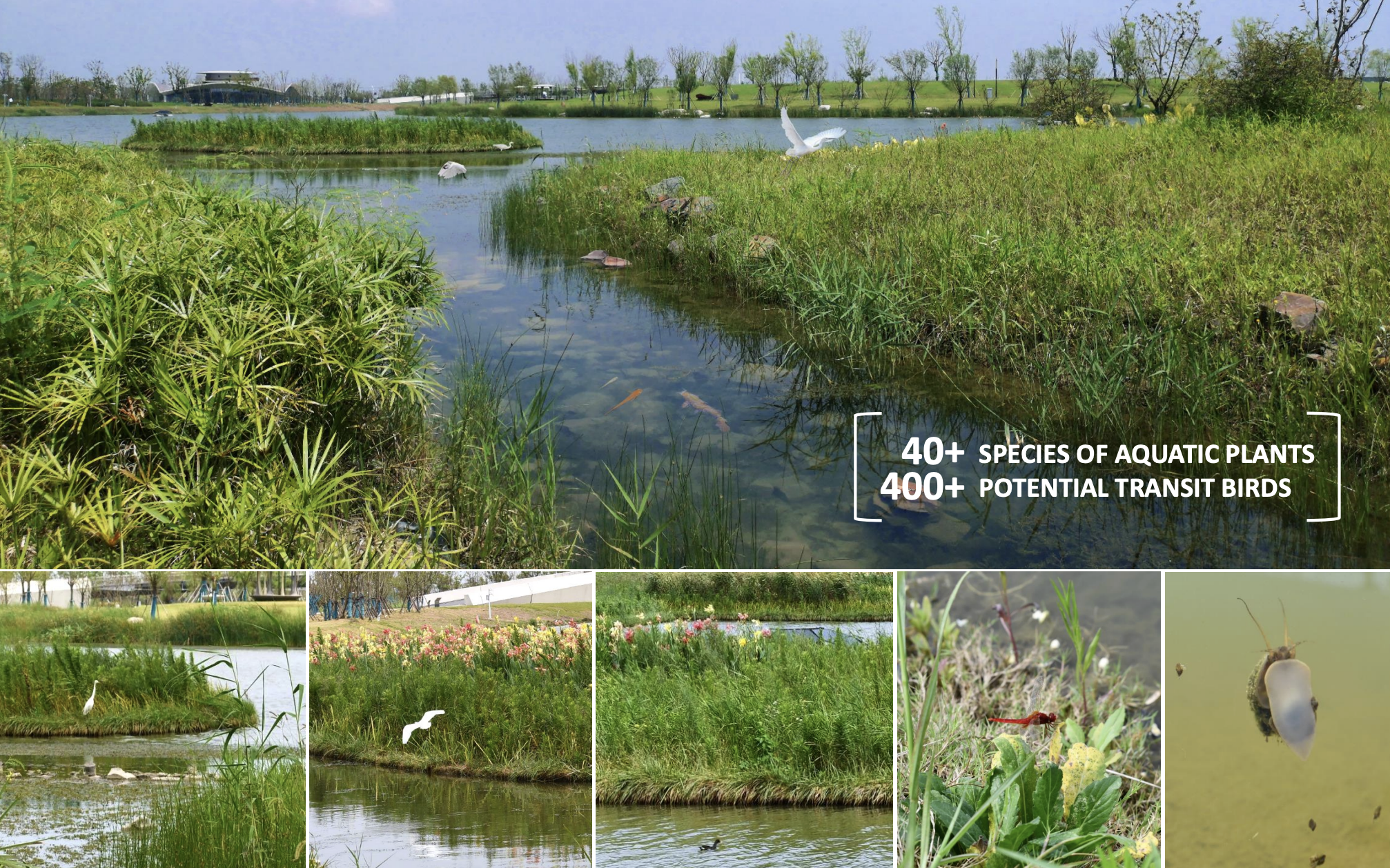
From there it has grown into a largely successful program involving more than 80 cities. As part of this program a 54 hectare sponge park, nicknamed Starry Sky Park, was built on Shanghai’s coast. The park was built around an artificial lake, allowing rainfall to be rerouted through ponds and wetlands. Not only does the land absorb and reroute water, it also filters it. By adding various aquatic plants throughout the different water streams, the system can purify up to 15,000 cubic meters of water everyday before it goes back into the river. The park is built on land that was underwater a decade ago. Due to the salty water, they buried a layer of gravel under the soil to add a layer of separation between the salt and the plants. This project cost approximately 1.55 billion RMB (229 million USD) and only took three years to complete. As soon as the park was completed in 2021, Typhoon In-Fa hit Shanghai and the park's water absorption was tested. The aftermath of the typhoon showed almost no puddles of water - the park had done its job.
Advertisement
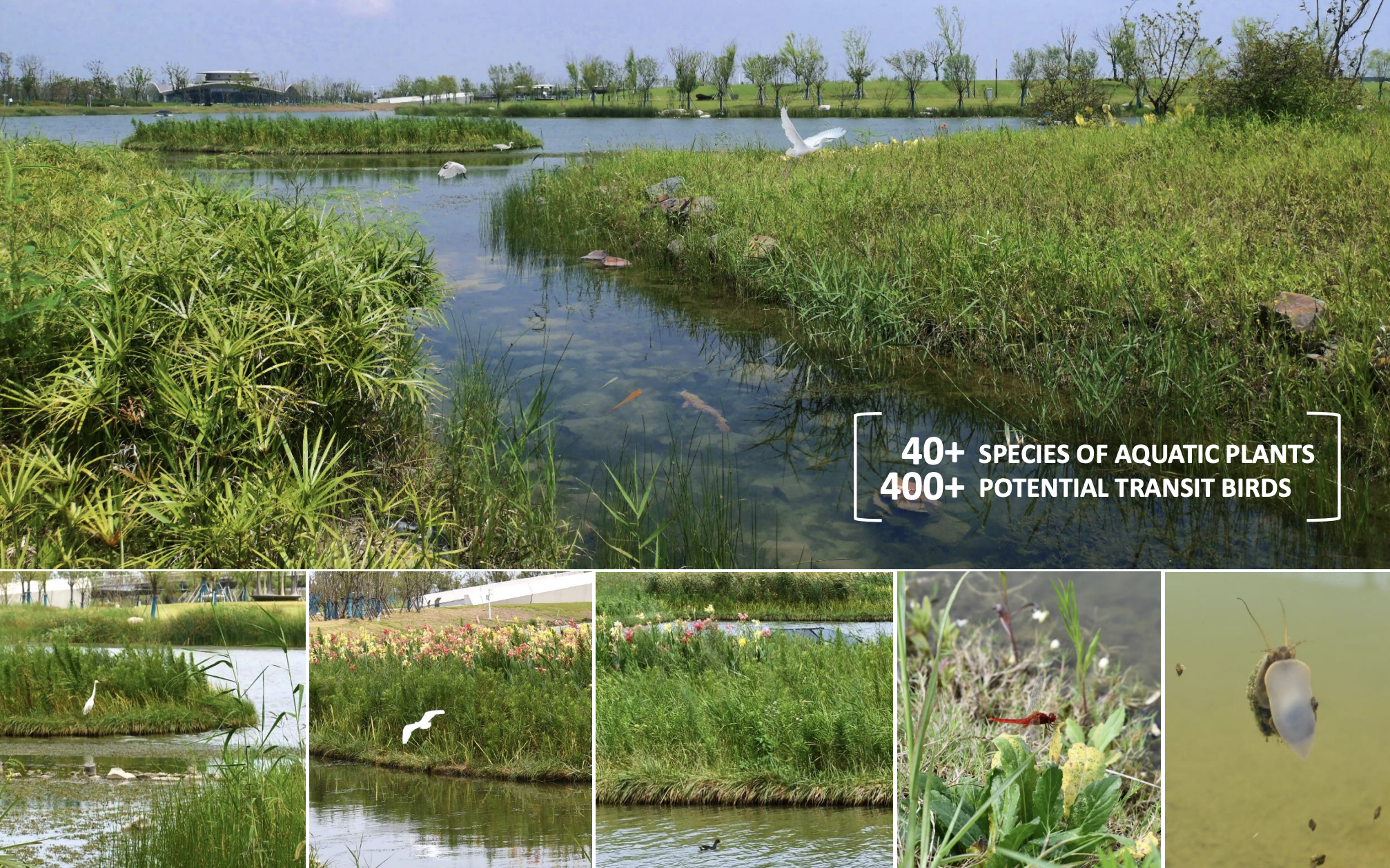
The park supports biodiversity efforts through its design. Source
Dr. M.S. Swaminathan Wetland Eco Park in Chennai, India
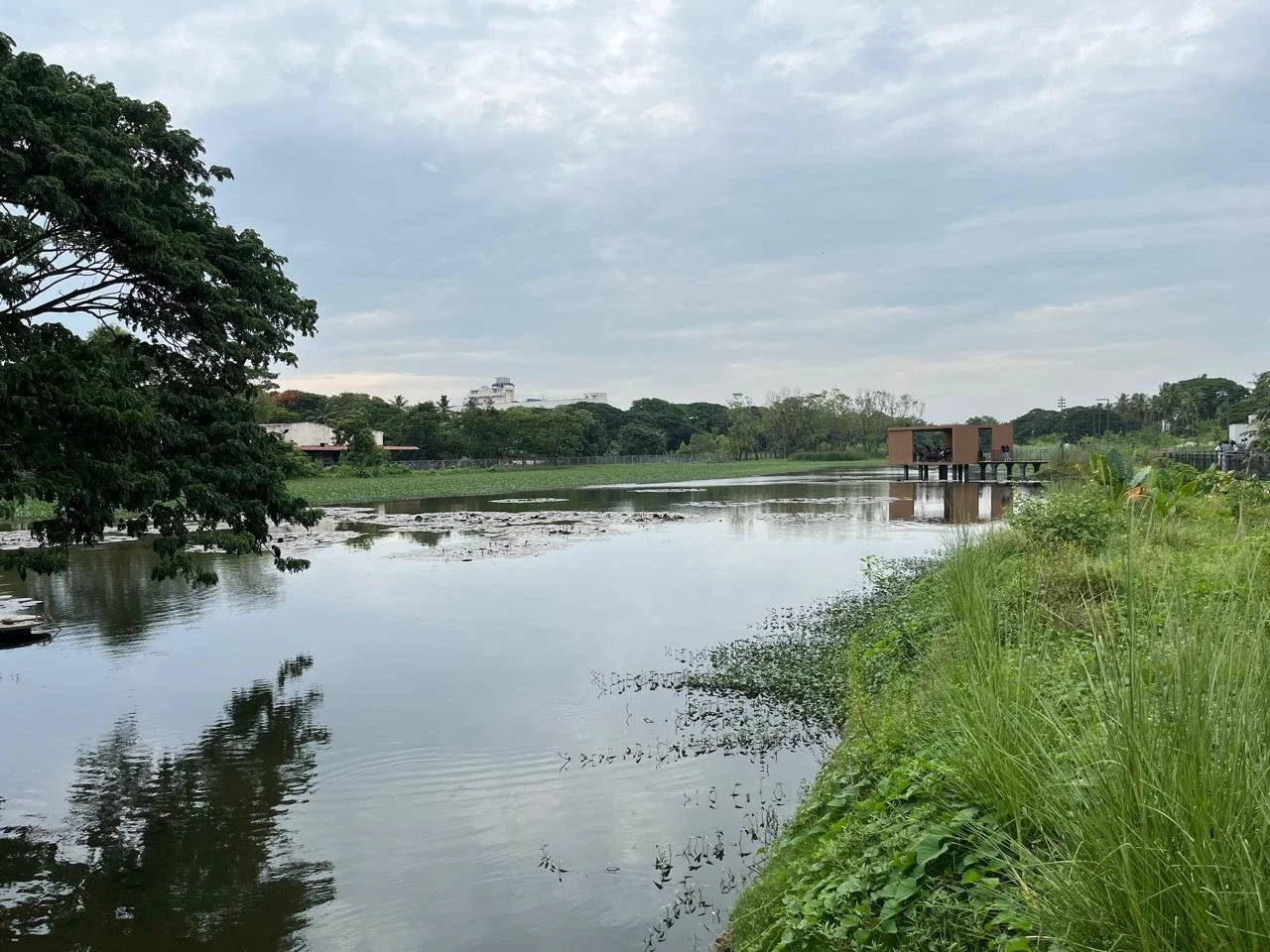
The large retention pond. Photo: ICLEI South Asia.
Environmental policy can yield long term benefits for all. Chennai has the “Open Space Reserved” policy which requires that any developments over 10,000 square meters have 10 per cent of the land be used as green space. That's how the Dr. M.S. Swaminathan Wetland Eco Park, allocated by Ramachandra University, was created. This 7-hectare was originally a wetland that led to a local lake. However, it was paved over to create a parking lot that lasted for decades. Now, it has become a nature-based solution to heavy rainfall. The stormwater goes through several sequences. First, a bioswale slows it down, then, a sedimentation pond, an aeration pond hosting plants that oxygenate the water, and finally a 30,000 liter retention basin that eventually recharges the groundwater underneath.
The impact of the park has been great. Biodiversity has increased with birds returning to the park. It’s become a community space rather than a space for cars. Chennai now has over 63 sponge parks built, with this being the most complex system.
Advertisement
Sponge City Benefits
Unlike traditional grey infrastructure which provides limited benefits, sponge city approaches have demonstrated multiple positive outcomes. Research on the impact of sponge cities have been shown to achieve the following:
recharge ground water
adapt to disaster/change
environmental restoration
less reliance on municipal pipelines
improve ecology of city
water purification through plants
prevention of sewer overflow
reduce stormwater runoff
flood mitigation
provide ecosystem services
interconnection/communication between cities
Conclusion
Sponge cities and related projects exist all over the world. With the effects of climate change increasing across the globe, extreme rainfall events are only going to get worse. The goal of these policies and programs is to create solutions that align with what nature has already provided. To restore land in natural ways that works alongside urbanization. China shows that a national policy is possible and can result in beautiful parks that manage stormwater during extreme rainfall events. Chennai sponge city projects demonstrate how local policy can lead to increased biodiversity, better communities, and stormwater management. Stormwater management can’t be solved with just grey infrastructure alone, nature-based solutions have to be implemented as long term solutions.
Advertisement
Rushil Malik is the Communications Manager for GRHC.