How Green Roofs Impact Vancouver’s Updated Rainwater Criteria
Advertisement
Introduction
As Vancouver continues to densify, managing rainwater effectively has become a priority. Creating new development in the City of Vancouver nearly always involves the re-development of older buildings. This often results in a significant densification of the existing land use, replacing a block of single-family homes with mid-rise apartment buildings containing hundreds of units, for example. This trend has also spread beyond downtown in recent years. For example, the construction of the Canada Line for the 2010 Olympics was later followed by the City’s Cambie Corridor Plan that is facilitating new mid- and high-density developments along this rapid transit route. Though providing much-needed housing to the City, this transformation also creates challenges with managing the excess stormwater runoff and sanitary flow to City sewer systems.
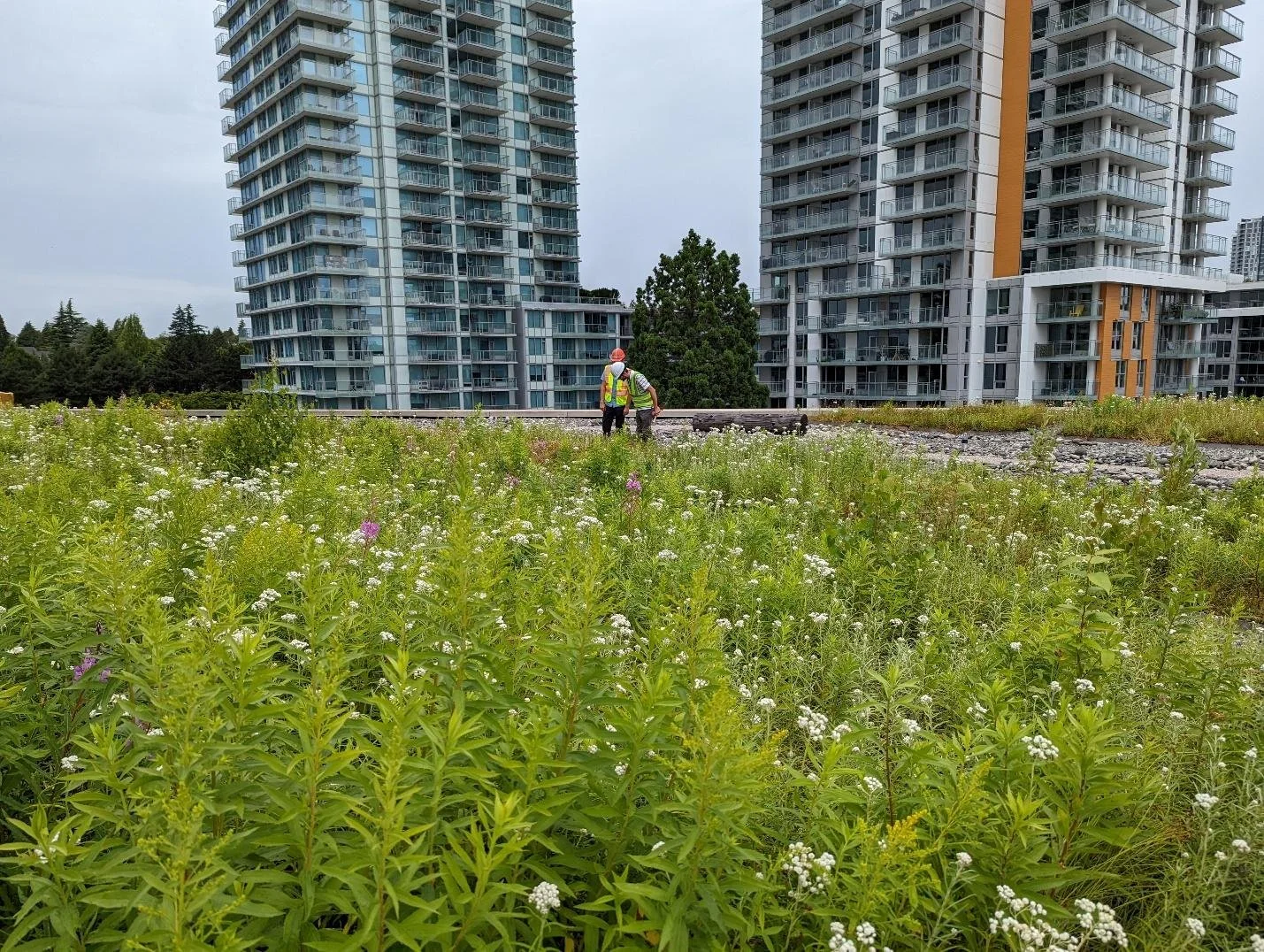
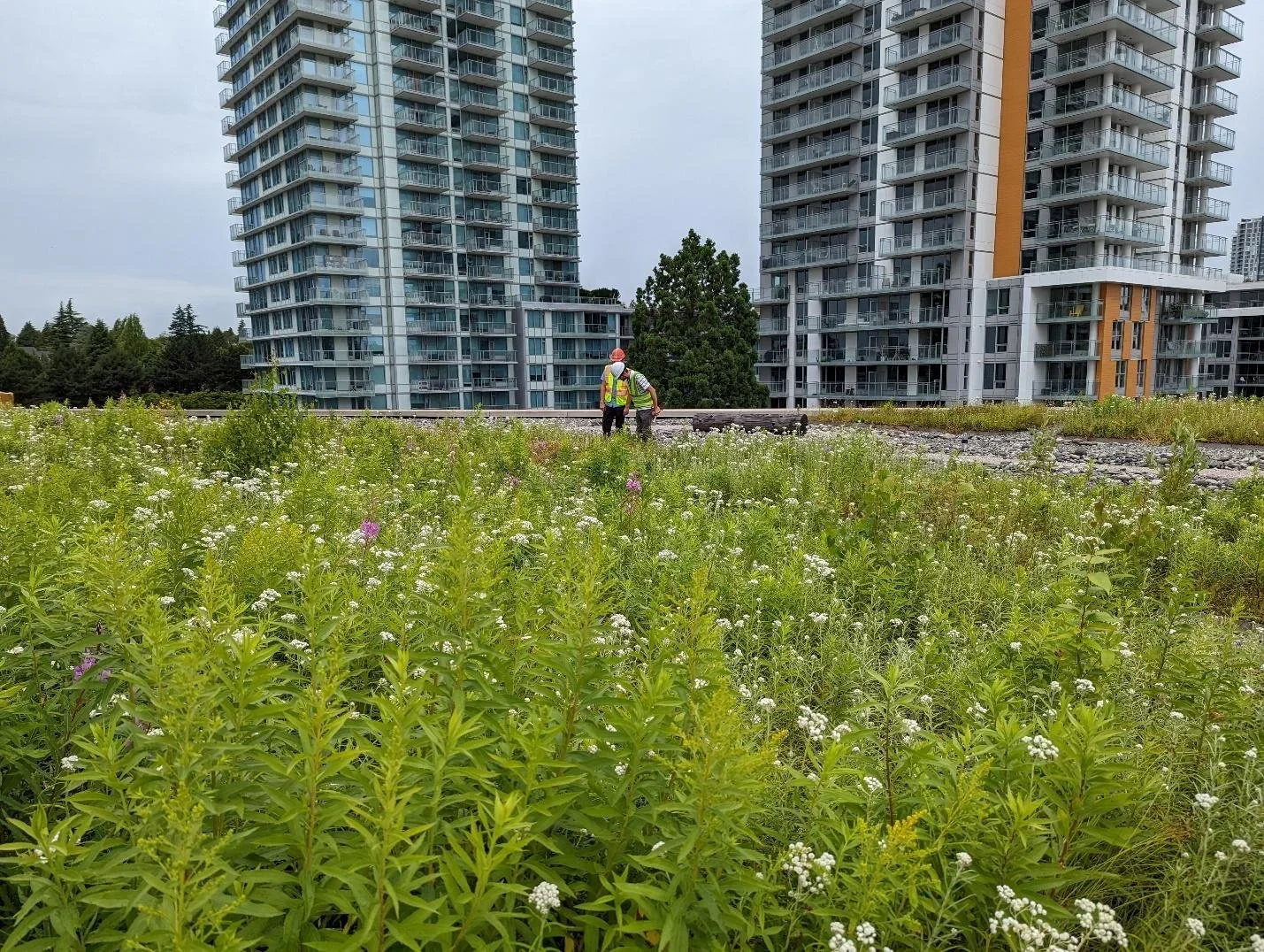
Staff inspecting a green roof outside a City of Vancouver office. Photo: Jamie Huang
Drainage System Challenges
Many areas being reimagined as dense urban landscapes were originally zoned and historically planned for low-density land uses, with the sewer and drainage infrastructure to support this. Most of Vancouver’s sewer systems were therefore constructed in previous decades and were not designed with capacity for either the current level of re-development or anticipated climate-change driven changes in rainfall patterns in mind.
Because many of Vancouver’s sewer systems are combined, rainfall runoff and sanitary sewage share the same pipes – something that the City has been actively working to eliminate since the 1970s through sewer upgrades and green infrastructure projects. However, this leads to frequent combined sewer overflows during rainfall events, when sewers bypass downstream wastewater treatment when system capacity is exceeded.
This combination of factors creates challenges of having more flow than the receiving sewer pipes can handle.
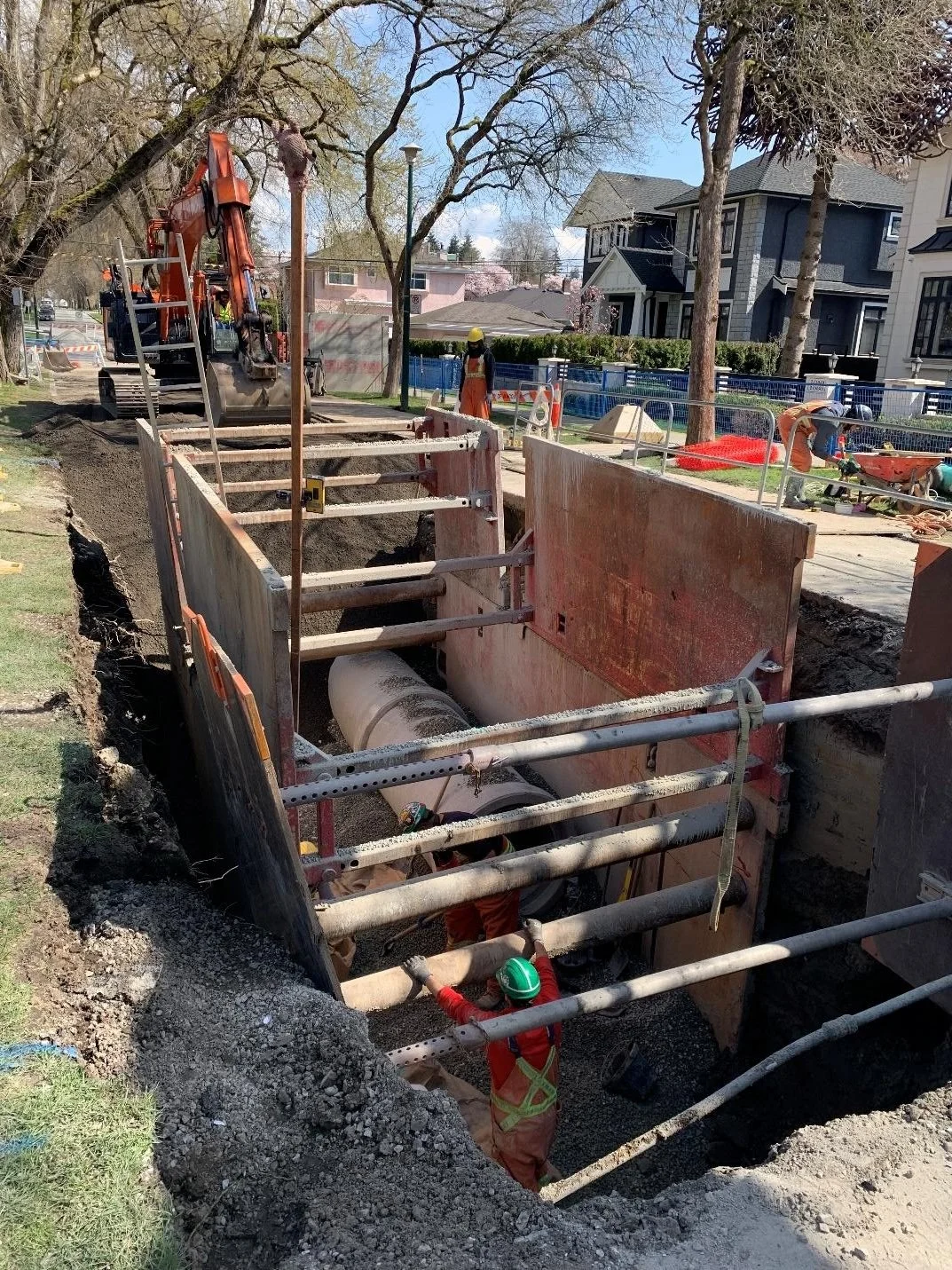
Sewer upgrade under construction in a residential neighbourhood in Vancouver. Photo: Maggie Sheu
The previous approach to dealing with increased flows to the sewer was to apply costly sewer upgrade conditions to many new developments to help convey the excess water resulting from re-development. This resulted in an often unpredictable and expensive process for developers looking to build much-needed new housing in the city.
Rainwater Management Solutions
As new developments in Vancouver are often quite dense, space is at a premium, which limits options for rainwater management. A lack of space for rainfall infiltration requires developments to consider alternate approaches for storing and controlling rainwater.
Recognizing these challenges, the City recently updated the rainwater management policy for high-density sites. The new criteria are more optimized to the needs of the drainage system and are performance-based, leaving it to a developer’s engineers to determine the best combination of rainwater management strategies given site-specific constraints.
The City’s criteria for rainwater management for new development are included in the Vancouver Building By-law, the local building code, along with other building performance criteria. The recent update significantly reduces the allowable rate of rainfall runoff for new high-density buildings to 25 litres per second per hectare of site area in the design storm event. This standardized flow target was determined based on modelling of the sewer system by the City’s Sewers and Drainage Planning team in recent years that has resulted in a better understanding of available sewer capacity.
In coordination with the ongoing Healthy Waters Plan, support for combined sewer overflow mitigation was also incorporated in the recent criteria update. This included an additional criterion that small, frequent rainfall events be controlled to a much lower release rate (5 litres per second per hectare) to slow down the rate of runoff to the point that it reduces the potential for combined sewers to overflow to receiving water bodies. Vegetated areas such as green roofs may also be considered to address the low-flow release rate requirement for small rainfall events, where water is primarily retained in the green roof vegetation and growing media.
Advertisement
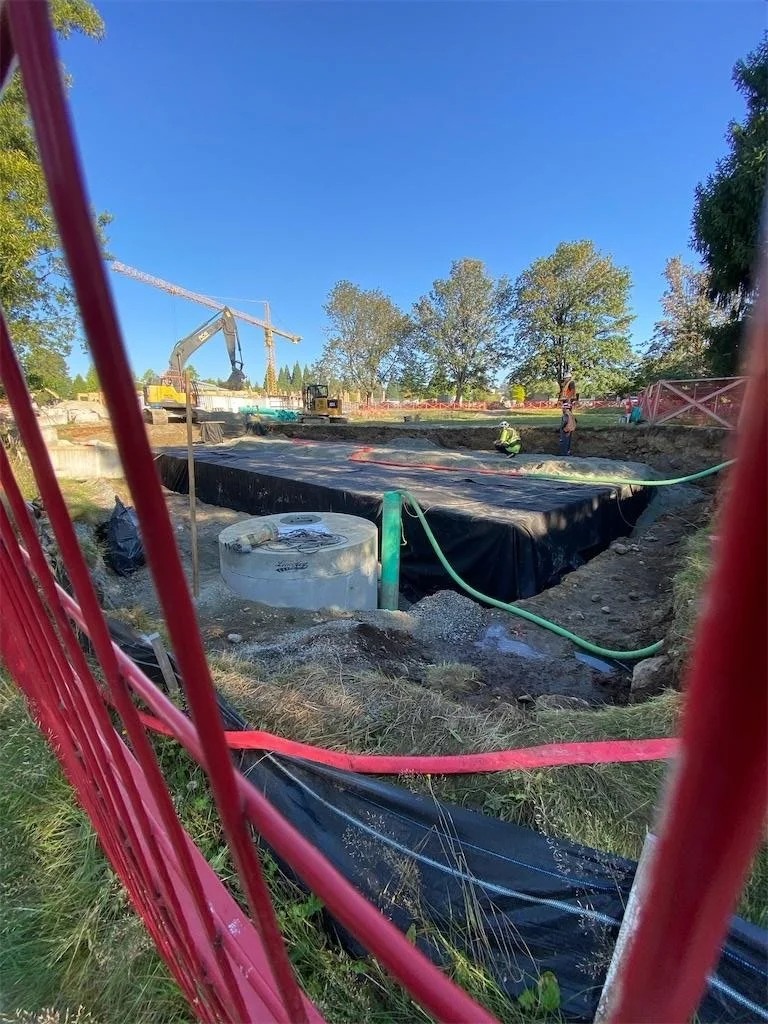
Rainwater detention tank under construction at the City of Vancouver's Marpole Community Centre. Photo: Anthony Leung, Development, Buildings and Licensing
Underground detention tanks are commonly used to address the City’s flow control requirements, but are frequently used alongside green roofs, blue-green roofs, or other landscaped systems. These green expressions can reduce the size of the required detention storage by limiting the rate of uncontrolled runoff from a site and thereby contributing towards meeting the updated flow targets.
To illustrate this, applying the updated rainwater management criteria to a past 0.28-hectare development with a green roof area covering most of the building would require a detention tank volume of approximately 31 cubic metres. By comparison, removing all rooftop landscaping would increase the detention tank size to approximately 107 cubic metres – over three times the volume and likely occupying space that could otherwise be dedicated to underground parking.
The increased presence of landscaped areas such as green roofs on new development also promotes the retention of water that would otherwise run off. This is a benefit that helps to reduce the quantity of combined sewer overflows occurring further downstream, therefore helping to support improved water quality in receiving water bodies.
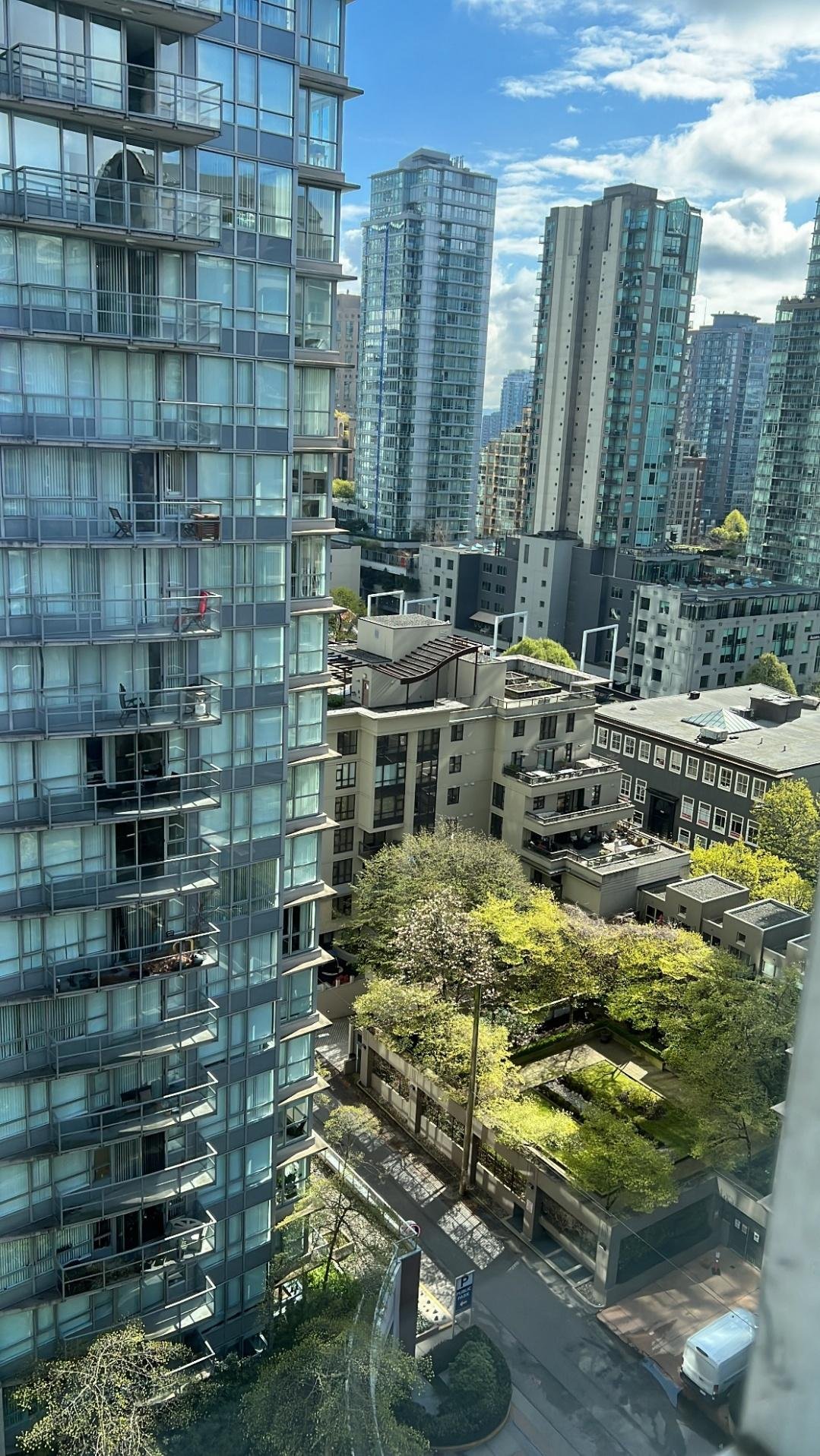
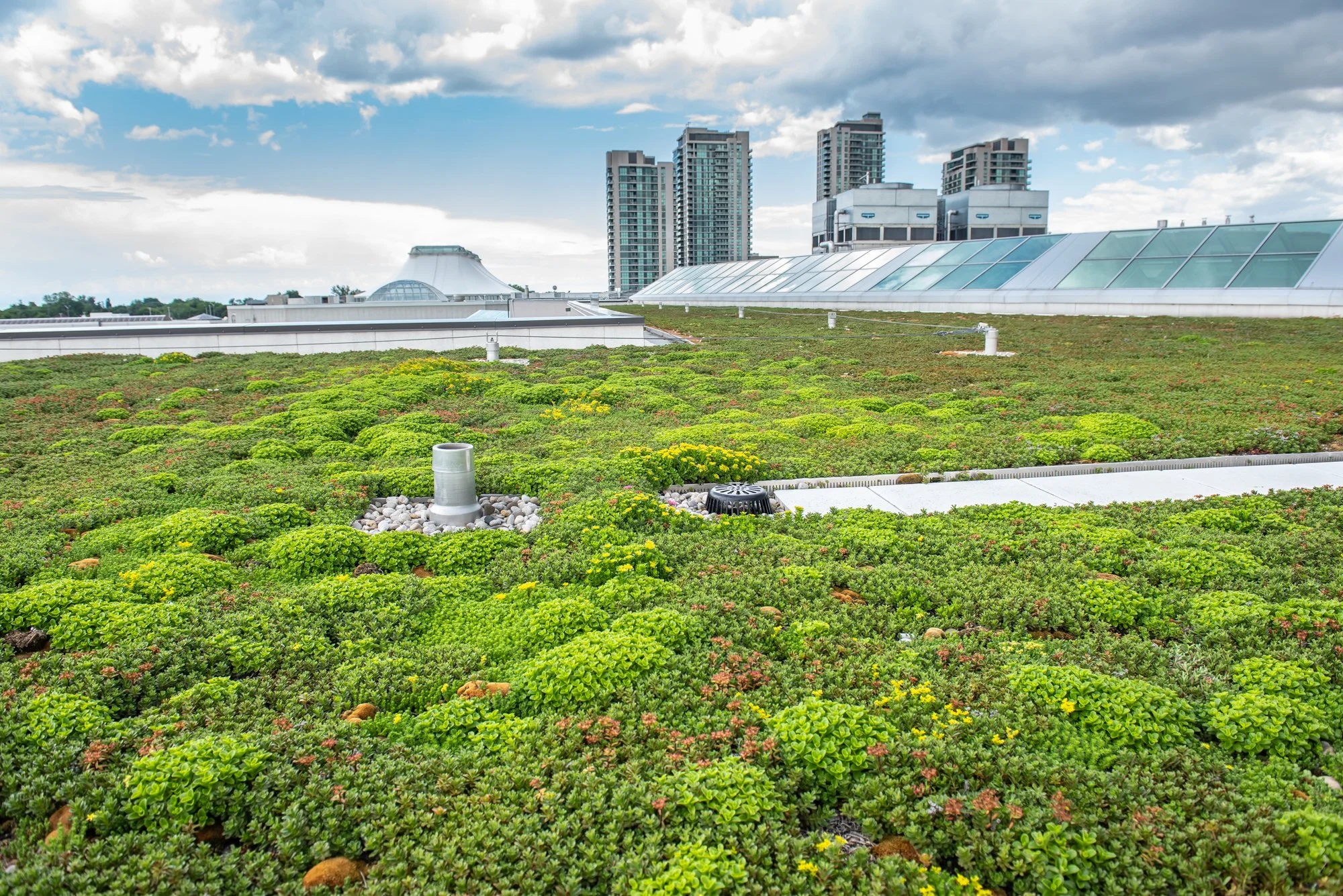
View of green roofs from a high-rise building in downtown Vancouver. Photo: Angela Steward
Based on a City rainwater management database of over 200 higher-density development applications from the past several years, nearly 40 per cent of files that completed the rainwater management review process included a green roof, and increasing to over 70 per cent when smaller rooftop planters are included. As developments in Vancouver often include underground parking, over 90 per cent of these sites included some type of landscaping over the building structure at ground-level or above. These statistics show how landscaping on buildings is commonly used in Vancouver to optimize the limited available space.
Though not drivers of rainwater management policy, green roofs also provide several other secondary co-benefits, one of which is providing access to nature for residents of high-rise buildings. This is commonly experienced through views of green roof areas on building podiums and rooftop community garden spaces that are popular building amenities on new developments in Vancouver.
The additional vegetation and evapotranspiration, increased insulation, and reduced absorption of heat that green roofs support can also help to moderate urban heat island effects experienced during summer and provide habitat for urban wildlife such as birds and insects.
The City’s Building By-law also regulates minimum construction requirements for buildings in Vancouver and allows (but not requires) the use of green roofs on buildings where specified requirements are met. These include meeting applicable standards for structural loading (ASTM E 2397/E 2397M), waterproofing, fire resistance (ANSI/SPRI VF-1 2023) and wind resistance (CSA-A123.24) that can be found along with other minimum roof construction requirements in Book I of the Vancouver Building By-law.
Advertisement
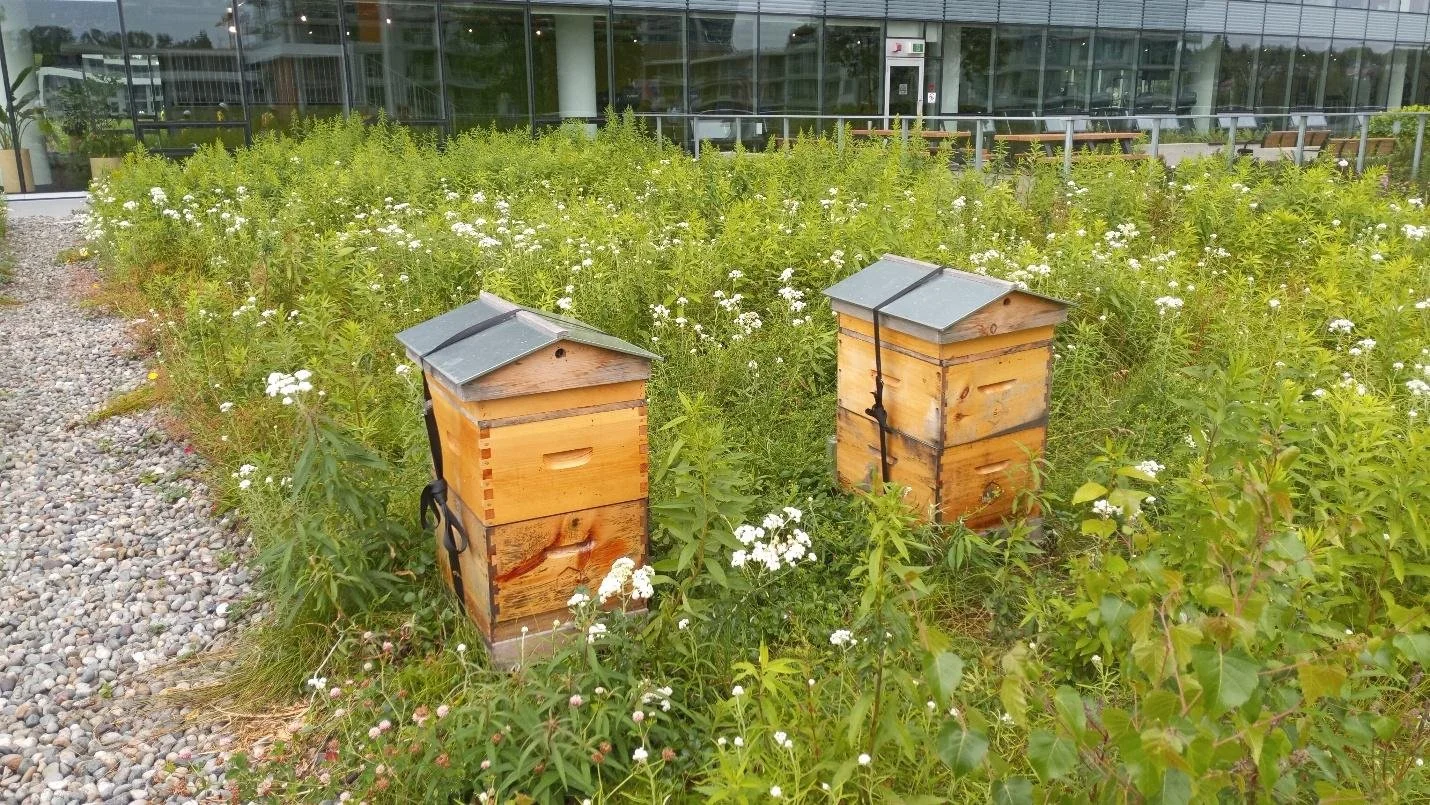
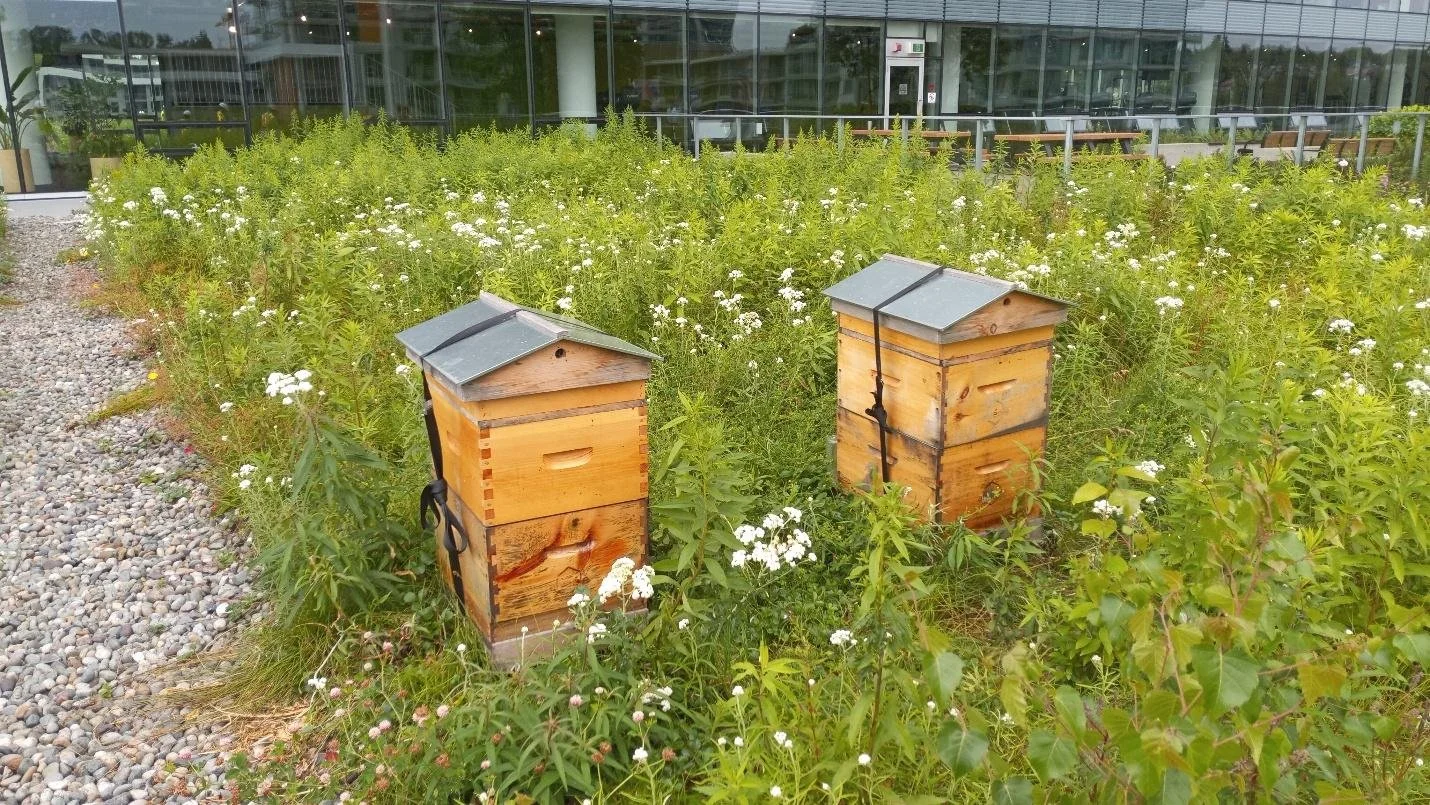
Beehives on a green roof in Vancouver. Photo: Peter Alm
Sewer Upgrade Process Improvements
As a result of this rainwater management policy change, the planned lifespan of existing sewer infrastructure can be realized by greatly reducing the need to upgrade sewers that are in otherwise good condition to support new development. Many new developments therefore no longer require sewer capacity upgrades, a change that has already saved tens of millions of dollars in upgrade costs. This change is estimated to save developments (excluding major sites) approximately 85 per cent on sewer upgrade costs on average compared to the previous process, though some will still require upgrades to prevent downstream impacts.

Beehives on a green roof in Vancouver. Photo: Peter Alm
The City continues to upgrade aging sewer infrastructure as a part of the capital plan dedicated to maintaining and renewing aging amenities and infrastructure to support population and employment growth.
Any increase in the cost of on-site rainwater management resulting from the updated criteria is typically anticipated to be outweighed by avoided off-site sewer upgrades, which can otherwise cost hundreds of thousands or even millions of dollars to support a single infill development.
This improvement in cost predictability for development was key to gaining the support of the development industry for the update. Reducing the rate of runoff from the site also provides benefits to the entire downstream drainage system, whereas local sewer upgrades have a limited extent of benefit.
Conclusion
The City of Vancouver faces a number of ongoing challenges related to urban intensification, aging sewer infrastructure, water quality and combined sewer overflows, anticipated future changes to rainfall patterns, and development constraints. The City’s recently updated rainwater management criteria attempt to provide a balanced and practical approach to address these issues, and green roofs can provide a significant contribution towards the new targets.
Advertisement
Peter Alm, P.Eng., is a Senior Rainwater Management Engineer in the Sewers & Drainage Planning division at the City of Vancouver, British Columbia, where he has supported City-wide implementation of on-site rainwater management policy since 2021. He has over 15 years of experience related to stormwater management and water resources engineering, including the design and review of stormwater management systems to support new development. He was a key Engineering department representative involved in supporting the recently implemented update to rainwater management requirements at the City of Vancouver.