Blue, Blue-Green, and Friction Based Approaches to Stormwater Detention
Advertisement
Introduction
In order to optimize stormwater management, different green roof design features should be chosen that are most compatible with the climate in which they are situated and that meet the stormwater regulations. In this context, engineers will consider features that improve not only stormwater retention, i.e. capturing the water on site, but also for detention, i.e. delaying runoff, usually between 24-72 hours. New roof designs such as blue-green roofs and friction storage systems include features that can provide more retention and detention capacity saving developers money on the costs or lost opportunity of traditional approaches like underground storage tanks.
Extensive green roofs are typically designed to retain the majority of the annual rain events, and can usually manage about 55-65 per cent of the rainfall in most Midwest and North East US markets. They address the small and medium storms, and stormwater regulators call them Water Quality Tools. The 35-45 per cent of annual rain volume these green roofs can’t retain effectively, are usually from the massive storms, and or multi-day storms where rain falls the subsequent day on an already ‘saturated’ green roof system from yesterday’s storm. This additional rainfall needs to be detained, and this is done to protect our streams and rivers from erosion and to help reduce flooding.
Blue Roof Systems
In their simplest form, blue roofs are basic water storage systems that hold water above a perfectly sealed waterproof roof membrane over a flat or slightly sloped roof. This water can be detained and slowly released through a weir or some sort of check dam upstream or integrated with a flow control drain. Flow control drains can be set to control outflow to meet municipal release rates. A major advantage of these systems is that more water can be held compared to a standard extensive green roof. However basic blue roofs alone, cannot provide the same ecosystem services, such as transpiration or habitat provisioning, that extensive green roofs are known for.
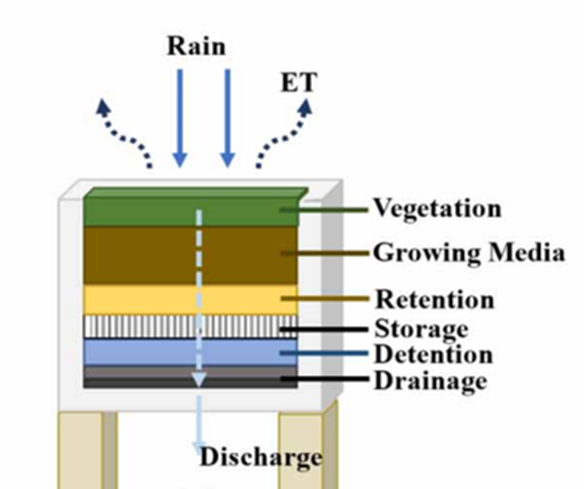
Figure 1a. Basic schematic of blue green roof whereby storage and detention layers represent rockwool or fleece layers over a reservoir. Photo: Frizzi et al 2025
Blue-Green Roof Systems
Of course, a water-storing blue roof reservoir can also be implemented as part of a green roof system. This “blue-green” system couples the benefits of water storage with living systems that can utilize water to carry out different functions such as the transpiration of plants. In these configurations the green roof layer is often connected to the void space below with fibrous material such as mineral wool or fleece (Frizzi and Drake, Figure 1a). Sometimes the void space is replaced with mineral wool to create what has been called a “sponge roof.” A study published in the Journal of Living Architecture in 2022 found that adding a water reservoir under a green roof system improved retention by 29-38 per cent compared to the same systems without the reservoir (Figure 1b). This research took place in Michigan from March to November; more work is needed to understand how this comparison might function in the winter months.
Advertisement
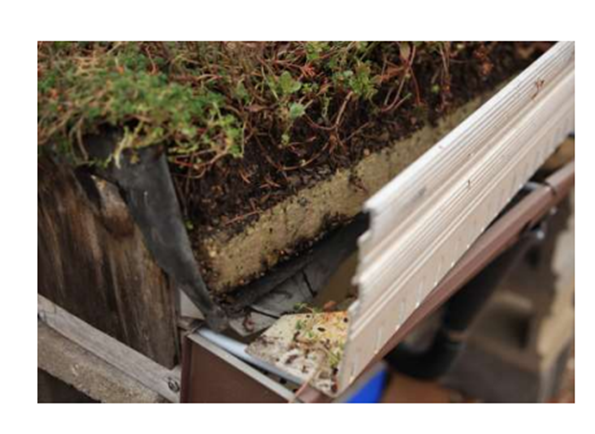
Figure 1b. Substrate and rockwool From: Rowe and Getter in JLIV 2022
Friction Storage Systems
Friction storage systems integrate plastic honeycomb layers below mineral wool as a storage layer (Figure 2a) and replace the free drainage layer with a detention layer that uses friction to dramatically slow the movement of water. The detention layer generates so much outflow ‘friction’ that water coming in from above cannot escape the detention layer quick enough so it backs up and fills the honeycomb tubes. This is even the case for sloped roofs. Alim et al. (2023) compared this system to a traditional green roof system in Perth Australia for one year and noted median runoff volume reductions of 10 per cent for extremely large storms (>50mm) and 55 per cent for medium-sized storms (25-50mm). Compared to the traditional green roof system, the friction storage system also delayed runoff hours longer.
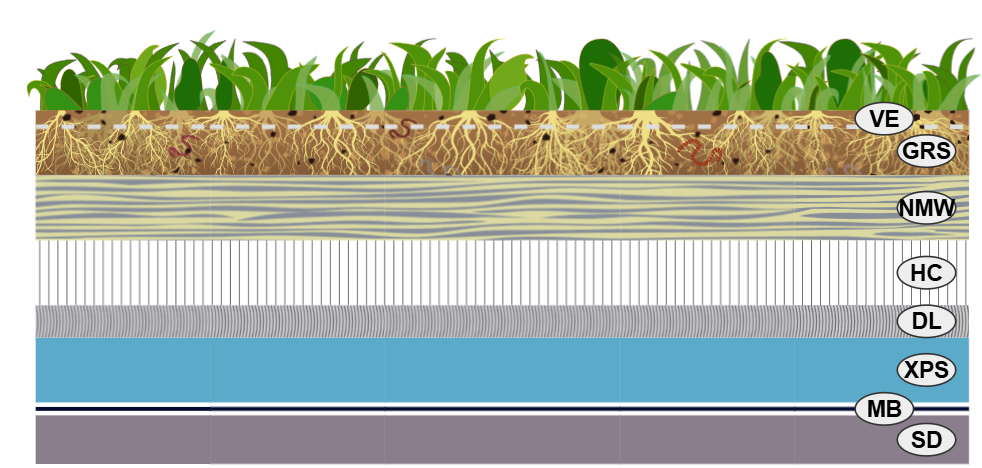
Figure 2a: Friction storage system, VE is vegetation, GRS is green roof substrate, NMW is needled mineral wool, HC is honeycomb, DL is detention layer, XPS is extruded polystyrene insulation, MB is waterproofing membrane, and SD is structural deck. Photo: sempergreen
The SNF Agora Institute at Johns Hopkins University in Baltimore, Maryland incorporates not only a friction storage system, but also a blue roof augmented with mineral wool. Designed by Renzo Piano (Figure 2b), the friction storage system utilizes 1 inch of mineral wool and 4 inches of honeycomb layer under 6.5 inches of substrate. Modeling results suggest that, for an 8 inch rainfall event over 24 hours, i.e. the 100 year design storm in Baltimore, this roof can achieve a 96 per cent peak flow reduction and over 100 minutes of peak delay.
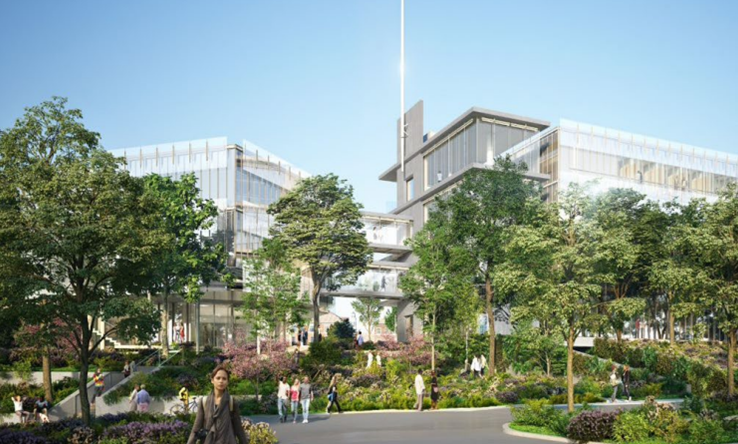
Figure 2b: SNF Agora Institute at Johns Hopkins University, Baltimore MD. Photo: purple-roof.com
Green roof systems that incorporate water storage mats and reservoirs hold a lot of promise for innovative stormwater management. Like any system, there are advantages and disadvantages found in different approaches. More work is needed to understand how the mineral wool or fleece layering affects plant roots and how they function on a seasonal basis. A study in Canada (Frizzi and Drake 2025) showed that the additional storage provided by the mats did not reduce runoff in winter. This would be the case for any system, of course, in which winter rain volume is higher than evapotranspiration.
Conclusion
In summary, stormwater management is a tangible, measurable benefit that supports decision making in favor of green roof systems. Reducing stormwater through retention and detention can convey significant space savings that is worth the extra cost. The green roof industry is working on enhancing retention and getting more stormwater detention in order to provide more stormwater management per square foot. These new designs include adding fibrous material under the substrate layer, water storage reservoirs and friction based systems. There are numerous examples of these systems already being implemented, and their performance continues to be documented. The utility of these systems is dependent on climate and their position in the larger stormwater treatment network.
Advertisement
Dr. Starry directs the Sustainable Technology and the Built Environment Program at Bucknell University, where she explores how green infrastructure influences ecological, social, and health outcomes. Olyssa has also co-authored a green roof activity book for children (Growing Up in the City). She previously taught urban ecology at Portland State University and was an active member of the Greenroof Info Thinktank (GRiT). She currently chairs the Regional Centers of Excellence (RACE) committee for Green Roofs for Healthy Cities.
References
Alim, M. Jahan, S. Rahman, A., Rahman, M., Liebman, M., Garner, B., Griffith, R., Griffith, M., and Tao, Z. 2023. Experimental investigation of a multilayer detention roof for stormwater management. Journal of Cleaner Production. 395: 136493.
Frizzi, G. and Drake, J. 2025. Hydrologic impacts of mat-based retention and detention layers within extensive vegetated roof assemblies. Blue-green systems 7(1) 156 doi: 10.2166/bgs.2025.004
Rowe, B.D. And K. L. Getter. 2022. Improving stormwater retention on green roofs. Journal of Living Architecture 9:1 (20-36).