Green Roof Energy Calculator Is Over Ten Years Old and Needs Some Investment
Advertisement
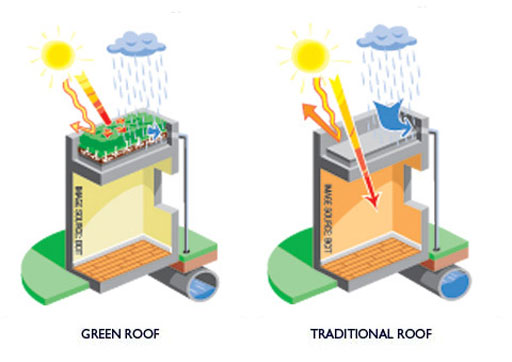
Energy Flows between green and traditional roof. Photo: BCIT
Introduction
In the early days of the North American green roof industry it is was a bit like the wild west! Lots of performance claims were being made with little evidence to back them up, such as green roofs will reduce your energy bills by 50 per cent or green roofs don’t require maintenance. Dr. David Sailor, then a professor at Portland State University applied for funding with Dr. Brad Bass, a University of Toronto scientist after they hatched a plan during the Baltimore Orioles reception at the Baltimore CITIESALIVE in 2008. With support from Green Roofs for Healthy Cities, Dr. Bass and Dr. Sailor asked for financial support from the US Green Building Council to build an online Green Roof Energy Calculator. They were successful and in 2011, after lots of analysis using two different energy models and discussion, the web-enabled Green Roof Energy Calculator was launched. Up until then, obtaining an estimate of the potential for energy savings from a green roof required a lot of modeling expertise as well as significant investment of time and money.
“At the time, the industry had no capacity to determine the energy benefits of green roofs without expensive and technical modelling. The free online Green Roof Energy Calculator provided answers to this question for many architects, landscape architects and engineers in the industry, with only very basic information,” said Dr. Brad Bass.
The purpose of the Energy Calculator was to provide a quick comparison of energy consumption for heating and cooling in different climates across North America. The user can compare office or residential buildings with green, dark and even white roofs. “At the time we wanted to give people something quick to look at for completing applications or answering quick questions” remarked Dr. Bass.
Users only need to select a building type, put in the area of their green roof, the depth of the growing media, what province and city it is located in (100 cities are included), degree of vegetation coverage (Leaf Area Index) and whether or not it is irrigated to obtain results. The data for each of these combinations is already calculated so it can be easily retrieved online. This includes a comparison to dark and white roofs, as well as a rough estimate of the water retention. Data on energy costs is now outdated from 2010, but you can customize this with more recent values.
Advertisement
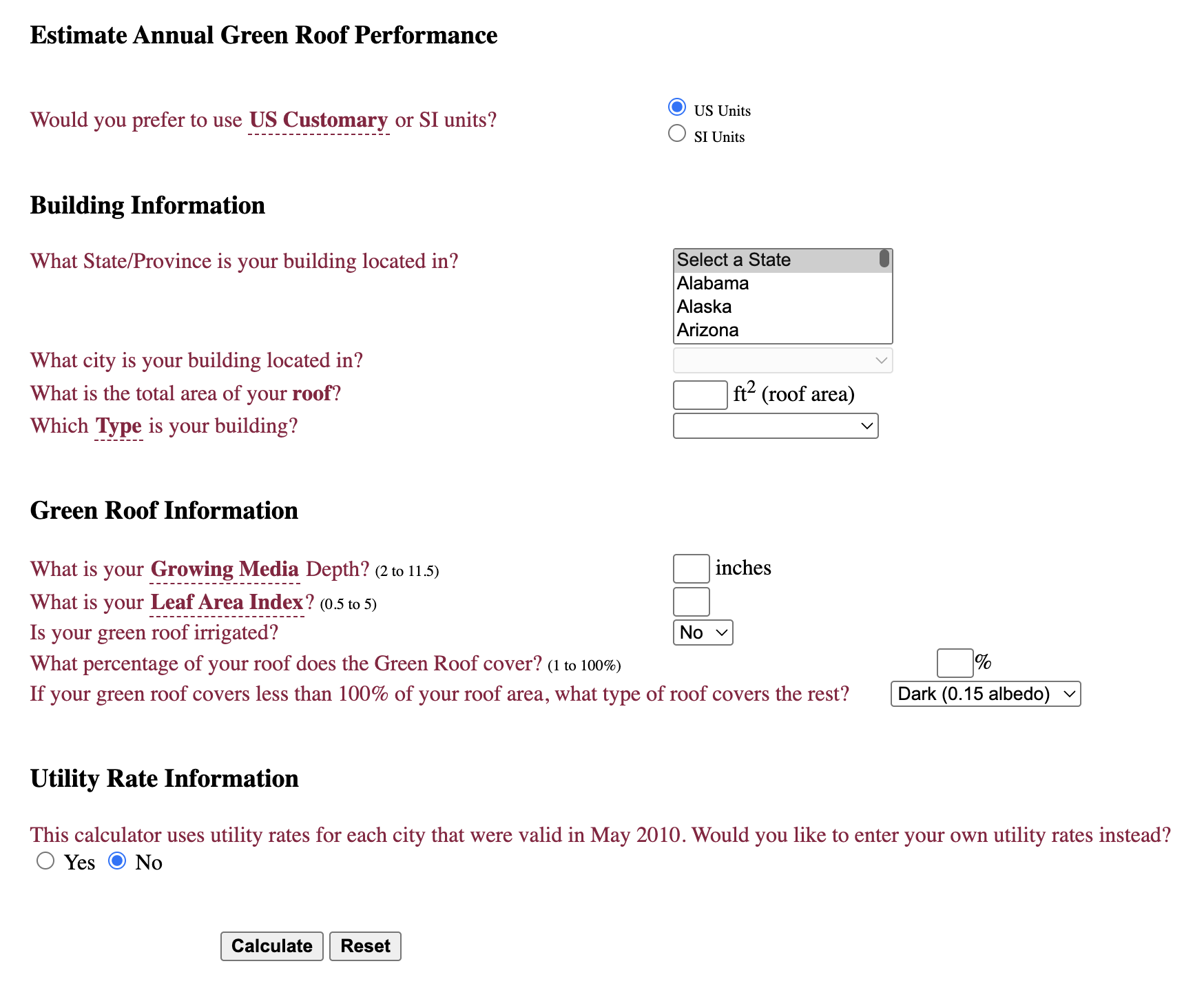
The Energy Calculator at work. Click here to access it.
The Energy Calculator isn’t customizable to a variety of building types and the results tend towards the conservative side of the spectrum. They ran the energy savings numbers using a 4-story apartment building and a 3-story office building, both of which were default settings in the EnergyPlus software they used. When the building code changed, requiring greater rooftop insulation, this had an impact on the results. To factor that in, there is a new construction (ASHRAE 90.1-2004) and old construction (pre-ASHRAE 90.1-2004) setting in the calculator you can choose.
“My only regret is that we didn’t have more resources to model other types of buildings. The Energy Calculator does provide a pretty good ball park energy savings figure for the buildings it covers, across two different ASHRAE standards and it doesn’t require significant technical expertise, like modelling software esp-R and EnergyPlus” said Dr. Brad Bass. “By combining the results from the two models the Energy Calculator is accurate in the range of plus or minus 20 per cent” he added.
“If I had more resources, I would modernize and extend the building types and vintages, including adding the option for the user to specify building characteristics in more detail (roof construction, insulation levels, etc). I would also use updated typical meteorological year data, allow more detailed characterization of irrigation schedules (frequency and quantity), and consider the option of adding typical meteorological year under climate change,” said Dr. David Sailor, Arizona State University.
The Calculator would definitely benefit from additional resources, but it is also important to note that it has other limitations. It doesn’t for example, calculate the energy savings from pre-cooling the intake air in air conditioning units which can be substantial. It doesn’t have a way to measure the ability of green roofs to cool the ambient temperatures around the building and contribute to a reduction in the urban heat island effect. But as a quick tool, to help quantify potential energy savings for many projects, it provides important data.
Conclusion
Unlike high efficiency lighting systems for example, Green Roof Energy Benefits as demonstrated by the Energy Calculator are typically insufficient in and of themselves to generate a reasonable return on investment. However green roofs do provide climate mitigation benefits through the building envelope, when integrated with air conditioning units, and by cooling the surrounding area through evapotranspiration. When all of the many benefits are factored in, green roofs make tremendous sense for public and private investment due to their multitude of performance characteristics many of which also help us address the extreme weather caused by the climate crisis.
Advertisement
Steven W. Peck, GRP, GRIMP, Honorary ASLA, is the editor of the Living Architecture Monitor and has worked from more than twenty-five years to build the green roof and wall industry in North America and around the world and participated in the development of the Green Roof Energy Calcultor.
For More Information
The Green Roof Energy Calculator currently resides in Arizona State University web site, moving from Portland State University when Dr. David Sailor took up residence in Arizona.
https://ucrc.asu.edu/green-roof-energy-calculator. For more information contact: Brad Bass, Status Professor, University of Toronto, School of the Environment. Brad.bass@utoronto.ca.