Before Green Roofs, There Were Ant Hills
Advertisement
Introduction
Kneel at the edge of an old meadow and look closely at the grass, and you'll find something easy to walk past: a small mound, built by thousands of ants working without a blueprint. We measure architectural ambition by height, towers, cathedrals, the roofs we now dress in greenery. Some of the oldest engineering on Earth happens below knee height, done by insects with no eyes to speak of.
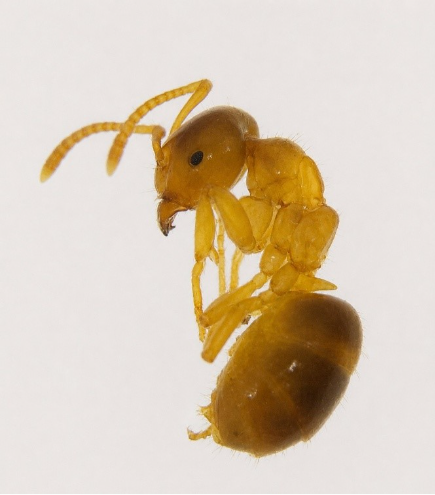
A yellow meadow ant, Lasius flavus, the mound-builder at the centre of this piece. Photo: Johnnie Johnson.
Green roofs, living walls, biophilic cities: we talk about these as though pairing architecture with living tissue were a modern idea. It isn't. Ants had it first. The mound rising out of the turf is a nest built by a superorganism, a colony that functions as a single animal spread across ten thousand bodies, engineering the ground beneath us since before anyone laid a blade of turf on a roof.
It is easy to underestimate what is small. E. O. Wilson liked to point out that insects, not vertebrates, hold the terrestrial world together: strip the earth of its mammals and birds and life would stagger on; strip it of its insects, and the system would collapse. We rarely register ants as engineers because we rarely register them at all.
A mound is not a heap of dirt any more than a coral reef is a heap of stone. It is tissue, built of soil instead of calcium, a green roof already, engineered not by us but by life itself.
So here is the question worth asking: why do we spend so much effort designing biodiversity into our buildings, while flattening the biodiversity a colony of ants already spent decades building for free?
Advertisement
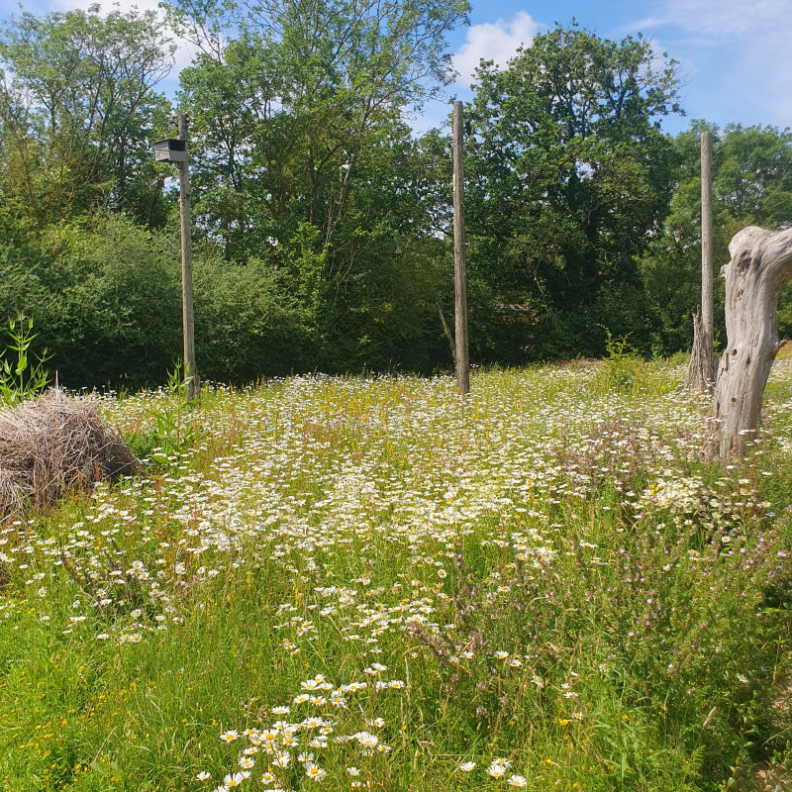
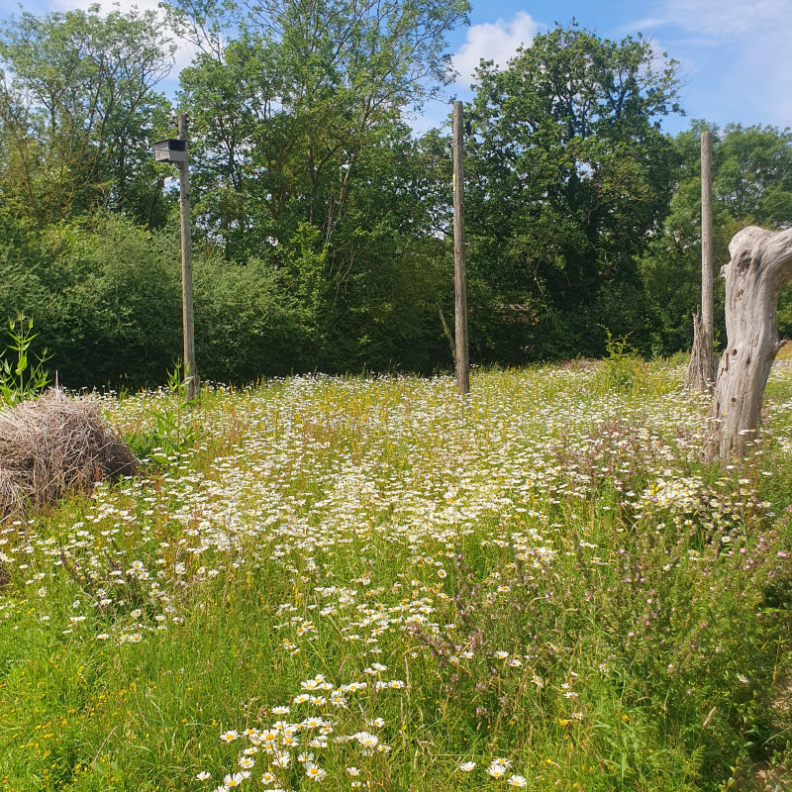
Wildflower grassland at Hilldrop Gardens, Essex, where the fieldwork for this piece was carried out. Photo: Johnnie Johnson.
Fieldword at Hilldrop
So I went looking for evidence closer to home. I surveyed Hilldrop Gardens in Essex, UK, with green-roof specialist John Little, as part of my University of Oxford Postgraduate Certificate in Ecological Survey Techniques (Johnson, 2026). Paired sampling compared mound quadrats with patches of neighbouring grassland a short distance from any ant mound, and the work revealed differences in the invertebrate communities associated with these two small-scale habitat conditions.
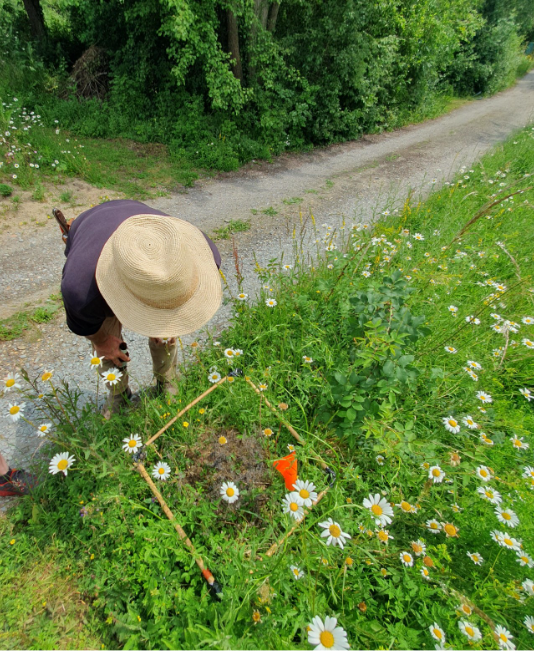
Paired quadrat sampling in progress: a bamboo quadrat marks a mound sample point against a control quadrat in the adjacent grassland. Photo: Johnnie Johnson.
The picture that emerged was not the tidy, more-is-better result a field biologist might hope for, but species counts alone are a crude instrument. The mound assemblage contained a notable range of invertebrates, reinforcing the impression that the mounds represented a distinct ecological component within the wider grassland. The mounds were not simply smaller versions of the surrounding meadow; they introduced different vegetation structure and disturbance into the same field.
The mound does not simply hold more species or fewer. Its importance lies in the different ecological conditions it creates within the wider grassland.
One study at one site cannot prove that ant mounds enrich biodiversity everywhere. But Hilldrop provides a useful case study of how these small structures can introduce ecological variety into a landscape that might otherwise sit at one more uniform pitch.
A Different Flora, A Different Season
That distinctiveness runs deeper than the invertebrates. The difference is not just who lives there. Mounds grow a different plant community, on a different clock. Long-term work shows mounds accumulate distinctive assemblages of grasses, forbs and mosses, set apart from the surrounding sward, persisting for decades and occasionally more than a century (King, 1977; Ehrle et al., 2017). Nest excavation brings nutrient-rich subsoil to the surface and raises the mound above the water table, favouring some plants and excluding others (Beattie & Culver, 1977).
South-facing slopes can also warm earlier, so a mound may shift the seasons in miniature. At Hilldrop, thermal imaging illustrated striking temperature differences between different aspects of the mounds. Research elsewhere has shown that ant mounds can extend the duration of plant phenological events and enhance flowering success (Hansen et al., 2023).
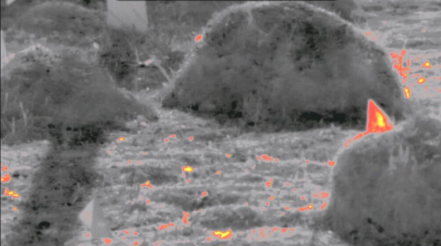
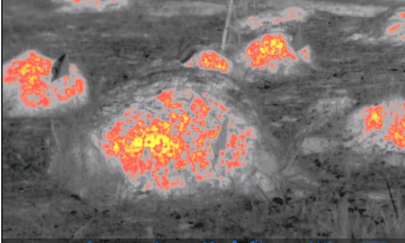
Paired thermal image of the north facing aspect (left picture) and one of the south facing aspect (right picture) of L.flavus mounds, illustrating temperature differences. Photo: Johnnie Johnson.
Advertisement
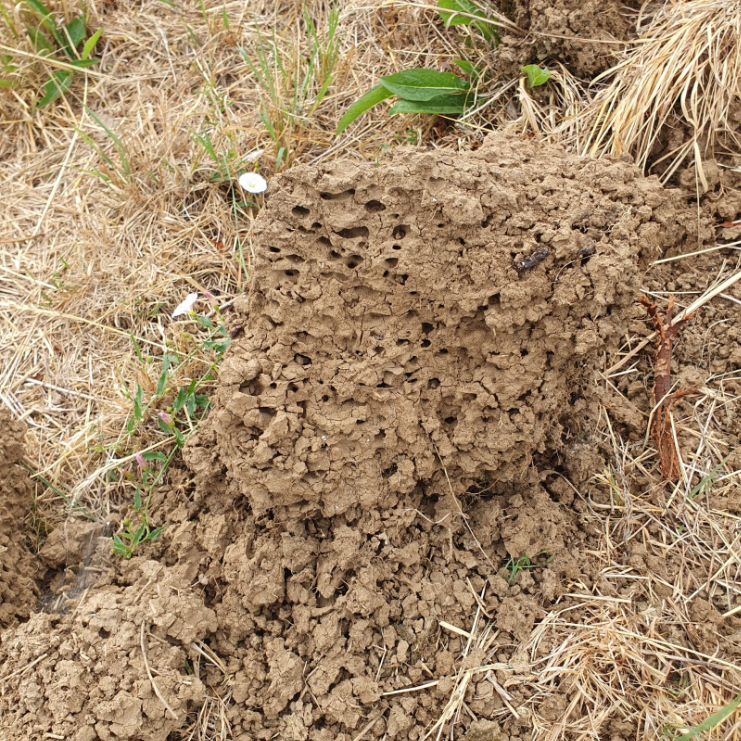
Inside an exposed Lasius flavus mound, the dense network of galleries and chambers reveals the architecture hidden beneath the grassland surface. Photo: Johnnie Johnson
The World Under Our Feet
The shifted seasons, the drier microclimate, the crowded, different assemblages: none of it is designed from above. Most of what a colony does happens where no human eye will fall on it. Ants earn our attention only when they cross the kitchen threshold or throw up a mound in the lawn, and our instinct is to reach for the spray.
But the mound is only the doorway. Underneath runs a city of galleries and chambers, built without drawings or a foreman, only tens of thousands of workers following rules simple enough to write on an index card, producing something that behaves, uncannily, like intelligence. Architecture with no architect.
This is exactly the trick green-roof design keeps trying, at cost, to fake, structural variation, a gradient of microclimates, niches in a small footprint. Yet so many roofs stay stubbornly flat. An ant colony won't tolerate that, its mounds break the level surface, catch the sun differently by slope, and diverge sharply from the ground a stride away, kept unfinished by ceaseless labour. That's the lesson worth stealing, a biodiverse landscape should never stay exactly as installed. Disturbance, change and chaos are all elements of life. Humans, for peace of mind, tend to prefer stability, a steady job, a routine, but nature, and progress, unfortunately do not.
What the Ants Are Actually Doing
Copying a mound's shape and bolting a decorative hump onto a roof misses the point, that is biomimicry as costume. The plainer question: what are the ants actually doing that generates ecological value?
They build microtopography into ground that was, before them, perfectly level.
They generate variation in soil moisture, temperature and compaction over centimetres.
They move seed and soil from one part of the ground to another.
They disturb vegetation, opening gaps for weaker, less competitive plants.
They interact constantly with seeds, plants and other invertebrates.
They maintain what they build without pause, rather than raising it once and leaving.
Translated into design terms: varied depth, slope and surface instead of one uniform substrate; pockets that hold moisture beside others baked dry; thick planting beside bare soil, stone, deadwood. To us, the result can look unfinished. To the creatures who might move in, it looks like an opportunity.
Advertisement
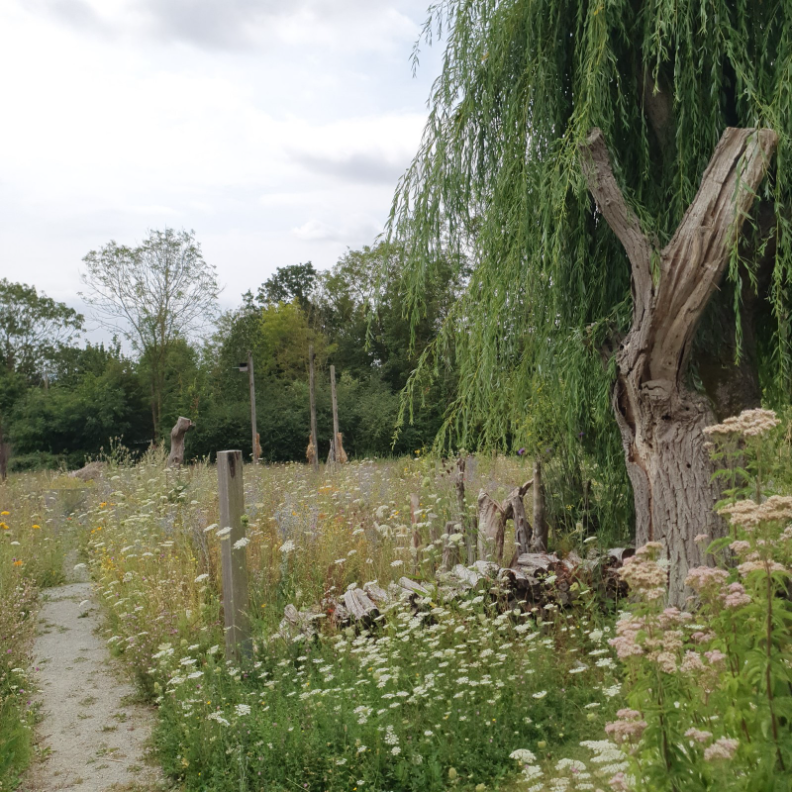
Deadwood, bare ground and dense flowering sward sit side by side at Hilldrop — the kind of engineered messiness this piece argues for. Photo: Johnnie Johnson
More Than Pests
Ants are among the most successful organisms the planet has produced, and we shrink our understanding of them down to the fact that they occasionally annoy us, poisoning them in the garden and leaving them out of habitat plans even in conservation circles.
But a colony is stitched into the landscape, shaping the plants, soil and microbial life, and its mound can become real estate for other species. At Hilldrop, slow worms and common lizards have been observed using active mounds, while the ant-associated woodlouse Platyarthrus hoffmannseggii is closely associated with ant nests. Lycaenid caterpillars go further, producing sugary secretions that can encourage attendance and defence by ants (Fiedler & Saam, 1995). The Hilldrop survey turned up its own share of notable species amid the mounds.
And ants are, in staggering quantity, food: Britain's Green Woodpecker feeds primarily on them (BTO, 2026), a badger will dig into nests for the reward inside, and North America's Northern Flicker has a diet composed mainly of ants collected at ground level (Wiebe & Gow, 2013). Take the ants out of a landscape and you have pulled a load-bearing wall out of the food web.
From Ant Hills to Green Roofs
If ants matter this much to the wider food web at ground level, the question becomes whether they can be persuaded to matter just as much several storeys up. A 2026 study surveyed ants across nine green roofs in Ohio and the ground beneath them (Walusis & Prather, 2026). Ant abundance and genus richness were lower on the roofs, but community composition overlapped substantially with ground level, suggesting green roofs can function as foraging habitat within a connected urban mosaic rather than as isolated islands. An earlier London survey similarly found rare invertebrates on green and brown roofs (Kadas, 2006). In the Ohio study, only one ant nest was found on a roof, while nests were regularly encountered at ground level; the authors also noted that roof substrates tended to be shallower, rockier and less densely packed.
The Ohio study also recorded workers scaling a 12.2 m building towards a green roof, providing striking evidence that ground-level colonies can exploit resources several storeys above them (Walusis & Prather, 2026). If ants will make that climb unassisted, a roof does not necessarily need to contain a nest to become part of an ant colony’s foraging landscape.
Workers climbing from below are only part of the story. Lasius flavus also produces winged reproductive queens and males that disperse during nuptial flights; after mating, queens can establish new colonies (Boomsma & Leusink, 1981; Waloff, 1957). A suitable green roof therefore need not be physically connected to an existing nest to be discovered. If the substrate and conditions are right, the ants have their own means of getting there.
Advertisement
What emerges from Hilldrop and Ohio alike is a rough brief for anyone designing green roofs, not a checklist of species to install, but the physical conditions ants themselves already select for. We don't need purpose-built ant condominiums, no manufactured "insect hotel" does the job a real mound does. What we need is ground where ants can build on their own terms:
varying substrate depth across a roof instead of one uniform specification
working in small banks, hummocks and south-facing slopes
leaving patches of sparse, exposed mineral substrate
scattering stone, deadwood and other thermal texture
allowing real transitions between short turf, tall growth and bare ground
holding off on insecticide wherever it isn't strictly necessary
letting a naturally formed mound stand instead of levelling it on sight
managing grassland to keep its structural variety, instead of mowing every inch to one height
Not every roof can carry a colony of mound-builders, and load and depth limits are real. The goal is enough heterogeneity that ecological process has room to take over.
Nothing Alive Is Ever Finished
So much of urban biodiversity design behaves as though a finished habitat could be specified up front, then held there forever. But a living ecosystem is not a finished product: soil shifts, vegetation dies back, colonies establish themselves where no one planned for them. A colony weighing less than a human hand can spend thirty years redesigning the soil beneath a field.
At Hilldrop, the patterns observed around the mounds reinforce the broader lesson in miniature. A mound adds another ecological condition to the grassland, creating variation that would disappear if the ground were flattened into uniformity.

Perhaps conservation begins here, with curiosity, a net in hand, and the discovery that the smallest lives beneath our feet can open an entire world. Photo: Johnnie Johnson
We already know how to build a green roof. The far more interesting problem is learning how to build a place where some other species gets to be the architect.
Conclusion
Living architecture keeps asking how buildings might support plant and animal life together. The ant mound pushes that further: is it enough to lay vegetation over a fixed structure, or must it also change and answer back? A colony recognizes no line between building and maintaining, construction, for them, never stops answering to rain, heat, growth, injury. We design, install, and spend years freezing the result in place. The ants build, respond, and build again, without asking our permission.
Long before there were green roofs, there were ant hills, doing patiently and for nothing what we now pay consultants to attempt. It may be time to pay proper attention to the architects who were here first.
Advertisement
Johnnie Johnson is a UK-based ecologist and naturalist with a particular interest in invertebrates, urban biodiversity and the ecological processes that shape habitats. He is completing the University of Oxford’s Postgraduate Certificate in Ecological Survey Techniques and is working with green-roof specialist John Little to investigate the ecological effects of Lasius flavus ant mounds at Hilldrop Gardens, Essex.
References
Beattie, A. J. & Culver, D. C. (1977). Effects of mound nests of ants on vegetation patterns in a Colorado grassland. American Midland Naturalist, 97(2), 390–399.
Boomsma, J. J. & Leusink, A. (1981). Weather conditions during nuptial flights of four European ant species. Oecologia, 50(2), 236–241. https://doi.org/10.1007/BF00348045
British Trust for Ornithology (BTO) (2026). BirdFacts: Green Woodpecker (Picus viridis). BTO, Thetford. https://www.bto.org/learn/about-birds/birdfacts/green-woodpecker
Ehrle, A. et al. (2017). Yellow-meadow ant (Lasius flavus) mound development determines soil properties and plant growth responses. European Journal of Soil Biology, 81, 83–93.
Fiedler, K. & Saam, C. (1995). Ants benefit from attending facultatively myrmecophilous Lycaenidae caterpillars. Oecologia, 104, 316–322.
Hansen, R. R. et al. (2023). Ant mounds extend the duration of plant phenology events and enhance flowering success. Arthropod–Plant Interactions, 17, 205–216.
Johnson, J. (2026). Assessing the Ecological Effects of Lasius flavus Ant Mounds in Managed Garden Grassland at Hilldrop Gardens, Essex. Postgraduate research, University of Oxford.
Kadas, G. (2006). Rare invertebrates colonizing green roofs in London. Urban Habitats, 4.
King, T. J. (1977). The plant ecology of ant-hills in calcareous grassland. Journal of Ecology, 65(2), 235–256.
Waloff, N. (1957). The effect of the number of queens of the ant Lasius flavus (Fab.) (Hym., Formicidae) on their survival and on the rate of development of the first brood. Insectes Sociaux, 4, 391–408. https://doi.org/10.1007/BF02224159
Walusis, G. H. & Prather, C. M. (2026). Urban green roofs as habitat and foraging sites for ants. Urban Ecosystems, 29, 155. https://doi.org/10.1007/s11252-026-02012-5
Wiebe, K. L. & Gow, E. A. (2013). Choice of foraging habitat by northern flickers reflects changes in availability of their ant prey linked to ambient temperature. Écoscience, 20(2), 122–130. https://doi.org/10.2980/20-2-3584.