
Advertisement
Introduction
Thanks to the important work of leaders like Robin Wall Kimmerer (Braiding Sweetgrass, 2013) and the popularity of practices such as forest bathing, the fundamental interconnection between people and their surroundings, especially plants, is increasingly celebrated. Innovative health care professionals are also increasingly utilizing horticultural therapy, bolstered by the Therapeutic Landscapes Network, a non-profit which manages a clearinghouse on evidence-based design in healthcare settings, networks of designers and projects, and an online communication forum.
Healthcare facilities have very limited ground space for things like healing gardens. But there are usually abundant, hot, unsightly exposed roofs that provide excellent opportunities for on-structure vegetation. Hospitals are often designed for expansion, with strong roof decks that can support a retrofit green roof. For these reasons, healthcare facilities are increasingly incorporating living roofs and walls in their campus designs.
Green Roofs and Horticultural Therapy
There are several critical ways in which green roofs can be utilized to improve the quality of horticultural therapy provided at health care facilities. Most people think first of the direct benefit that either seeing or interacting with plants can provide to patients during the healing process as has been repeatedly shown since Roger Ulrich’s foundational study (Ulrich 1979). Some of these recognized health benefits include reduced use of narcotic pain medication, fewer post-operative complications, and better overall chart reports. Patient views to green courtyards and rooftops are often incorporated into new hospital designs, and the staff and patient feedback is frequently positive.
There are also many indirect benefits. Green roofs and walls can provide quiet spaces where patients can privately practice physical therapy moves or simply navigate the first days outside a hospital room among the trees. Rooftop greenery can reduce the number of stairs or elevators patients would face to access greenspace. The roofs are safer and more secured than the grounds at street-level. In addition to providing healing space for patients, green roofs can also offer respite for staff and caregivers during stressful times.
Outside of the user experience, hospital green roofs provide marketing and fundraising opportunities as well as all the other environmental benefits such as energy conservation and stormwater management.
The buildings themselves benefit from their vegetated adornments. When properly designed and maintained, roofing systems that are covered in overburden such as vegetation and growth media, - have shown significantly longer lifecycles compared to exposed roofing. This is a great benefit to the bottom line, considering roofing is one of the most expensive building maintenance items, especially on a hospital that will likely be closed during re-roofing. Additionally, the cooler roof environment creates a cooler campus and less need for expensive HVAC operations. For more detailed information on the business case for green roofs see Bill Browning's article in this issue of the LAM.
Despite growing hospital green roof success, more work is needed to improve design practices. This includes leaving space in the budget for things like railings, and ongoing maintenance to keep the green roof thriving and leak-free. Measures should be taken for communicating to end users how they can access the green roof, even if this is only visual access.
On the research side, more work is needed to understand the mechanisms via which greening affects human health in order to enhance the human experience of open spaces. For example, will a passive user get the same benefit as someone actively engaged in the space? There is more to learn about which types of plantings and landscape designs affect various types of healing processes. A physical therapy garden for recovering from a knee surgery calls for different landscape features than window views from a psychological wellness center.
A 2002 study (Starry et al. 2002) identified over one hundred hospital green roofs. Here we present three case studies emphasizing different design possibilities that promote greening to improve health care services.
Advertisement
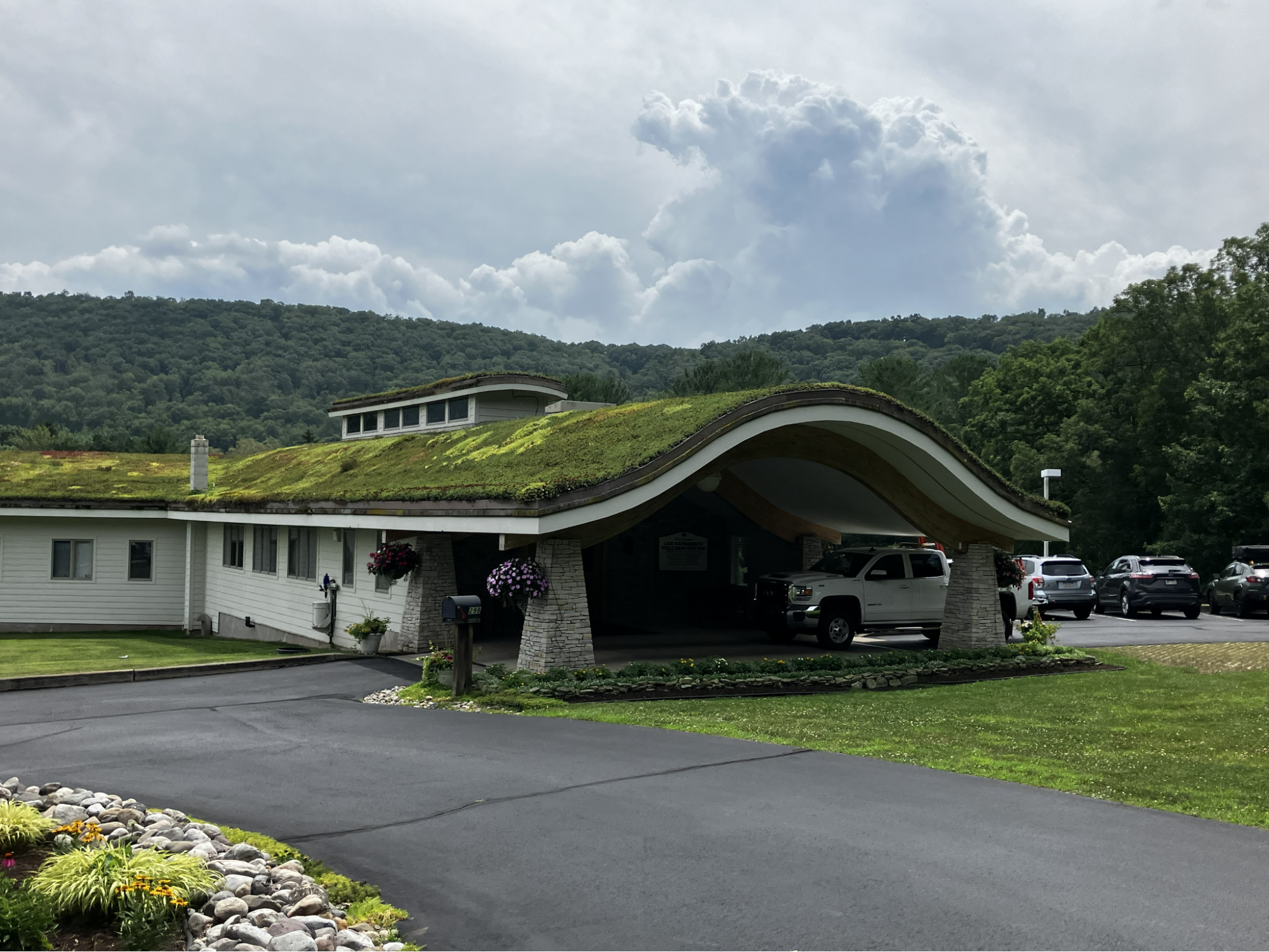
Life Expression Wellness Center, SugarLoaf, PA, Photo: Olyssa Starry, July 11 2025.
The Life Expression Wellness Center
A prime example is the Life Expression Wellness Center located in SugarLoaf PA. This green roof was designed by Charlie Miller and constructed in 2001; succulent plants were supplied by Emory Knoll Farms/Green Roof Plants. Pictures of the roof under construction can be found at greenroofs.com. Due to a meticulous and informed maintenance regime it looks very much the same today as it did 25 or so years ago. The architect of the building was Sim Van Der Ryn of Sausalito, California. The green roof was part of many features in this building designed to provide a holistic patient experience. Every aspect of the building from the way it is situated in the landscape to the hydronic tile flooring was designed to be non-toxic and support patient healing.
Oregon Health & Science University
Greening is also possible at larger scale campuses. Oregon Health & Science University OHSU now has about 150,000 square feet of green roofs in more than a dozen locations across two campuses. These roofs vary in size with plantings ranging from ground-level sedums to Japanese maples. In many cases, they have worked to incorporate rooftop gardens into respite areas for faculty, staff and visitors. Erik Robinson, Communications Specialist for the University notes, “green roofs are part of OHSU’s overall commitment to ongoing action to reduce carbon emissions in health care and to make our facilities more resilient to the effects of climate change.”
Their most recent expansion includes a green rooftop garden that affords people with cancer the opportunity to experience the natural environment by looking out the windows of inpatient rooms in the new Vista Pavilion.
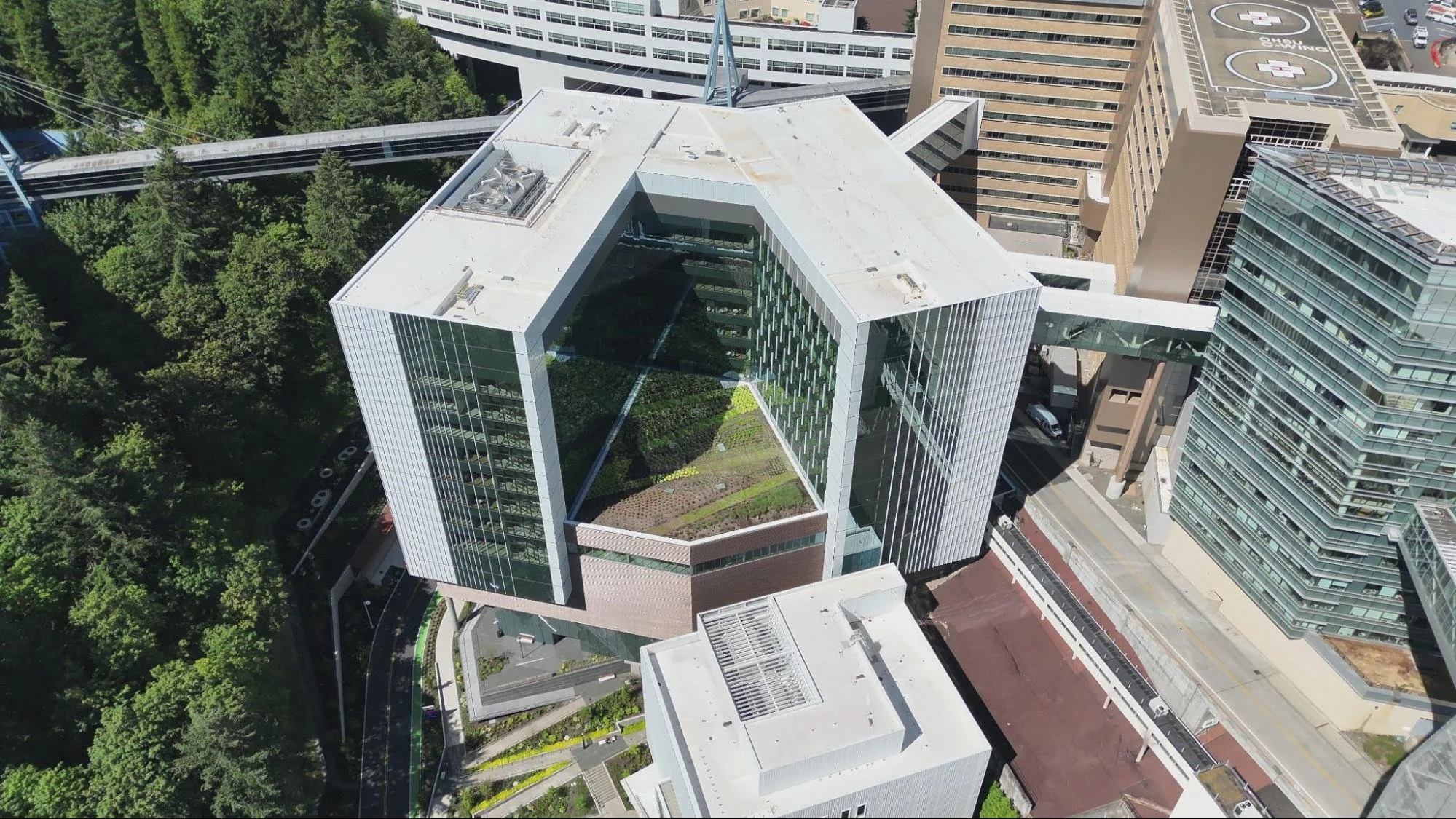
Vista Pavilion green roof at the Oregon Health and Science University provides cancer patients with views of nature. Portland OR.
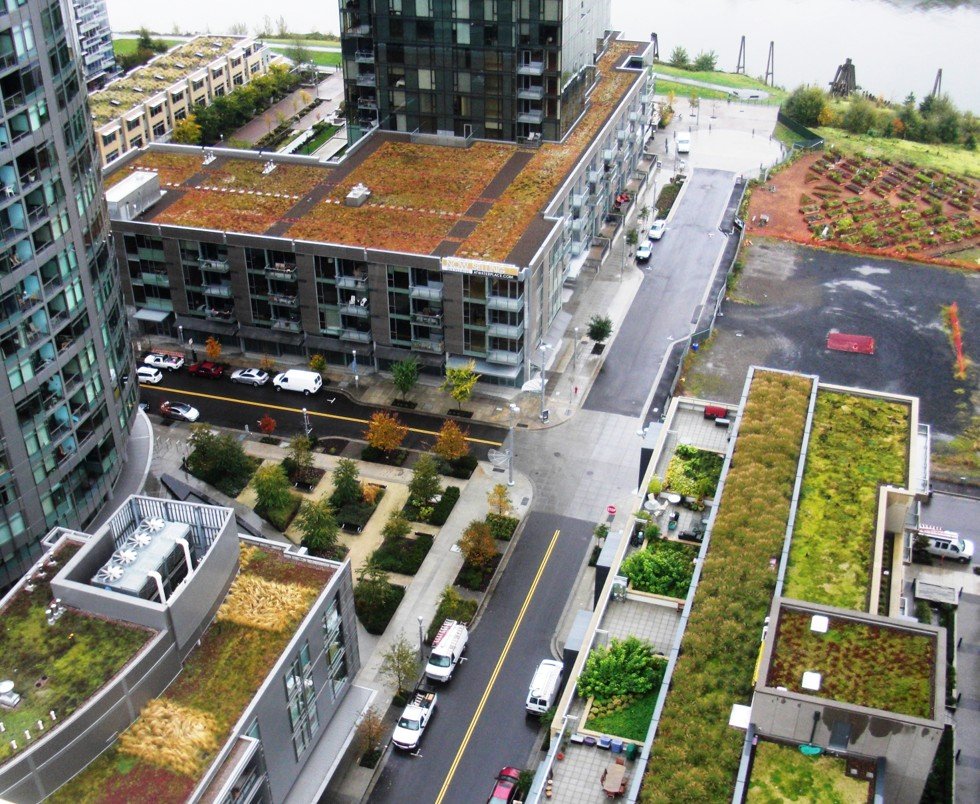
OHSU Lower campus green roofs.
This hospital chose to replace a highly-visible aging EPDM and gravel ballast roof with an extensive vegetated roof over a new modified bitumen roofing system. The roof area is visible from dozens of windows, and the feedback is resoundingly positive from both patients and staff. For people enduring long dialysis treatments, and those in the maternity ward, also the many staff offices viewing the vegetation, the reports are all similar - the green roof is much cooler than the hot gravel roof was, and more importantly, the views are relaxing and inspiring, filled with flowers and butterflies. Even in the winter the dormant and snow-covered sedum are beautiful to view.
Advertisement
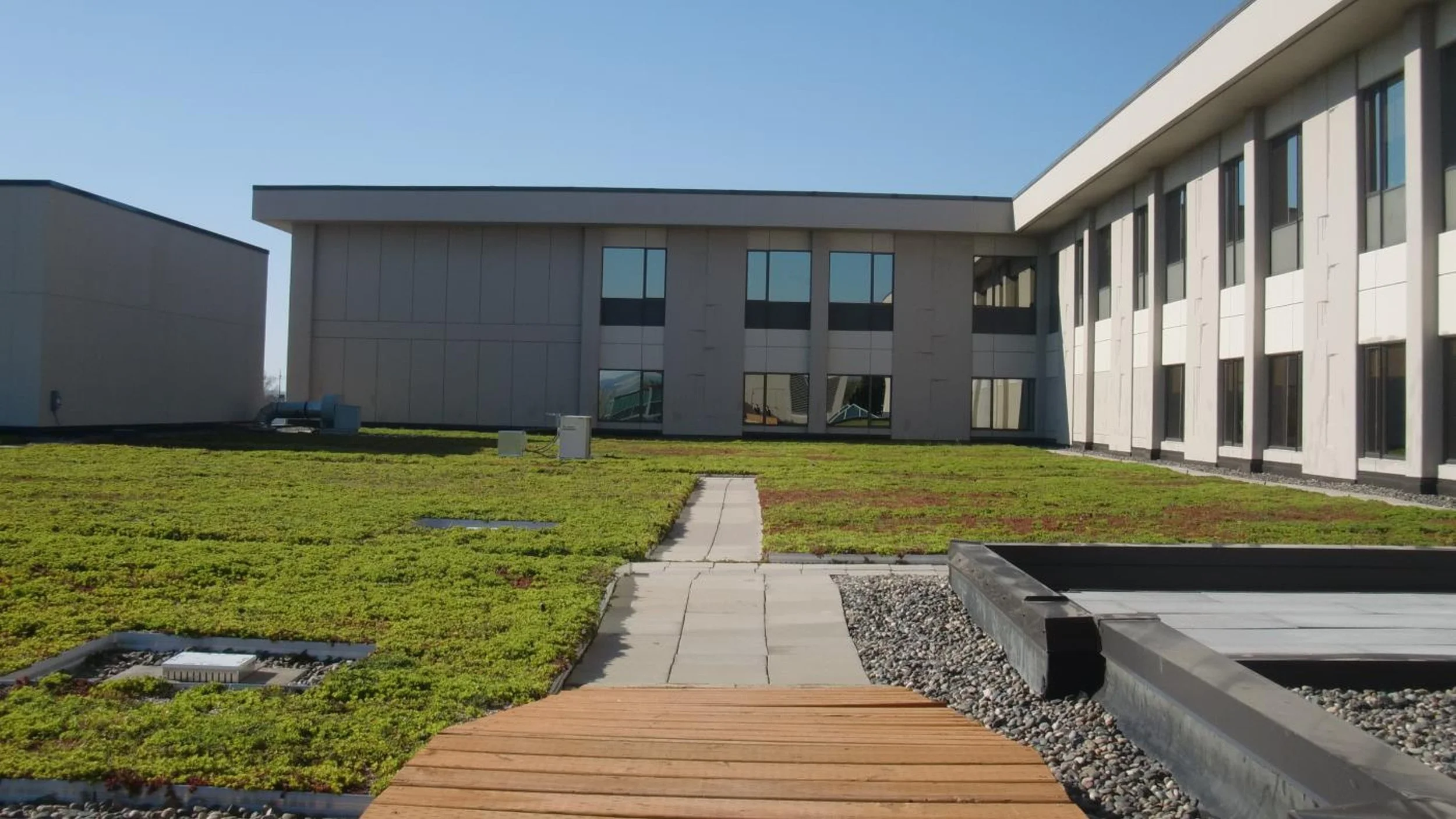
Providence St Mary Medical Center l in Walla Walla, Washington
Conclusion
In an era in which our global health care system is facing many challenges, these examples provide inspiration to return to an approach to medicine that recognizes the intrinsic connection between people and their environment. We can learn from centuries-old practices which involved herbal apothecaries and cloister gardens. Physicians are unofficially prescribing nature walks and fresh produce. People seeking healing gravitate towards healthcare facilities that incorporate nature into the architecture. In a setting known for very high staff turnover, a beautiful flowery window view creates a much more relaxing and welcoming workplace. The use of horticultural therapy practices in health care settings is another important tool in the toolbox of healing for patience and stress relief for staff and visitors.
Advertisement
Olyssa Starry is the Program Director of Sustainable Technology at Bucknell University. Her research focuses extensively on green roofs ("ecoroofs"), urban ecology, and stormwater management.
Elizabeth Morris is the founder of Green Up Roofing, with over 20 years of green roof and waterproofing consulting experience. She is on the board of GRHC and is past president of IIBEC Portland Chapter.
Resources
Kimmerer, Robin Wall, 2013. Braiding Sweetgrass: Indigenous Wisdom, Scientific Knowledge and the Teachings of Plants. Milkweed Editions
Starry O., Viray, A., Park-Egan, B., Terway, A.C., Oxendahl, T., and T. Burdsall 2022. A Pilot Study Considering Ecoroofs as Therapeutic Landscapes. Front. Sustain. Cities 4:811306. doi: 10.3389/frsc.2022.811306
Ulrich, R. S. (1979). Visual landscapes and psychological well-being. Landsc. Res. 4, 17–23. doi: 10.1080/01426397908705892