Regulatory Certainty is a Catalyst for Investments in Urban Green infrastructure
Introduction
On 19 February 2026, the World Green Infrastructure Network (WGIN) and the European Federation of Green Roof and Living Wall Associations (EFB) published a new document providing guidance for transposing existing European legislation to the National level to advance urban green infrastructure and unlock the full potential of building-integrated nature-based solutions. Its central message is clear: Europe has recently adopted a regulatory framework capable of scaling up green roofs, living walls, and blue–green systems across its many cities. What is needed now is prompt and rigorous implementation and long-term regulatory certainty at the National level. These are the two conditions required to mobilise public and private investment.
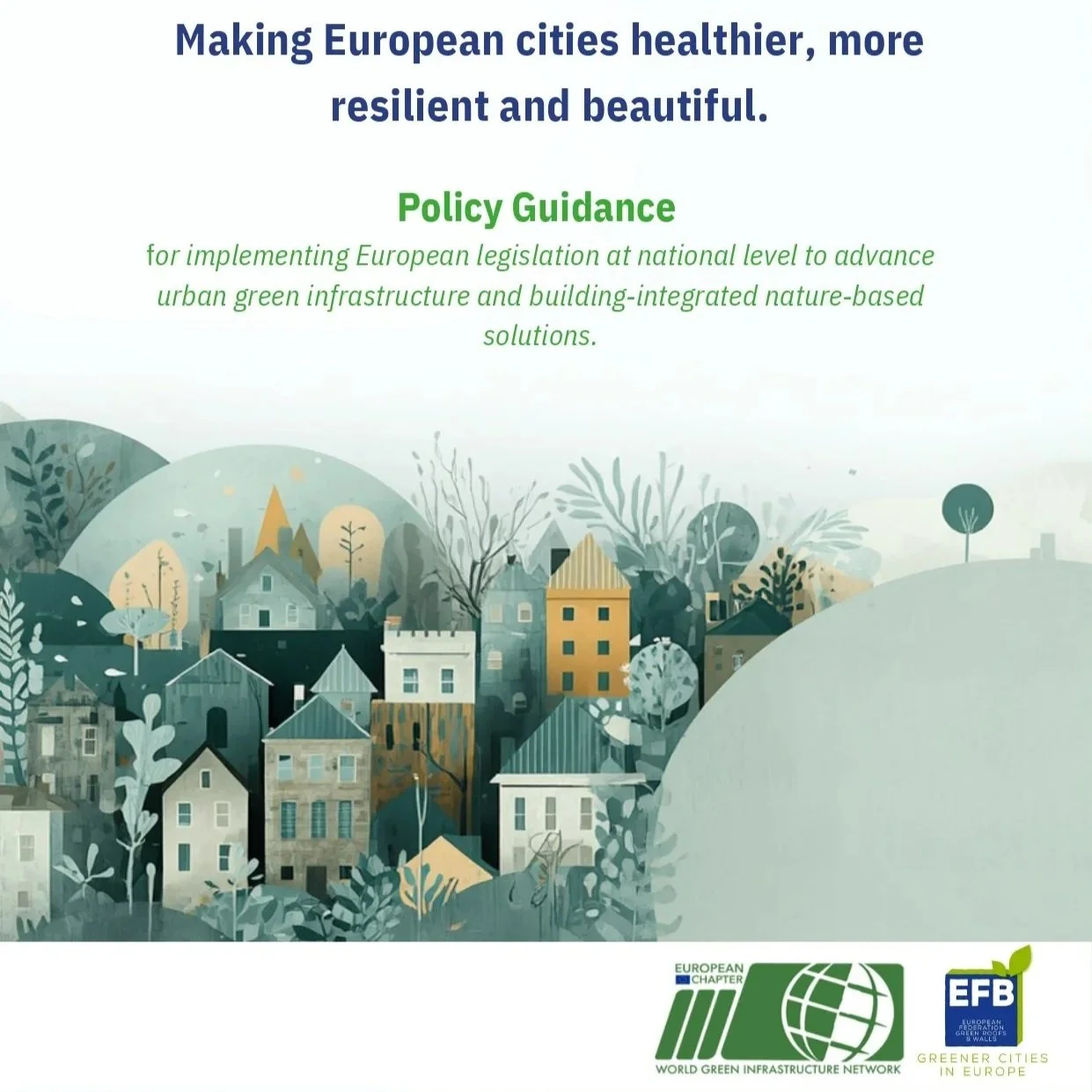
In the European Union, transposition of EU legislation into the National legislation of twenty-seven Member states is a decisive step in the policy process. This is because the quality and ambition of such transposition determines whether European objectives set in EU directives translate into tangible results such as increasing market demand.
The WGIN–EFB guidelines analyse policies within four existing legislative instruments and explain how EU Member States can implement them in a way that structurally embeds green and blue infrastructure into future urban development. The new EU legislative instruments described below are as follows:
Nature Restoration Regulation (NRR)
Energy Performance of Buildings Directive (EPBD)
Energy Efficiency Directive (EED)
Urban Wastewater Treatment Directive (UWWTD)
The Energy Performance of Buildings Directive’s (EPBD) solar mandates and multifunctional roofs
The Nature Restoration Regulation establishes binding restoration targets, including for urban ecosystems. EU Member States must ensure no net loss of urban green space by 2030 and after 2030, Member States shall achieve an increasing trend in total national area of urban green space until a satisfactory level (to be defined by the European Commission and Member States) is reached. The new regulations stress that rooftops and façades should be considered as restoration surfaces, particularly in dense urban areas where horizontal expansion of green space is constrained. National restoration plans, required by the regulation, can therefore integrate green roofs and living walls as tools to meet urban ecosystem targets. By recognising the vertical surfaces of a city as part of the ecological fabric, the regulation transforms urban greening from a voluntary enhancement into a legal responsibility.
The Energy Efficiency Directive (EED): annual savings, public leadership and the water–energy nexus
The Energy Performance of Buildings Directive (EPBD) introduces progressive obligations for the installation of solar photovoltaic systems on new buildings and on existing buildings undergoing major renovation. This requirement will reshape Europe’s roofscape over the coming decade. The implementation guidelines identify this provision as a major opportunity for solar-green roofs. Rather than treating photovoltaic (PV) systems and green roofs as competing uses of space, National government transposition regulations can explicitly facilitate their integration. The Guidelines recommend that Member States clarify that vegetated roofs are compatible with, and can enhance, PV efficiency through cooling effects. Member states should also avoid technical or administrative barriers that prevent combined systems. If implemented coherently, the EPBD solar mandate can accelerate the transformation of conventional rooftops into multifunctional solar-green roof integrated infrastructure delivering renewable energy, stormwater management, biodiversity, and urban cooling.
The UWWTD: Integrated urban wastewater planning
The Energy Efficiency Directive (EED) strengthens the “energy efficiency first” principle and reinforces public sector leadership. The Guidelines highlight that the EED establishes annual energy savings obligations, including specific requirements for public administrations to reduce energy consumption and renovate public buildings. This creates a structural driver for integrating green infrastructure into public renovation strategies. Green roofs and walls can reduce cooling demand, stabilize indoor temperatures, and lower peak electricity loads during heatwaves - contributing directly to measurable savings. The Directive explicitly refers to the possibility of achieving energy savings at the level of wastewater treatment plants. This provision is significant because it illustrates the water–energy nexus: urban water management is energy-intensive, and efficiency gains in treatment processes can significantly contribute to national energy savings targets. Here, the connection with green infrastructure becomes clear. By reducing stormwater inflows into sewer systems through green roofs and permeable surfaces, cities can decrease hydraulic loads and the associated energy required for pumping and treatment. Green roofs, bioswales , green walls and urban forests also reduce urban heat island effect which in return reduces energy consumption for cooling. Transposition of the EED can therefore encourage integrated approaches where blue–green infrastructure contributes simultaneously to energy efficiency, water management objectives and alleviation of urban heat island effect.
The Urban Wastewater Treatment Directive strengthens requirements for the creation of integrated urban wastewater management plans and recognises the importance of prioritising green infrastructure whenever possible. The Guidelines emphasise that, during transposition, Member States should explicitly recognise nature-based solutions as eligible and strategic measures within their plans. Green roofs and permeable surfaces reduce runoff volumes and delay peak flows, directly contributing to the Directive’s objectives.
By allowing investment in blue–green infrastructure to qualify under wastewater financing frameworks, Member States can shift from an exclusive reliance on grey infrastructure expansion to more cost-effective and resilient integrated solutions.
The economic rationale for full implementation of nature based solutions in urban areas is reinforced by the European Commission’s recent assessment of EU and Member States’ adaptation investment needs. According to this assessment, around €70 billion per year until 2050 will be required across Member States and the private sector to reduce climate exposure and strengthen resilience. Within that same assessment, the Commission quantified the investment needs for urban cooling and green infrastructure in about €430 million annually.
These figures refer to projected annual investments over the coming decades. An annual €430 million dedicated to urban cooling and green infrastructure represents a substantial and targeted contribution to risk prevention and adaptation in cities.
Placed alongside the documented economic losses from climate-related events - hundreds of billions of euros over recent decades and tens of billions annually in extreme weather damage - the business case for investment in preventive urban measures becomes clear. Urban green infrastructure is one of the practical, proven and implementable tools available today to reduce future liabilities.
Increasing Investor Confidence
Investment decisions in real estate, infrastructure, utilities, and insurance are shaped by regulatory expectations. Clear and stable obligations under the NRR, the EPBD solar mandate, the EED annual savings framework, and the UWWTD integrated planning requirements create predictable demand for urban green and blue solutions. At the same time, policy continuity is essential. Ongoing discussions on regulatory simplification of environmental legislation to support competitiveness must avoid weakening the very frameworks that provide long-term certainty. A clear regulatory framework and stability do not inhibit competitiveness; on the contrary they enable it by reducing risk and guiding investments.
The Investment context: a strong signal from the European Commission
The forthcoming European Climate Resilience Framework, expected in the first quarter of 2027, can reinforce this trajectory by aligning adaptation planning across sectors and creating further avenues to increase resilience through the deployment of nature-based solutions on and around buildings. Meanwhile, the European Water Resilience Strategy, launched last year, already provides a strategic direction for strengthening water security and resilience and like the Directives and Regulation discussed above, it now requires consistent implementation at national and local levels.
Conclusion
The WGIN–EFB Guidelines ultimately points to two indispensable conditions for scaling urban green infrastructure. The first one is ambitious and coherent implementation of existing EU legislation at Member State level. The second one is regulatory certainty about the future direction of Europe’s resilience agenda. Europe does not need to reinvent its policy architecture. It needs to implement what it has agreed to and in a way that recognises buildings, water-energy systems, and urban ecosystems as interconnected components of climate resilience. For when implementation and certainty align, investment follows. And when investment flows into resilient urban infrastructure, Europe strengthens not only its environmental performance but also the economic and social foundations of its cities for decades to come.
Luigi Petito, 51, father of two, is an expert in European public affairs. He is based in Brussels, cross-roads for international affairs and the European Institutions. In 2019 he was invited to establish and lead the European (EU) Chapter of the World Green Infrastructure Network. Since then, he follows EU policy and regulatory developments related to green infrastructure and advocates for a systematic integration of green infrastructure in urban areas.