
Biomimicry and the Business Case for Saving Like a Chickadee
Introduction
I’ve been fascinated by birds for a long time and have often wondered how the tiny black capped chickadee can survive the often bitterly cold winter temperatures in the Northern Hemisphere. How do these amazing little birds that weigh about as much as three triple A batteries survive? Ornithologists have recently discovered that they are unequalled masters at saving seeds in the fall. They save thousands of them in small caches, often spread across a 10 square mile territory. What’s even more amazing, is how these playful little birds keep track of this massive stash of winter food. Every fall, they replace 30 per cent of the old neurons in the hippocampus region of their brains, the area responsible for memory. This amazing feat of neuroplasticity increases their ability to remember where they hid all of their winter food supplies. (1) The caching of their food begins in late fall before the deep freeze of winter. Then when spring arrives, they purge all the old information and their brains become smaller because food such as insects become more bountiful and saved food less important for their survival. The hippocampus region of their raisin sized brains have adapted to grow in order to recall saved food supplies and shrink when food is more abundant, an incredible ability that enables their winter survival.

Black Capped Chickadees increase their brain size in the fall to keep track of where they save all of their food in order to survive the cold winter months. Photo: Lisa Hupp/USFWS.
Savings for Survival
On the savings for survival front, chickadees appear to be doing better than many humans. People’s savings rates vary significantly, depending on factors such as culture, age group, income (older and more wealthy people save more), and the state of the economy (higher costs of living mean less savings). At present, only 46 per cent of U.S. adults have enough emergency savings to cover three months of expenses, according to Bankrate’s Emergency Savings Report. The capacity to save money is essential for our well-being and survival. What we actually do with our savings also contributes or detracts from our chances of collective survival. The type of retirement investments we make can contribute to businesses that support equity and sustainability, remain neutral or actively undermine our future well-being. A company’s financial statements clearly don’t tell the whole story about how they operate, what kind of risks they take, if they are well managed, or how they will perform in the long term. By aligning your savings, no matter what size, with your personal values, you can tap into a powerful way to “be the change you seek in the world”.
Overview of Value Based Investing
The core concept of using investments to advocate for positive social change has been around for a long time. It started centuries ago when religious institutions called for a ban on investing in companies associated with the business of slavery. Fast forward to 1971 when two United Methodist ministers who were opposed to the Vietnam War, created the first publicly available mutual fund which factored in social and environmental investment criteria into its decision making. In the 1980’s I remember being at rallies on my campus calling on the university to divest from companies that were doing business in South Africa due to its policy of apartheid. Divest now we shouted! Around that time a number of pension funds with the interests of worker-investors in mind began targeting investments in areas geared to improved healthcare and affordable housing. And in the decades to follow, actions like these eventually evolved into specific rules and practices that manifested into what is now called ESG - environmental, social and governance - frameworks for investing.
The term ESG was actually coined in 2004 by the United Nations Global Compact, as efforts to track corporate greenhouse gas emissions had been gathering momentum for a decade. ESG refers to a set of metrics used to measure an organization’s environmental and social impact, and its transparency of governance by clear principles. ESG has become increasingly important in investment decision-making. ESG frameworks are complex and numerous. They are designed to guide investors into putting their savings to work supporting a more sustainable and equitable world and to help companies identify, measure and report on various metrics that represent performance aspects of ESG.
What are ESG Frameworks
A variety of ESG principles and frameworks have been created, providing further guidance on how companies can integrate and report on ESG factors. Some prominent examples include the Principles for Responsible Investment (PRI), the Climate Disclosure Standards Board (CDSB) and the Sustainability Accounting Standards Board (SASB).
Today, ESG data is used to evaluate a company’s performance on specific ESG issues. Examples of each component of ESG may include:
Environmental – Focusing on renewable energy procurement, reducing the carbon footprint, reducing waste, responsibly using energy and resources, etc.
Social – Focusing on human rights, data privacy, racial and gender diversity in hiring practices, treating employees fairly, involvement in the community, etc.
Governance – Focusing on the board composition, limiting corruption, aligning incentives for the executive compensation schemes, protecting whistleblowers, etc.
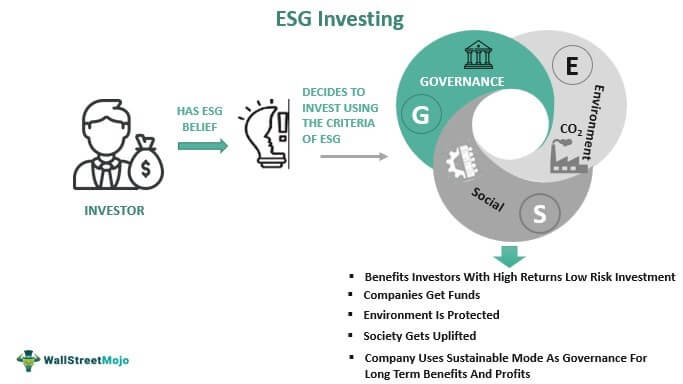
ESG investing attempts to only invest in companies that use sustainable practices in relation to governance, social, and environmental impacts. Source: wallstreetmojo.com
Some metrics include for instance, carbon emissions per unit of revenue, used to evaluate a business’ environmental impact, while employee turnover rates may be used to evaluate a company’s labor practices. (3)
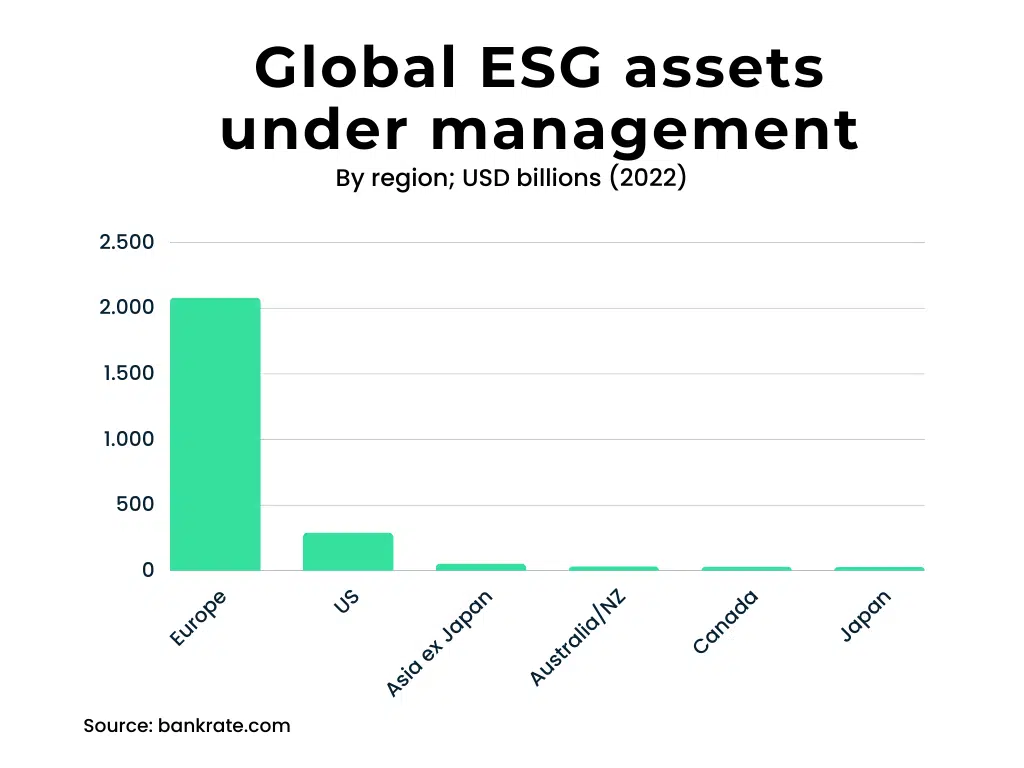
Despite some recent political efforts to push back against ESG investing, the market continues to grow and companies continue to integrate ESG principles into their operations, but they talk less about it publicly. (4) According to Bloomberg Intelligence, the global total of assets under management in ESG-related funds is around $41 trillion, up from $22.8 trillion in 2016. Bloomberg Intelligence also estimates that ESG-related investments will soon surpass $50 trillion, with European investors leading the way.
Who Invests in ESG Funds and How Do They Perform
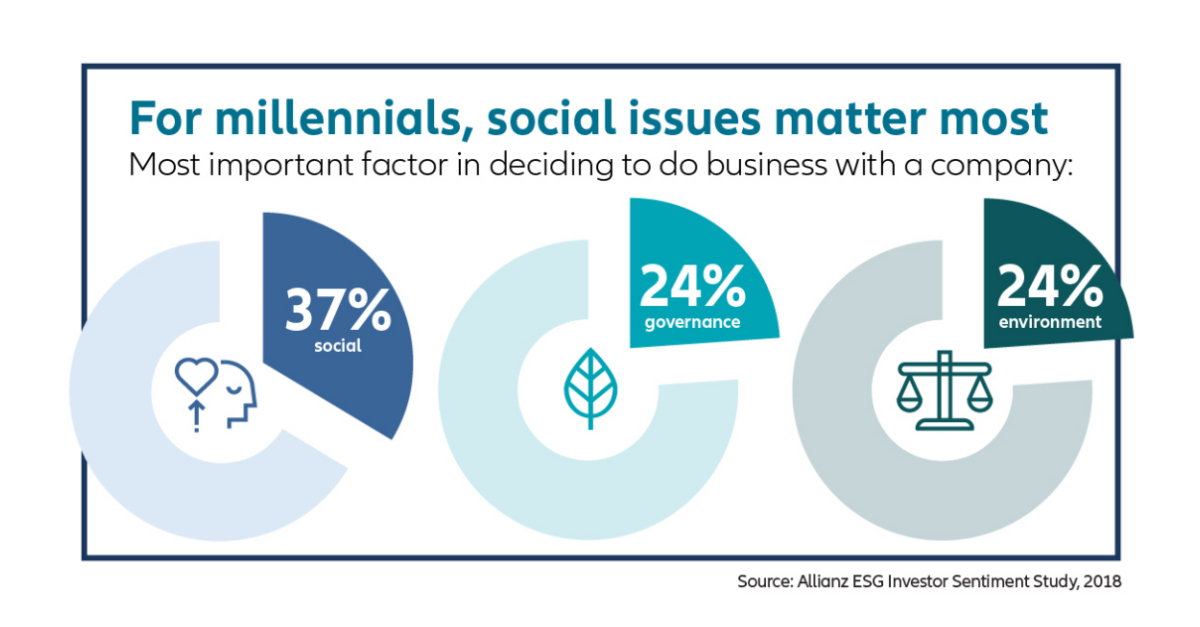
Maybe it’s that they have larger hippocampi, or better access to information, or perhaps it is that they have a greater stake in the future, but Millennials are twice as likely to support ESG investments as Baby Boomers. A Stanford University Study recently found that younger people, Gen Z/Millennials, followed by Gen X’s are considerably more supportive of ESG-focused investing than Baby Boomers, even if it is costlier. (5) Several studies have found that companies which adopt ESG in their operations also financially outperform firms in the same sectors that do not, largely due to improved risk management. ESG-integrated companies exhibit lower reputational, regulatory and operational risks, have lower long-range risks, are better managed and more innovative. Similarly, ESG funds, which hold more technical and industrial stocks and avoid fossil fuels, have between the years 2023 and 2025 financially outperformed traditional funds in the same sectors by margins of 3 to 4 percent. (6) Various studies suggest that ESG funds outperform or at worst, are at par with funds that only focus on financial returns.
Years ago I asked my financial advisor to eliminate any funds in my portfolio that included fossil fuel companies. I also wanted to avoid bank stocks that continue to invest in new production of fossil fuel infrastructure. It took a little while, but my advisor was able to locate four different funds that hold companies, such as solar energy firms, which align more directly with my values. The results have been very rewarding, both in terms of supporting a more equitable and sustainable future, as well as financial returns. There are lots of different ESG rated funds for sale on the market, so be careful about potential greenwashing.
Conclusion
The driving force for the design of the natural world appears to be survival in an ever changing environment. If you haven’t already, it is time to contact your financial advisor if you are fortunate enough to have one, and find out about how to shift your investments to ESG rated funds and/or ESG rated companies. You can also just research companies on your own and make investments. The business case for this is both financial and self-preserving. Perhaps it is time for us to mimic those tough little black-capped chickadees and use our amazing brains to save for our retirement and for a livable future!
Steven W. Peck, GRP, GRIMP, Honorary ASLA has been a passionate bird watcher for decades and enjoys learning about the natural world and the lessons it has to share. He is the founder and president of Green Roofs for Healthy Cities, the Editor of The Living Architecture Monitor and currently the President of the World Green Infrastructure Network. What is also extraordinary about black capped chickadees, is that they are one of a few birds that will perch on your outstretched hand to gather a few extra seeds.
Resources
https://a-z-animals.com/articles/survive-or-starve-how-chickadees-rewrite-their-brains-each-winter/
https://www.ibm.com/think/topics/environmental-social-and-governance-history
https://investingintheweb.com/education/esg-investing-statistics/
https://www.forbes.com/sites/lbsbusinessstrategyreview/2025/03/25/what-the-esg-backlash-reveals-and-what-comes-next/
80% of Millennials and Gen Z’s feel that their investment firm should influence a company’s ESG practices compared to less than 30 per cent of baby boomers. https://www.gsb.stanford.edu/insights/esg-generation-gap-millennials-boomers-split-their-investing-goals
https://www.morganstanley.com/insights/articles/sustainable-funds-outperform-traditional-first-half-202