
Addressing the Costs of Extreme Heat Through Policy Entrepreneurship
Introduction
Communities are experiencing more frequent and prolonged periods of record-breaking heat. In the United States, heat kills thousands of people and hospitalizes tens of thousands more every year. In 2024 alone, the economic toll of extreme heat was over $162 billion. These costs are avoidable through integrated planning, resilience requirements and investments in mitigation, such as green infrastructure.
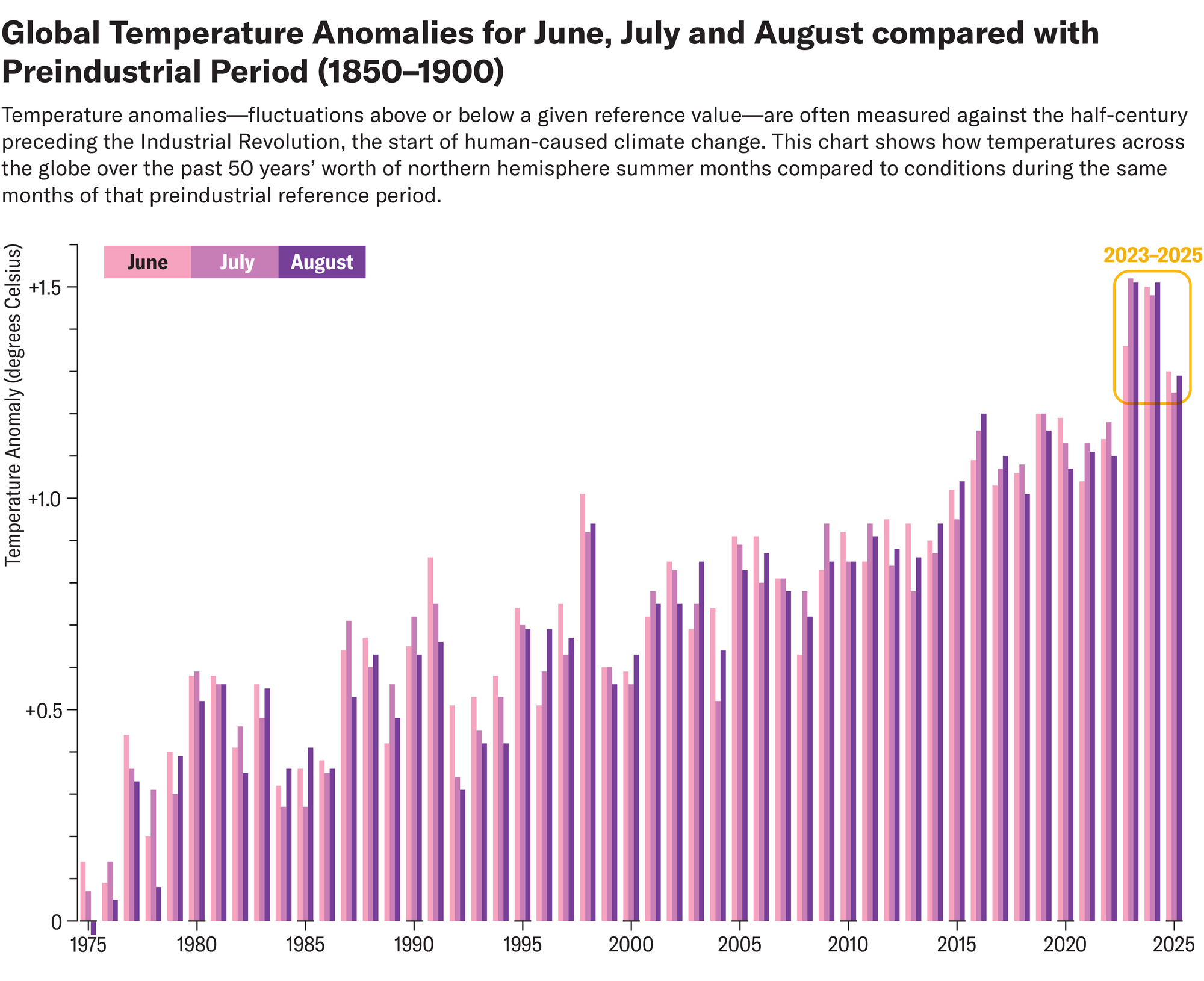
Summer 2025 was cooler than the past two summers, but still the third-hottest on record. Credit: Amanda Montañez in Scientific American; Source: Copernicus Climate Change Service (data)
The Costs of Extreme Heat
2025 was the third hottest summer on record. The combination of the urban heat island and heat waves is exacerbating the impacts. Heat waves temporarily turned places in Texas into the hottest places on earth, while the Pacific Northwest, the Midwest, the Mid-Atlantic, and New England smashed early-summer temperature records. Even Alaska issued its first-ever heat advisory, showing that no place in the United States is safe from temperature extremes.
Combined with aging and non-resilient physical infrastructure, extreme heat can result in significant life and safety impacts and hundreds of billions of dollars in damages to critical infrastructure and economic productivity. Just some of these impacts include:
Thousands of preventable deaths annually. In 2023 alone, at least 2,300 people died from extreme heat. However, because of discrepancies in cause-of-death attribution, and the knowledge that heat makes certain life-threatening chronic conditions worse, clinicians project that true mortality is actually +10,000 annually. Hundreds of millions of people are at risk of dangerous exposure due to physiological conditions that increase risk and greater exposure to extreme heat due to employment or housing situations.
Lower worker productivity and increased workers compensation claims. Workplaces are seeing $100 billion in lost productivity each year because of extreme heat, diminishing the output and efficiency of businesses in hundreds of industries. Each excess workers’ compensation claim can cost a state $6,500 dollars.
Increased learning loss among school age children. For each 1°F rise in average annual temperature in school districts without air conditioning or proper heat protections, there is a 1 per cent drop in learning. The Environmental Protection Agency found that these learning losses could translate into nearly $7 billion dollars in annual future income losses if warming trends continue. Paved, asphalt schoolyards can make it impossible for kids to play safely outside without excess heat exposure and potential burn risk, impacting physical activity and overall health and wellbeing.
Damaged gray (e.g. roads and transportation systems) and green infrastructure (e.g. urban forests). Extreme heat increases wear and tear on aging roads, bridges, and rail. Road maintenance costs are expected to balloon to $26 billion annually by 2040. Excess heat can also lead to the premature death of trees, diminishing the areas with protective shade.
Excess healthcare utilization. Extreme temperature spikes in emergency room visits and hospitalizations cost the healthcare system $1 billion a year. Each extreme heat day costs the Medicare program an extra $4 per recipient per day. Extrapolated to the entire Medicaid population, costs could top $274 million a day. With some of the most vulnerable people on public insurance, extreme heat is draining public resources.
Increased energy costs and risk of power system strain and failure. 1 in 4 U.S. families are in some form of energy debt and 1 in 3 families has to forgo other needs, like medicine and food, to pay energy bills. Extreme heat also puts roughly two-thirds of the country at risk of a blackout. Even a minute of power outage can cost thousands of dollars. The federal government had to issue a power emergency in June 2025 to prevent the grid from failing during a heat wave in the Southeast.
What Can Policy Do to Address Extreme Heat
The Federation of American Scientists (FAS) is a U.S. hub for steering heat policy efforts, convening +700 stakeholders across academia, government, NGOs, and the private sector and organizing +100 organizations around policy goals. We work on extreme heat through a range of tactics we like to call policy entrepreneurship. This involves, identifying the right policy levers to solve problems, developing the tools to enable policy change, building a base of allies and champions inside and outside of government, and leveraging key policy windows to enable change.

Electric grids are under extreme stress as a result of increasing demand for mechanical cooling systems and air conditioning. Smart interventions can reduce the urban heat island effect and decrease demand.
After years of dedicated organizing and entrepreneurial activity, FAS released the 2025 Heat Policy Agenda, a roadmap for federal government action to combat extreme heat. The Agenda has shaped the federal policy dialogue even in a challenging political environment: its recommendations have been incorporated into multiple introduced bills, cited in Congressional reports, and realized through federal appropriations. We are a recognized experts for Congressional staffers looking to craft policy.
Extreme heat is also a rising concern for state and local governments. FAS connects with actors in almost every state in the U.S. crafting solutions to address extreme heat. For example, California, Arizona, New Jersey, and New York have all implemented dedicated statewide Heat Action Plans, while at least 200 local jurisdictions have created heat plans of their own or integrated heat into key plans.
After interviewing hundreds of state and local government and community champions advancing policies and programs to support their communities, my team at FAS has identified four policy principles that can reduce the long-term costs of extreme heat on communities:
Prepare for extreme heat as a chronic risk, integrating into all plans and strategies.
Establish a clear governance structure and authorities for managing extreme heat.
Assess extreme heat and its impacts to inform where to prioritize interventions.
Prioritize and incentivize heat-resilient infrastructure over non-resilient infrastructure.
In our work to craft a State and Local Heat Policy Agenda, a blueprint for polycentric action towards a Heat Ready Nation, we are tracking innovative actions that are enabling heat-resilient communities. These include Arizona’s Chief Heat Officer position, Cambridge, Massachusetts “Cool Score” zoning requirement for urban heat island mitigation, green roof incentives in Chicago, cool roof ordinances in Atlanta, and shade requirements in Phoenix, Arizona.
Conclusion
Extreme heat is a problem that is here to stay and will only worsen as warming trends continue. In the months ahead, my team looks forward to supporting the implementation of the State and Local Heat Policy Agendas and continuing to provide actionable, evidence-based guidance to leaders at all levels of government. I am energized by the powerful multi-sector coalition that has come together to confront extreme heat head-on. The heat is rising and together we can rise to the challenge.
Grace Wickerson (gwickerson@fas.org) is the Senior Manager, Climate and Health on the Climate and Environment team at the Federation of American Scientists (FAS). Grace leads programmatic work at FAS to showcase how a changing climate impacts health outcomes and public health and healthcare systems, through emerging threats like extreme heat and wildfire smoke. Grace is committed to identifying policy solutions that secure access to a clean environment, while bringing down costs, bolstering the economy, and improving Americans’ quality of life. Grace is nationally recognized for their extreme heat policy work by Grist 50 2025. Grace holds a Masters of Science in Materials Science and Engineering from Northwestern University and a BS in Materials Science and Nanoengineering from Rice University.
Learn more about FAS’ work on extreme heat here: https://fas.org/initiative/extreme-heat/