Green Roofs and Fire Resilience: Extending Defensible Space Above Ground Level
Advertisement
Introduction
The state of California is no stranger to devastating wildfires. In October 2017, the Tubbs Fire in Napa and Sonoma County destroyed nearly 6,000 structures and killed 22 people, one of the most destructive wildfires in California history. Only a year later, in November 2018, the Camp Fire destroyed nearly 19,000 structures and killed 85 people, surpassing the destruction of the Tubbs Fire. Fast forward to January 2025, and the Eaton and Palisades fires have now dwarfed the estimated insured loss of the Camp Fire by a factor of 6.25, setting, yet again, a new wildfire record.
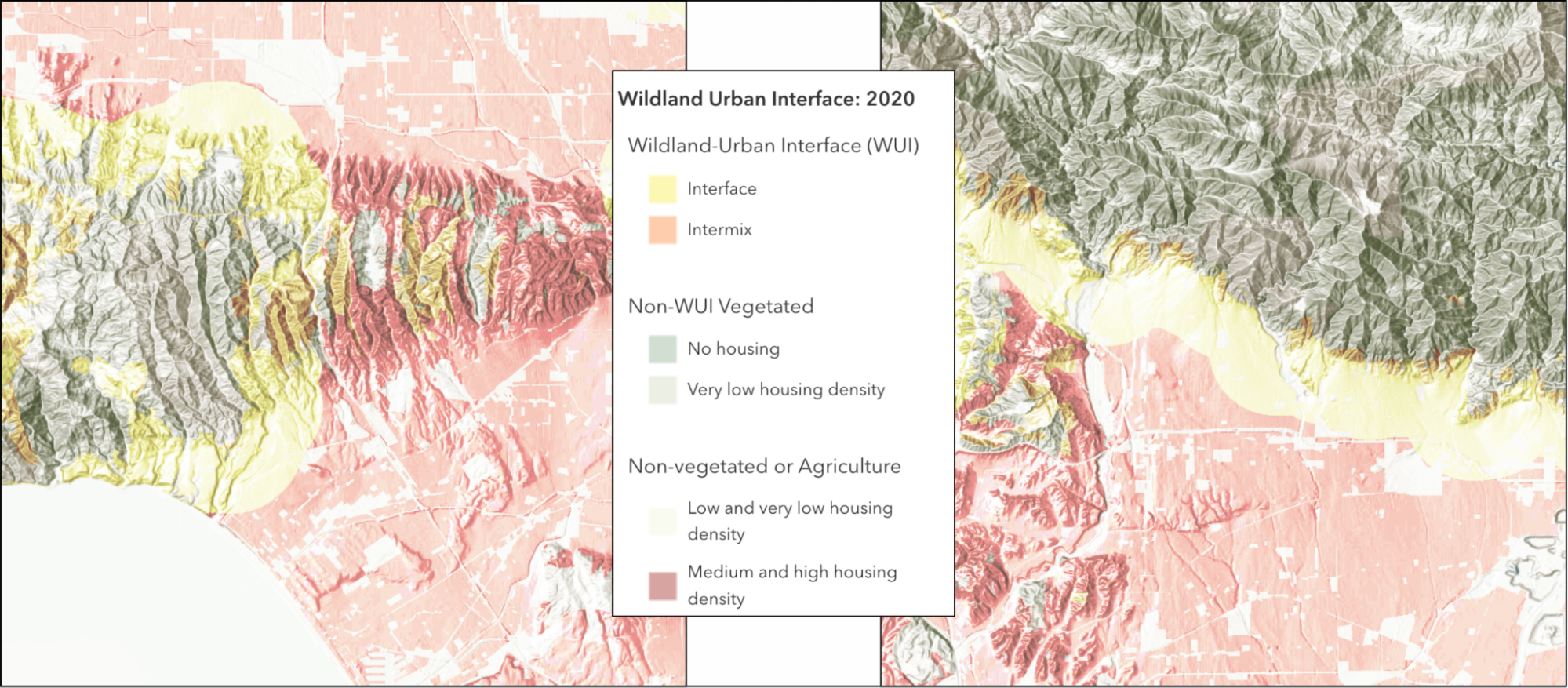
Wildland-Urban Interface (WUI) in Pacific Palisades (left) and Altadena (right) in Los Angeles, CA. Photo: United States Forest Service Research Data Archive
The Los Angeles wildfires are on track to be the most costly natural disaster in United States history, with total property and capital losses estimated to fall between $95 billion and $164 billion, respectively. As wildfire severity, prevalence, and subsequent structure loss increase across California, extensive green roofs (EGRs) must be integrated into defensible space conversations in wildland-urban interfaces (WUIs). Defensible space - the strategic selection and placement of vegetation to minimize combustible materials and create a buffer zone - can be extended to the roof level, potentially enhancing fire resilience in WUIs, the area where human development meets undeveloped wildland.
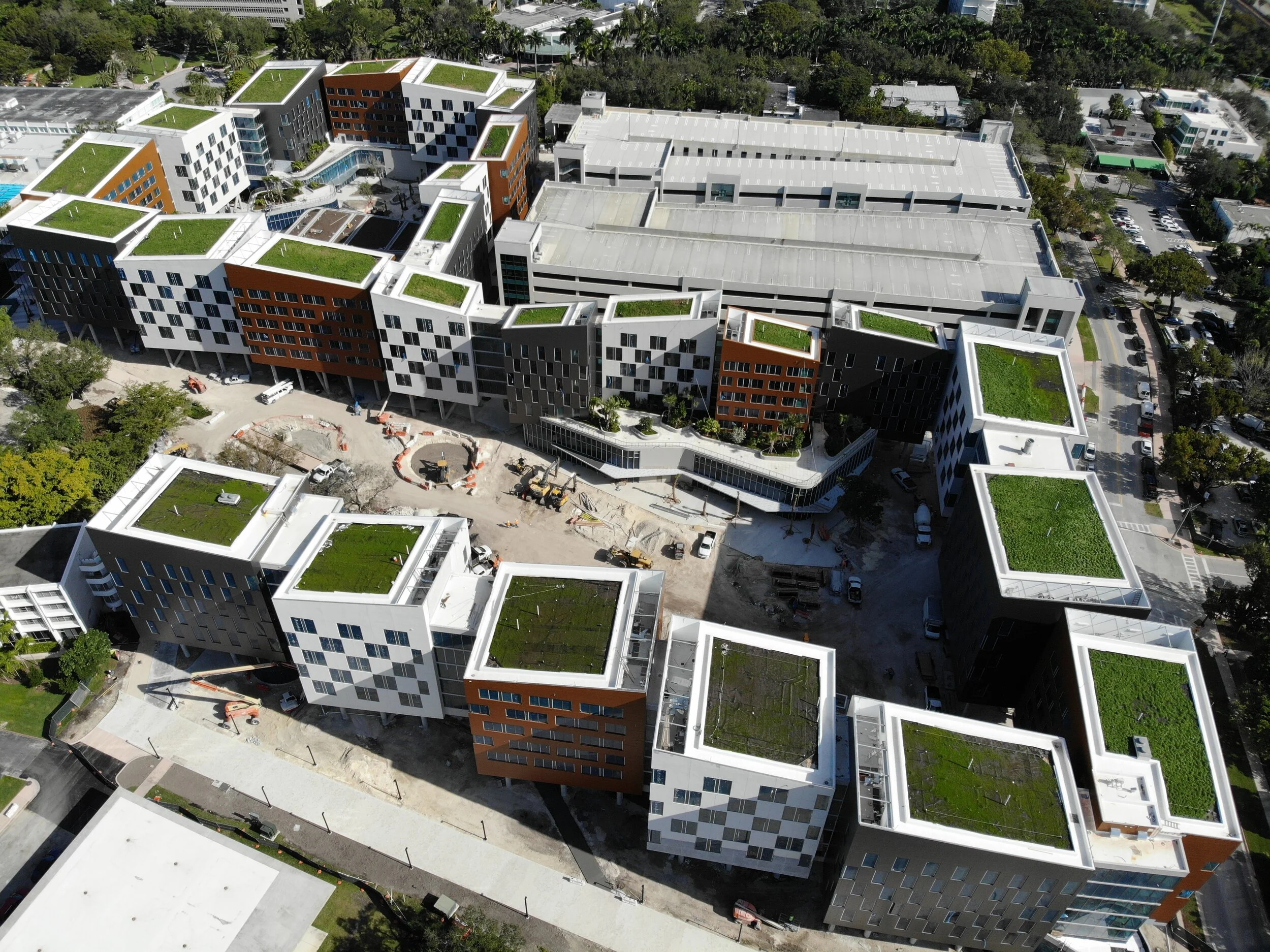
California’s stringent building codes in Fire Hazard Severity Zones (FHSZ) and progressive green roofing codes (“cool roofs”) have created a perfect market for the mass adoption of residential and non-residential low-pitch green roofing systems as a means for fire resistance, an homage to their first modern application in industrial Germany.
The History of Green Roofs and Defensible Space
The roof is the keystone of the building envelope, providing security and protection from the elements. In the late 19th century, Germany, determined to address the hapless reaction between chimney embers and tar roofs, referenced a building technique that predates even slate and tile roofing: green roofs. Using a combination of gravel, sand, and sod, Germany built green roofs on low-cost rental housing for industrial working families across the country, effectively mitigating rooftop fires caused by chimney embers. If green roofing successfully mitigated fires from chimney embers, then why can't it be used to prevent structural fires from wildfire spotting?
Advertisement
The concept of mitigating wildfire risk using landscaping is not a new concept. Defensible space has been around for nearly 50 years in California and is a critical component of fire-adapted landscape design, reducing the intensity of radiant heat, ember ignition, and direct flame contact. While traditionally applied to ground-level landscapes, the principles of defensible space could also be extended to green roofs. EGRs could serve as an additional layer of fire protection by adding wildfire-resilient, drought-tolerant plants to already abundant, fire-resistant roof membranes across Los Angeles.
Fire-Resilience Potential of Extensive Green Roofs
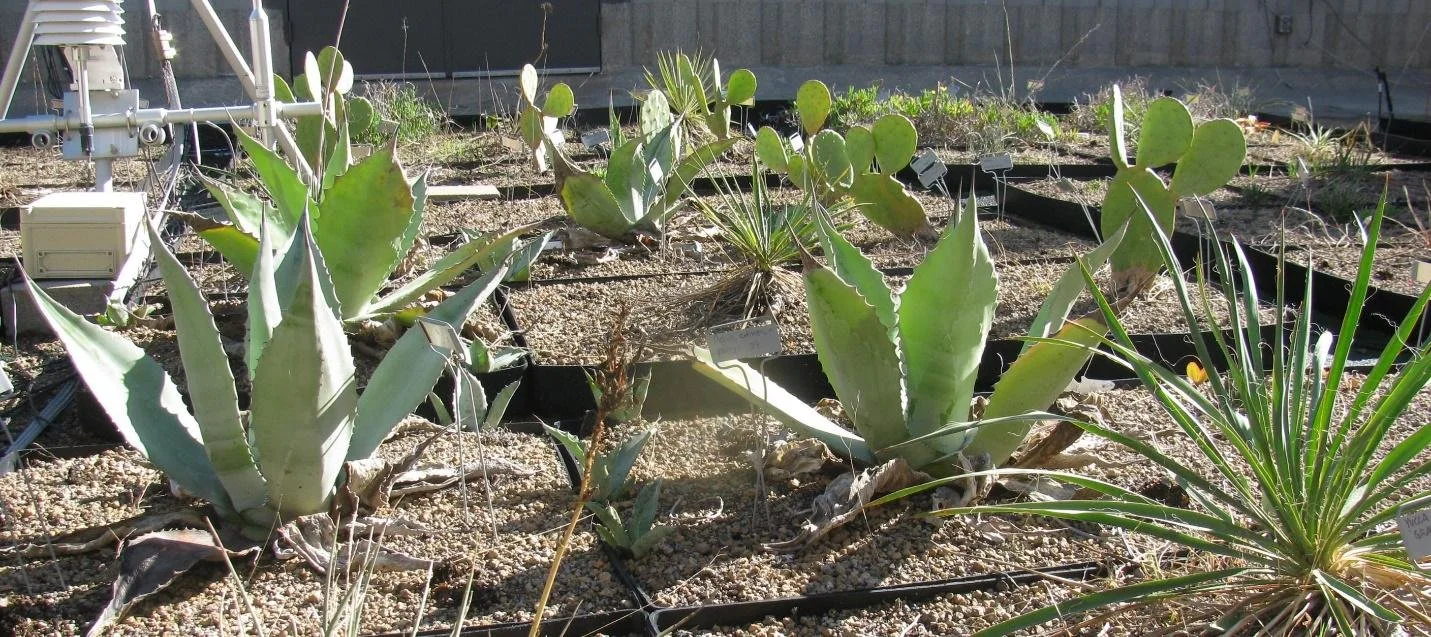
Extensive green roofs (EGRs) are defined by their shallow growing substrates (< 6”) with low organic content. Most plants used on EGRs, like sedums, are naturally drought-tolerant and fire-resistant due to their high moisture content, making EGRs the most relevant green roofing system for fire prevention. Even with a shallow growing medium, ground-level defensible space can be emulated on rooftops, potentially increasing fire resistance and reducing spotting from embers.
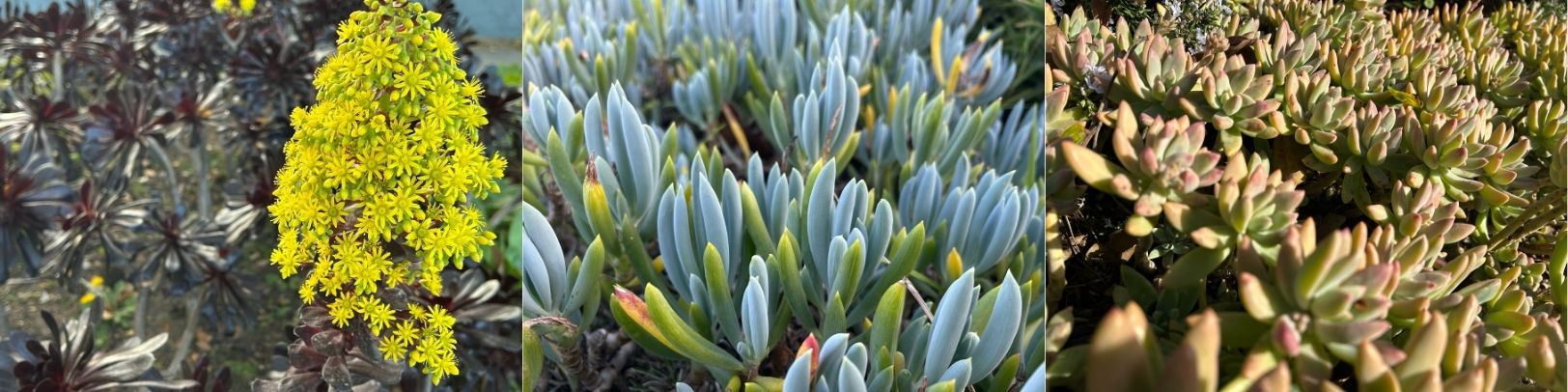
While not California natives, Aeonium arboreum (tree aeonium) (left), Senecio serpens (blue chalksticks) (center), and Graptosedum ‘Francesco Baldi’ (right) are popular drought-tolerant and fire-resistant succulents in Los Angeles. Photos: Nate Constan
In a publication by Michigan State University titled Selecting Plants for Extensive Green Roofs, various popular fire-resistant California natives were cited as top choices for EGRs, including Sedum spathulifolium (yellow stonecrop) and Dudleya pulverulenta (chalk dudleya), though this list is relatively underdeveloped and untested. Research investigating the compatibility of common flora used for defensible space on EGRs is requisite to the success of green roofs in California. The state has an abundance of defensible space and fire-resistant landscaping resources, including Sustainable Defensible Space, the Theodore Payne Foundation, and USGBC California, which cites dozens of fire-resistant native plants that could revolutionize the feasibility of EGRs to combat structure loss from wildfires across Los Angeles.
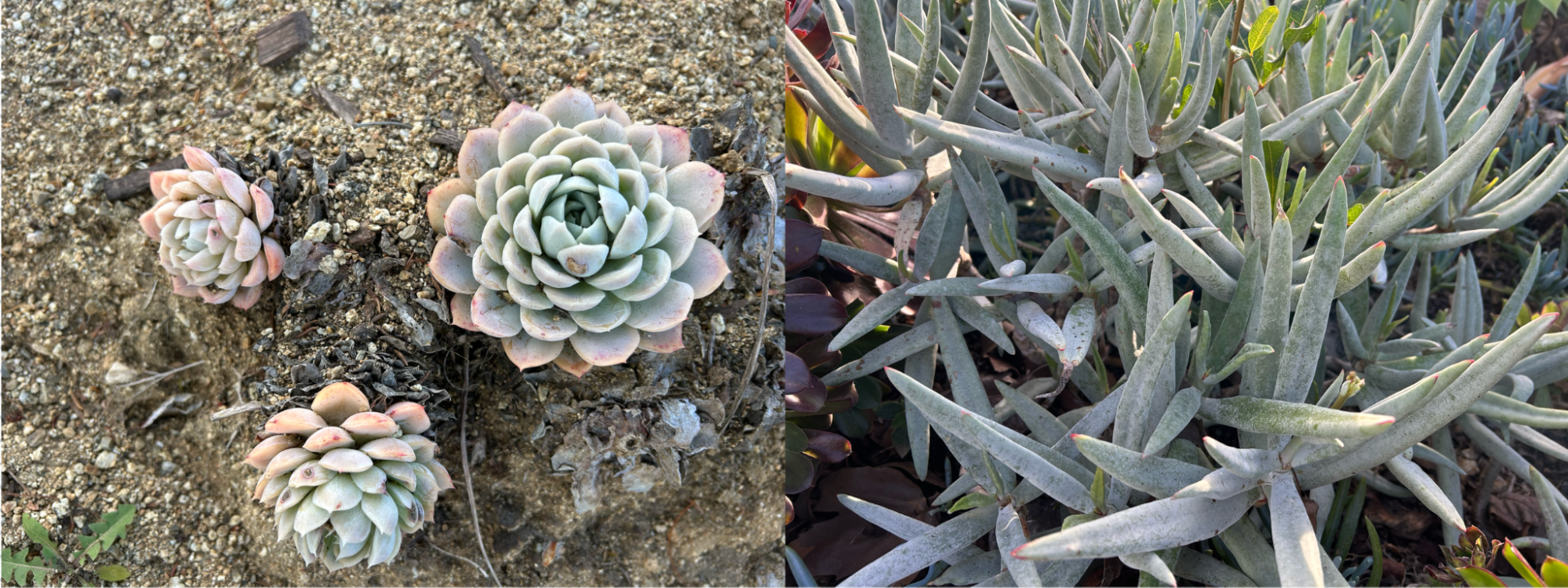
Echeveria elegans (Mexican snowball echeveria) (left) and Dudleya edulis (fingertips) (right) are popular succulent choices endemic to Mexico and California. Photos: Nate Constan
Advertisement
Wildland-Urban Interface Building Codes and ANSI/SPRI VF-1
Los Angeles has some of the strictest roofing codes for wildland-urban interfaces (WUIs). In Fire Hazard Severity Zones (FHSZ), California Residential Code (CRC) R337.5 and California Building Code (CBC) 705A require all roofs to meet ASTM E108 or UL790 Class A, the highest roof fire rating. While these strict building codes are integral in mitigating structure loss, pairing low-pitch roofing membranes with EGRs could increase the fire resilience of structures and help protect entire communities.
In a previous publication for Living Architecture Monitor, Understanding the Behaviour of Fire and Green Roofs, Nataliia Gerzhova performed three separate studies on the fire risks of green roofs, measuring thermal conductivity, heat transfer behavior, and flammability characteristics, respectively. Through detailed and rigorous testing, it was determined that in heating loads from 50-100 kW/m2 (small scale fires to forest fires) on substrate with both a plywood and steel roof deck, soil substrates were effective in insulating the roof by retarding the propagation of heat. The effectiveness of green roofs in preventing roof deck failure was dependent on the depth of the growing substrate relevant to the testing parameters. In these particular tests, substrate depths of 3-10cm (≈ 1-4”) were tested, with thicker substrate proving more resistant to the downward propagation of heat, proving that EGRs could be directly beneficial in mitigating fire propagation.
Los Angeles wildfires are primarily ember-driven, meaning burning embers (lofted firebrands) are carried by the powerful easterly Santa Ana winds, igniting spot fires across the landscape. Fire-resistant plants could further elevate the fire resistance of roofs by playing a critical role in slowing the spread of embers (responsible for 90% of structure loss from wildfires). By catching and extinguishing embers before they can reach drier fuels, these plants act as living fire barriers, reducing the risk of ignition and enhancing wildfire resilience in WUI communities.
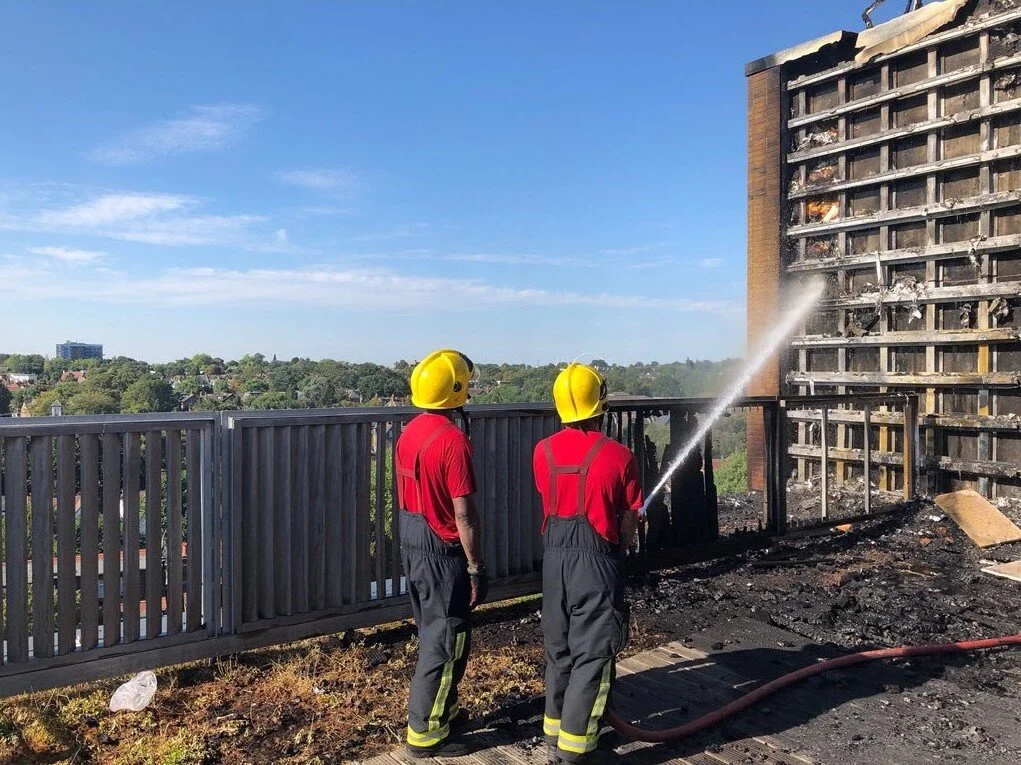
In the same study by Nataliia Gerzhova, Gerzhova investigated the potential amount of fuel a green roof presents, specifically examining the heat release rate (HRR) produced by substrate, vegetation and common bitumen roof membranes. It was found that green roofs can outperform conventional roofing materials in fires. Bitumen roof membranes (even with fire retardants) were found to release heat at much higher rates for a prolonged period of time as compared to dry and moist vegetation, posing an elevated risk for intensifying fire severity and propagation.
Advertisement
In the Approved American National Standard (ANSI) and Single Ply Roofing Industry (SPRI) VF-1 External Fire Design Standard for Vegetative Roofs, section C3.5 highlights existing data of succulent-based EGRs achieving ASTM E108 Class A ratings. California has around 6,500 species, subspecies, and varieties of naturally occurring plants across the state, including around 200 native succulent species, per Calscape. While deeper research needs to be conducted, EGRs could potentially host hundreds of native cactaceae, crassulaceae, and agavaceae.
Additionally, ANSI/SPRI VF-1 section C3.2 identifies ASTM roofing membranes compatible with green roofing systems, which include ethylene propylene diene monomer (EPDM), thermoplastic polyolefin (TPO), and polyvinyl chloride (PVC), some of the most common and fire-resistant low-pitch roofing membranes already prevalent across Los Angeles. In 2013, Section 5.106.13 of the Los Angeles Green Building Code was adopted, requiring all new roofs to achieve higher solar reflectance and thermal emittance (“cool roofs”). Coincidentally, some of the single-ply roof membranes that achieve the highest solar reflectance, thermal emittance, and fire resistance are EPDM, TPO, and PVC. Paired with green roofs, which have a comparable albedo (.7 to .85) to white roofs (.8), they create a highly effective roofing system that enhances energy efficiency, reduces urban heat island effect, and potentially improves fire resistance. In terms of green roofing adoption, ANSI/SPRI VF-1 and Section 5.106.13 are mutually beneficial and have laid the foundation for Los Angeles to explore the next era of best roofing practices through EGRs.
Conclusion
While there is a lot of optimism surrounding the use of green roofs for fire resistance in WUIs, this excitement does come with an asterisk. There is limited empirical research into how green roofs fare in wildfire threatening structures. However, there are proven truths supportive of increased fire resilience from living architecture. Fuel moisture scenario is an input that clearly affects fire size, burn probability, rate of spread, and fire intensity. As fuel moisture increases (for example, succulents), burn probability and rate of spread drastically decrease. Additionally, fire-adapted plants can catch and extinguish embers, protecting structures and communities from ember-driven wildfires. As repeated throughout this article, living architecture needs a place in fire-resilience conversations in Los Angeles and other fire-prone communities.
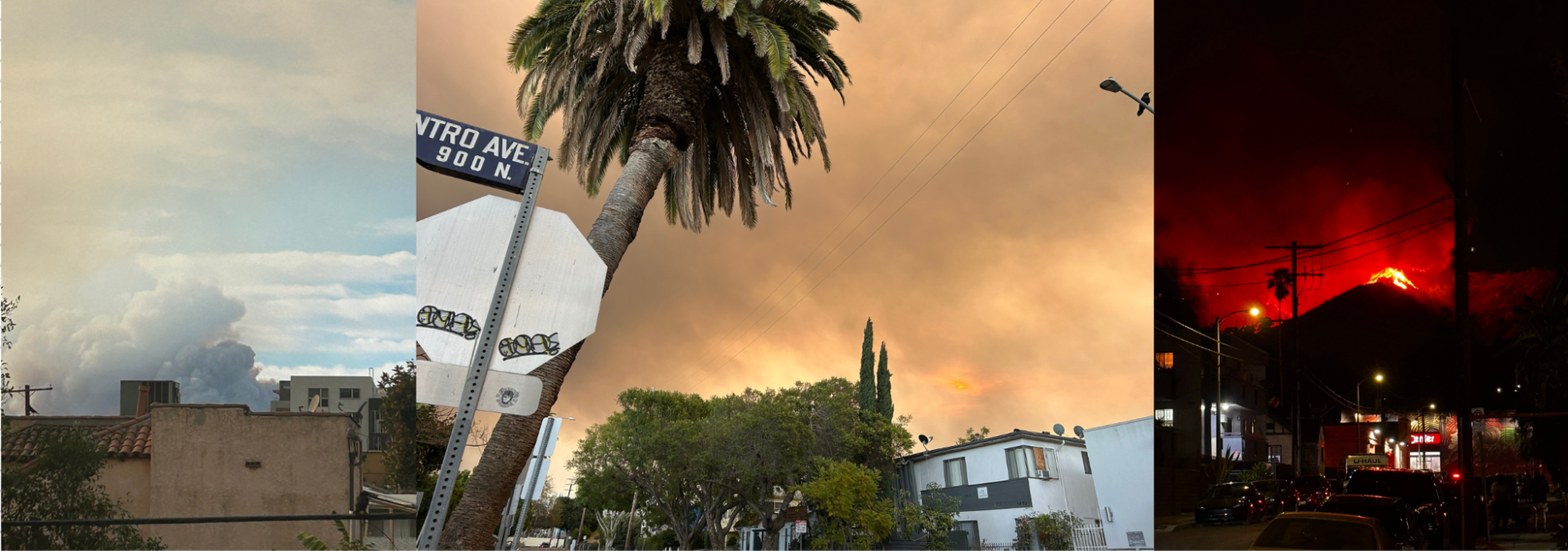
Wildfire progression in Los Angeles: Pacific Palisades wildfire smoke plume (left), wildfire smoke propagating over the Los Angeles Basin (center), and the Sunset Fire in the Hollywood Hills (right). Photos: Nate Constan
By leveraging existing low-pitch roof membranes and California’s robust defensible space guidelines, EGRs represent a scalable, multi-benefit solution for mitigating wildfire risk. Further research is urgently needed to refine plant selection, optimize fire-resistant substrates, and evaluate long-term performance. Over 16,000 structures were lost in the Palisades and Eaton fires. As wildfire severity continues to increase in the Mediterranean subclimate, continuing research into the use of green roofs as fire-resilient infrastructure is necessary. EGRs should be seriously considered as part of a holistic wildfire resilience strategy for fire-prone communities across North America.
Advertisement
Nate Constan is a Projects Associate at the Association for Energy Affordability, where he focuses on decarbonizing low-income and affordable housing across California. He previously led urban forestry and climate engagement initiatives in Los Angeles and continues to advocate for living infrastructure and sustainable urbanism through his committee roles with Green Roofs for Healthy Cities and USGBC-California. His work is driven by a deep interest in the role of living infrastructure in advancing energy resilience.
References
California Native Plant Society. (n.d.). Calscape native plant database. Calscape. https://calscape.org/
Gaffin, S. & Rosenzweig, C. & Parshall, L. & Beattie, D. & Berghage, R. & O'Keeffe, G. & Braman, D. (2005). Energy balance modeling applied to a comparison of green and white roof cooling efficiency. Research Report. https://www.researchgate.net/publication/285727297_Energy_balance_modeling_applied_to_a_comparison_of_green_and_white_roof_cooling_efficiency
Getter, K. (2015, October). Selecting plants for extensive green roofs in the United States. MSU Extension. https://www.canr.msu.edu/resources/selecting_plants_for_extensive_green_roofs_in_the_united_states_e3047
Hazard HQ Team. (2022, October). Title five years later: The Tubbs Fire. CoreLogic. https://www.corelogic.com/intelligence/title-five-years-later-the-tubbs-fire
International Code Council. (2022). 2022 California Building Code, Part 3: Chapter 7A—SFM Materials and Construction Methods for Exterior Wildfire Exposure. ICC. https://codes.iccsafe.org/s/CABC2022P3/chapter-7a-sfm-materials-and-construction-methods-for-exterior-wildfire-exposure/CABC2022P3-Ch07A-Sec705A.
International Code Council (ICC). (2022). California residential code: Chapter 3—Building planning. ICC. https://codes.iccsafe.org/content/CARC2022P3/chapter-3-building-planning#CARC2022P3_Pt03_Ch03_SecR337
International Code Council (ICC). (2023). California Green Building Standards Code: Nonresidential mandatory measures. ICC. https://codes.iccsafe.org/s/CACLAGBC2023P1/chapter-5-nonresidential-mandatory-measures/CACLAGBC2023P1-Ch05-SubCh5.1-Sec5.106.13
Li, Z. & Yu, W. (2025, February). Economic impact of Los Angeles wildfires. UCLA Anderson School of Management. https://www.anderson.ucla.edu/about/centers/ucla-anderson-forecast/economic-impact-los-angeles-wildfires
Miller, R. & Gerzhova, N. (2021, June). "Understanding the Behaviour of Fire and Green Roofs." Living Architecture Monitor. https://livingarchitecturemonitor.com/articles/green-roofs-fire-su21?rq=roxanne%20miller
Radeloff, V. & Helmers, D. & Mockrin, M. & Carlson, A. & Hawbaker, T. & Martinuzzi, S. (2023). The 1990–2020 Wildland-Urban Interface of the Conterminous United States – Geospatial Data. 4th ed. Fort Collins, CO: Forest Service Research Data Archive. https://doi.org/10.2737/RDS-2015-0012-4.
Readiness and Emergency Management for Schools (REMS). (2021, September). California case study: Wildfire. US Department of Education. https://rems.ed.gov/docs/2021ToolBox/CA_Case_Study_1_Wildfire.pdf
SPRI. (2010, January). ANSI/SPRI VF-1: External fire design standard for vegetative roofs. SPRI. https://www.spri.org/download/ansi-spri_standards_2020_restructure/vf-1/ansi_spri_vf-1_external_fire_design_standard_for_vegetative_roofs_jan_2010.pdf
U.S. Green Building Council California. (2022). Wildfire Toolkit 2022. U.S. Green Building Council California. https://usgbc-ca.org/wp-content/uploads/2022/04/Wildfire-Toolkit-2022-1.pdf.